
Top 10 Accessories for Pronghorn Hunting
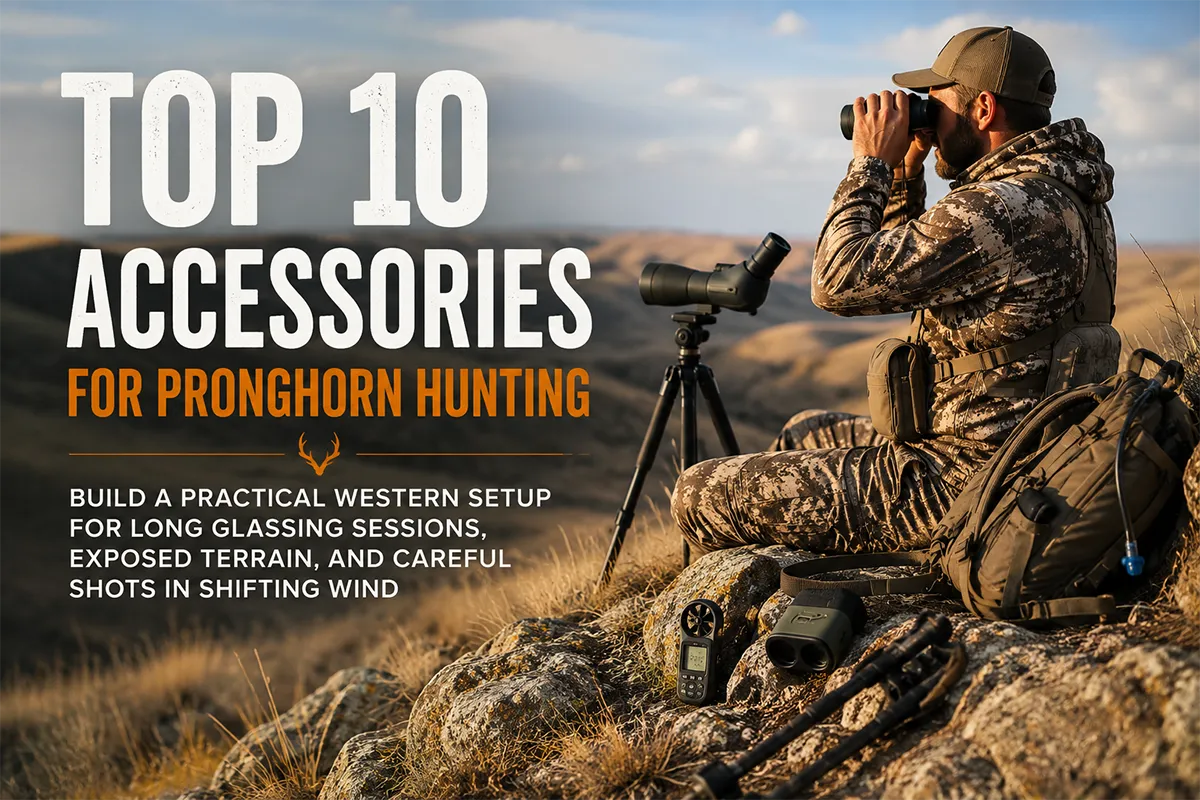
Build a practical western setup for long glassing sessions, exposed terrain, and careful shots in shifting wind.
The best pronghorn hunting accessories solve the problems created by wide-open country: finding animals at distance, judging range, managing wind, staying mobile, and making a steady shot with little natural cover. Pronghorn hunts often involve hours of glassing followed by a fast stalk across prairie, sage flats, or rolling agricultural ground. The right gear should reduce uncertainty without overloading your pack. Prioritize optics, stable shooting support, navigation, water, and footwear before spending money on specialty items. Every accessory should match your hunting method, expected shot distance, terrain, recoil tolerance, and budget.
Where/When: Pronghorn commonly occupy the open basins, shortgrass prairie, sagebrush flats, and agricultural edges of the western United States, especially across the Great Plains, Intermountain West, and high desert regions. Hunters often find them near preferred feed, reliable water, fence crossings, broad travel corridors, and bedding areas with long visibility. Seasons typically occur from late summer into fall, with behavior changing around local rut timing, hunting pressure, crop harvest, and weather. Early and late daylight often provide the best movement, while midday can still be productive for glassing bedded animals or watching water in hot conditions. Wind, heat, and storms can quickly alter patterns, so timing always varies by region, season structure, and local regulations.
1. Quality Binoculars
Binoculars are the primary tool for locating pronghorn before committing time and energy to a stalk.
Overview
Choose 10×42 binoculars for an all-around balance of magnification, field of view, brightness, and manageable weight. Hunters who glass from a vehicle or fixed ridge may prefer 12×50 models, but the added shake often makes a tripod adapter worthwhile. Look for fully multicoated lenses, good edge clarity, weather sealing, comfortable eyecups, and a warranty you trust. A chest harness keeps optics protected from dust while allowing fast access.
Benefits
- Finds animals and evaluates terrain from long distances.
- Reduces unnecessary walking in exposed country.
- Helps assess herd composition before planning a stalk.
Notable Brands
- Vortex
- Leupold
- Maven
2. Laser Rangefinder
A dependable rangefinder removes guesswork when open terrain makes distance difficult to judge.
Overview
Select a model that reliably ranges reflective targets beyond your realistic shooting distance and nonreflective animals at the ranges you expect to encounter. Angle compensation is useful in broken country, while a bright, uncluttered display helps in low light. Favor simple controls that can be operated with gloves. Confirm that the rangefinder displays the measurement mode you intend to use and practice ranging rocks, fence posts, and vegetation near animals when a direct reading is difficult.
Benefits
- Supports more accurate hold and wind decisions.
- Prevents underestimating distance across featureless flats.
- Speeds preparation when shot opportunities are brief.
Notable Brands
- Leica
- Sig Sauer
- Bushnell
3. Spotting Scope and Tripod
A spotting scope helps confirm animals and routes before a long approach.
Overview
A compact 15-45x or 20-60x scope can be valuable when judging distant pronghorn or studying terrain from a road or ridge. Optical quality matters more than maximum magnification because heat shimmer often limits usable power. Pair the scope with a stable tripod and smooth head sized for the optic. Backpack hunters should favor a lighter setup, while vehicle-based hunters can accept more weight for stability and image quality.
Benefits
- Confirms details that binoculars may not resolve.
- Helps identify terrain folds, fences, and hidden approach routes.
- Reduces pressure caused by unnecessary close approaches.
Notable Brands
- Vortex
- Athlon
- Swarovski
4. Shooting Sticks or Bipod
Portable support creates a steadier firing position where trees, rocks, and natural rests are scarce.
Overview
Prone bipods work well in short grass but may be blocked by sage or uneven ground. Adjustable shooting sticks are faster for kneeling or seated positions and can double as trekking support. Choose a height range that matches positions you have practiced, and check attachment compatibility before the hunt. Avoid carrying support that is too slow or complicated to deploy under pressure.
Benefits
- Improves stability in exposed, uneven terrain.
- Supports ethical shot placement at realistic distances.
- Provides repeatable positions during practice and field use.
Notable Brands
- Primos
- Harris
- BOG
5. Compact Wind Meter
A wind meter provides objective data when prairie wind makes visual estimates unreliable.
Overview
Choose a pocket-sized unit that measures wind speed quickly and has a readable screen. Advanced weather meters can track temperature, pressure, and density altitude, but many hunters only need reliable wind speed. Remember that the reading at your position may differ from conditions along the bullet path. Use grass, dust, mirage, and vegetation to compare wind across the full distance, and stay within ranges where you can make a responsible correction.
Benefits
- Replaces guesswork with a measured starting point.
- Improves pre-hunt practice and field judgment.
- Helps identify when conditions exceed your limits.
Notable Brands
- Kestrel
- WeatherFlow
- Caldwell
6. Lightweight Hunting Daypack
A streamlined pack carries essentials without becoming a burden during long crawls and quick moves.
Overview
Look for roughly 1,500 to 2,500 cubic inches for a typical day hunt, with quiet fabric, a supportive hip belt, hydration compatibility, and external compression straps. The pack should hold optics, layers, food, water, a field kit, and emergency gear while staying close to your body. Test it fully loaded and confirm it does not interfere with rifle carry, shooting position, or binocular harness access.
Benefits
- Keeps essential gear organized and accessible.
- Distributes weight during long approaches.
- Carries extra layers for rapid weather changes.
Notable Brands
- Mystery Ranch
- Eberlestock
- Badlands
7. Hydration System
Reliable water storage prevents fatigue and poor decisions in hot, dry, exposed country.
Overview
A two- to three-liter reservoir is practical for many day hunts, though required capacity depends on temperature, distance, and access to safe water. Select a durable bladder with a shutoff valve and an insulated hose for cold mornings. Some hunters prefer rigid bottles because leaks are easier to detect and rationing is simpler. Carry more than expected when vehicle access is limited, and include electrolytes when heat and exertion are significant.
Benefits
- Supports concentration during long glassing sessions.
- Reduces dehydration risk during warm-weather stalks.
- Allows quiet drinking without unpacking gear.
Notable Brands
- CamelBak
- HydraPak
- Platypus
8. Supportive Boots and Gaiters
Good footwear protects your feet across cactus, sharp rock, mud, and miles of sidehill travel.
Overview
Choose boots based on terrain and weather rather than appearance. Flexible, lightweight boots suit dry plains, while stiffer midsoles help in rocky breaks. Waterproof membranes can be useful in wet grass or snow but may run warmer during early seasons. Gaiters keep seeds, dust, mud, and light moisture out of the boot. Break footwear in before the hunt and pair it with socks that manage heat and friction.
Benefits
- Reduces blisters and foot fatigue.
- Improves traction on loose or uneven ground.
- Keeps debris from interrupting a stalk.
Notable Brands
- Crispi
- Kenetrek
- Danner
10. Field-Dressing and Meat-Care Kit
A compact processing kit helps protect meat quality when warm temperatures make cooling urgent.
Overview
Carry a sharp, controllable knife, spare blades or sharpener, lightweight game bags, gloves, cord, and a small cleanup cloth. Select breathable bags sized for pronghorn quarters and keep them clean inside a sealed pouch until use. Plan the recovery route before the shot and know how far the animal is from a road, shade, or cooler. Safe handling and ethical shot placement remain more important than any accessory: keep the muzzle controlled, identify the target and what lies beyond it, and do not take shots beyond your practiced ability. Regulations vary for seasons, licenses, legal equipment, access, tagging, transport, and carcass handling, so check current local laws before hunting.
Benefits
- Speeds cooling and protects meat from dirt and insects.
- Keeps processing tools organized and sanitary.
- Supports an efficient recovery plan in warm weather.
Notable Brands
- Havalon
- Outdoor Edge
- Caribou Gear