
Top 10 Accessories for Greater Prairie-Chicken Hunting
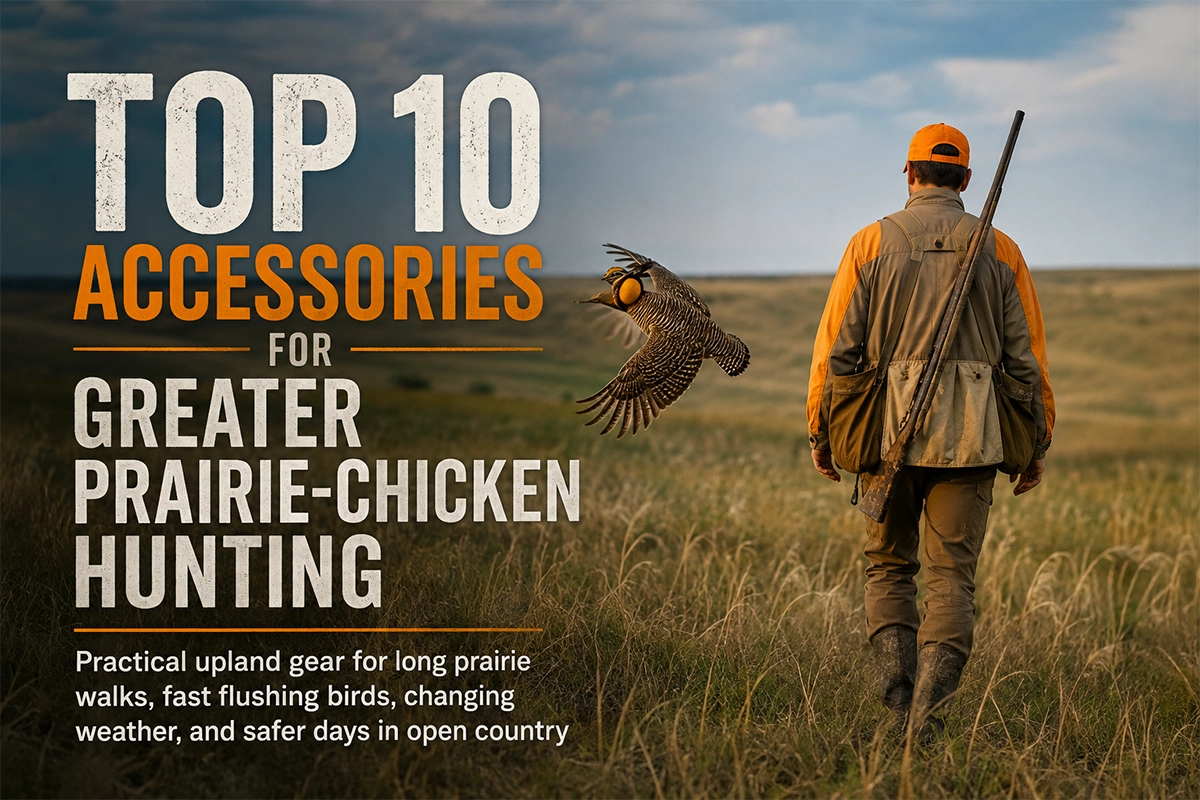
Practical upland gear for long prairie walks, fast flushing birds, changing weather, and safer days in open country.
The best Greater Prairie-Chicken hunting accessories help you stay mobile, organized, comfortable, and ready when birds flush with little warning. Prairie-chicken hunts often involve covering substantial ground across grass, pasture, uneven prairie, and field edges, so gear weight and fit matter as much as durability. Prioritize equipment that improves footing, carries shells securely, protects your eyes and hearing, helps you navigate open country, and supports reliable shotgun performance. Buy for the conditions you actually hunt rather than carrying unnecessary equipment that adds weight without solving a real field problem.
Where/When: Greater Prairie-Chickens commonly occupy native tallgrass and mixed-grass prairie, grazed grasslands, conservation cover, and areas near crop or grain fields across portions of the central Great Plains. Hunters may encounter birds around feeding areas, loafing or roosting cover, travel corridors, and transitions between secure grass and agricultural food sources. Legal hunting generally occurs during fall or winter where seasons are offered, while early-season birds may be more scattered and late-season birds can form larger, warier flocks. Morning and evening movement is often important, and wind, cold, heat, snow, or changing weather can influence where birds hold and how readily they flush. Timing, access, seasons, bag limits, shooting hours, and equipment regulations vary by region, so always check current local rules before hunting.
1. Supportive Upland Hunting Boots
Good boots solve one of the biggest prairie-hunting problems: covering miles of uneven ground without developing hot spots, sore feet, or poor footing.
Overview
Look for boots that fit securely through the heel while leaving enough toe room for descents and thicker socks. Moderate ankle support is useful on rough pasture and hidden holes, while lighter construction reduces fatigue on long walks. Waterproof membranes can help in wet grass or snow, but breathable non-insulated boots may be more comfortable during warm early-season hunts. Choose insulation according to temperature rather than assuming heavier is better, and break new boots in before opening day.
Benefits
- Improves traction on uneven prairie, muddy field edges, and frost-covered grass
- Reduces foot fatigue during long walking hunts
- Provides ankle protection around holes, ruts, and rough ground
Notable Brands
- Danner
- Crispi
- Irish Setter
2. Upland Hunting Vest with Game Bag
An upland vest keeps shells, water, gloves, and harvested birds organized without forcing you to stop and dig through a backpack after every flush.
Overview
Choose a vest that fits over your normal hunting layers without restricting your shotgun mount. Front shell pockets should be easy to reach with either hand, and a rear game bag should open widely enough for convenient loading. Prairie hunters often benefit from models with water-bottle pockets and some blaze-orange material. Adjustable shoulder and waist systems can distribute weight better during long walks. Avoid oversized models that shift around or snag when you shoulder the gun.
Benefits
- Keeps shells and small gear immediately accessible
- Carries birds while leaving both hands free
- Can distribute water and gear more comfortably than stuffed pockets
Notable Brands
- Browning
- Gamehide
- Orvis
3. Blaze-Orange Hat or Visibility Gear
High-visibility clothing helps hunting partners keep track of one another when birds flush unexpectedly and several hunters are moving through tall grass.
Overview
A blaze-orange cap, vest panel, or other highly visible garment can improve partner awareness without adding meaningful weight. Choose items that stay visible when worn with your normal outer layers and that do not interfere with your shotgun mount. Some jurisdictions may specify particular visibility requirements, while others may not, so confirm current rules rather than assuming one standard applies everywhere. Visibility gear complements, but never replaces, safe muzzle control and clear shooting lanes.
Benefits
- Makes partners easier to locate in tall grass and rolling terrain
- Adds little weight or bulk to an upland kit
- May help satisfy local visibility rules where required
Notable Brands
- Browning
- Allen
- Gamehide
4. Electronic Hearing Protection
Hearing protection reduces exposure to damaging shotgun noise while electronic models can still allow normal conversation and awareness between shots.
Overview
Low-profile electronic earmuffs and hunting-oriented electronic earplugs are useful when shooting opportunities appear quickly. If choosing muffs, check that the ear cups do not contact the shotgun stock and interfere with a consistent cheek weld. Earplug-style systems can be easier with hats and shouldering, although fit is critical. Whatever style you use, select properly rated protection and practice shooting with it before the hunt so your mount and communication remain familiar.
Benefits
- Reduces harmful impulse noise from repeated shotgun fire
- Electronic amplification can preserve normal field communication
- Low-profile options can work with a natural shotgun mount
Notable Brands
- Walker’s
- Howard Leight
- Peltor
5. Protective Shooting Glasses
Shooting glasses protect against windblown debris, grass stems, dust, brush, and the small particles that can accompany shotgun shooting.
Overview
Choose impact-rated lenses that provide a clear, wide field of view without distorting a crossing bird. Clear or light-enhancing lenses can help in dim morning conditions, while darker lenses may be comfortable under bright prairie sun. Wraparound coverage helps with wind and dust. Fit matters: glasses should sit securely beneath a cap and hearing protection without creating pressure points. Anti-fog treatment is useful when temperatures swing or exertion causes lenses to cloud.
Benefits
- Protects eyes from debris and shooting-related particles
- Can reduce glare in exposed prairie conditions
- Helps maintain clear vision in wind, dust, and light brush
Notable Brands
- Wiley X
- Oakley
- ESS
6. Compact Field Binoculars
Binoculars help hunters inspect distant field edges, identify birds or other wildlife, and evaluate terrain before walking unnecessary ground.
Overview
Compact 8x or 10x binoculars are generally easier to carry than large high-magnification models. An 8×42 configuration often provides a forgiving field of view, while smaller objective lenses can reduce weight. Look for waterproof construction, a comfortable focus wheel, and a chest harness or secure strap. Binoculars are for observation, not for identifying something through a shotgun sight; positively identify game and maintain awareness of people, livestock, roads, and buildings before any shot.
Benefits
- Helps evaluate distant habitat before committing to a long walk
- Improves observation of birds and terrain without approaching them
- Compact models add relatively little weight
Notable Brands
- Vortex
- Leupold
- Bushnell
8. Choke Tubes and Patterning Supplies
Patterning equipment solves the uncertainty of whether your chosen shotgun, choke, and shell combination actually delivers an even pattern at realistic hunting distances.
Overview
Use choke tubes specifically compatible with your shotgun’s barrel and choke system. Improved-cylinder and modified constrictions are common starting points for upland hunting, but the pattern board should make the final decision. Test the exact shell, pellet size, and shot material you intend to hunt with at several distances. If using steel or another hard non-toxic material, verify that both the barrel and choke are approved for it. Do not rely on choke markings alone to predict effective range.
Benefits
- Shows the actual pattern produced by your shotgun and hunting load
- Helps establish an ethical maximum shooting distance
- Allows hunters to tune pattern density for expected conditions
Notable Brands
- Carlson’s
- Briley
- Trulock
9. Lightweight Shotgun Sling
A sling gives your arms a break during long approaches, road walks, or transitions between patches of promising grass.
Overview
Choose a sling that fits your shotgun’s existing swivels or approved attachment system without interfering with operation. Lightweight, non-slip models work well for walking hunts, but the sling should be removed or positioned so it cannot snag during shooting. Practice transitioning from carry to a safe ready position before hunting. Never use a sling in a way that compromises muzzle control, and keep the action and chamber condition appropriate for the situation and applicable safety practices.
Benefits
- Reduces arm fatigue during long periods between bird contacts
- Frees a hand when crossing gates or handling other equipment
- Adds minimal weight when a simple field model is selected
Notable Brands
- Butler Creek
- Allen
- Quake
10. Hydration System and Compact Field Pack
Water and a small amount of emergency gear become important quickly when a prairie-chicken hunt turns into several miles of walking away from the vehicle.
Overview
Choose a hydration bladder, bottles, or compact pack sized for the distance, weather, and access on your hunt. The system should ride close to the body and leave your shoulders free for an unrestricted shotgun mount. Carry water, basic first aid, weather protection, identification, and other essentials appropriate to the trip without overpacking. In hot or dry conditions, additional water may matter more than extra equipment; in cold weather, insulated bottles and spare layers can be more useful.
Benefits
- Keeps water available during long walks away from the vehicle
- Carries basic safety and weather gear without filling shell pockets
- A fitted, compact design can preserve normal shotgun movement
Notable Brands
- CamelBak
- Osprey
- Badlands