
Introduction
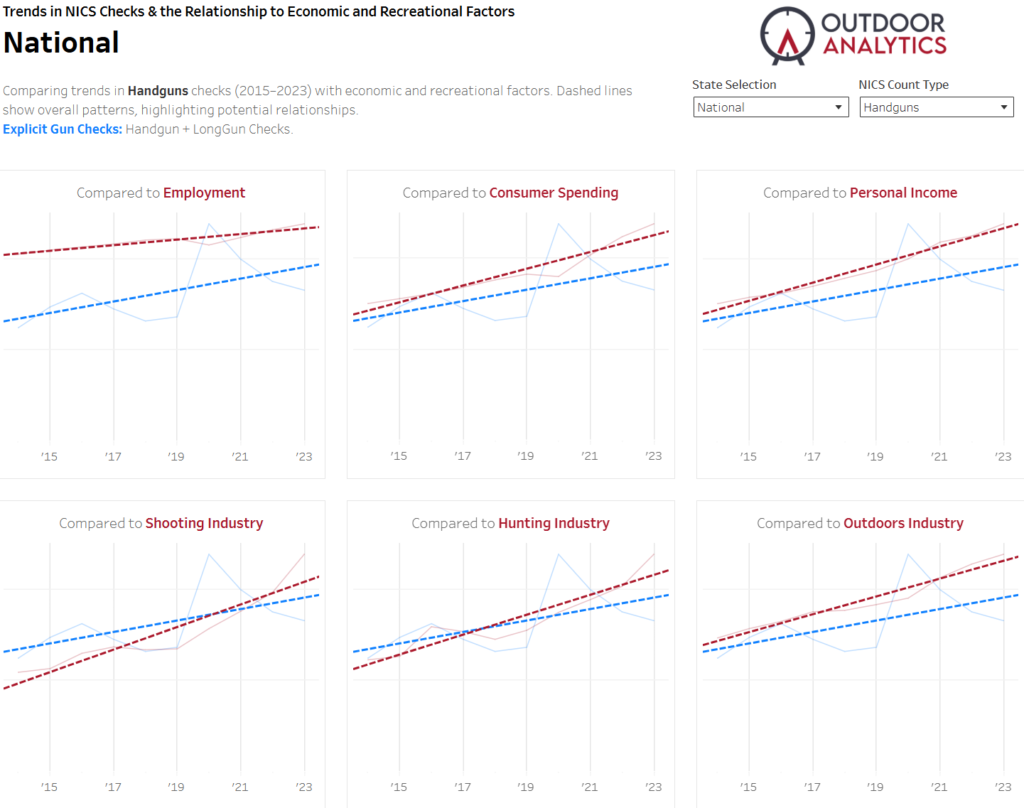
In recent years, handgun background checks have skyrocketed beyond steady economic growth alone. The Outdoor Analytics “National Dashboard” visualizes FBI NICS handgun check data from 2015 to 2023 alongside key economic measures—employment, consumer spending, personal income—and recreational sector growth in shooting, hunting, and broader outdoor industries. By comparing the solid trend lines of each factor to the dramatic spike in NICS checks around 2020, we get a clear picture of how social upheaval, pandemic-driven uncertainty, and lasting shifts in outdoor recreation can ripple through firearm demand.
Key Takeaways
From 2015 through 2019, NICS handgun checks (blue solid line) rose gradually in step with climbing consumer spending and household incomes. Then, in 2020, checks exploded to unprecedented highs, driven more by pandemic-era anxiety than by economics—unlike the dashed blue trend line, which reflects a long-term upward trajectory that smooths out the 2020 surge.
Economic factors such as employment (up 3 million jobs in 2023), consumer spending (peaking at $18.8 trillion in 2023), and median household income (reaching $80,610 in 2023) all trended upward steadily. Yet none showed the abrupt spike seen in firearm checks. Instead, they underpin a higher baseline of demand post-2020, as Americans returned to work, saw higher incomes, and enjoyed renewed interest in recreational pursuits.
The shooting industry itself saw robust expansion: in 2022 it directly employed 172,697 people and generated over $80.7 billion in economic activity, supporting nearly 394,000 jobs when supplier and ancillary roles are included. Recreational hunting and target shooting combined added $133 billion to U.S. economic growth in 2022 and supported 1.3 million jobs, while the broader outdoor recreation sector reached $1.2 trillion and 5 million jobs in 2023.
Real-World Relevance
What does this mean for you as an outdoor enthusiast, hunter, or range operator? First, it confirms that recreational shooting and hunting remain growth industries—even as the panic-driven spike subsided, interest levels stayed elevated thanks to higher disposable incomes and strong consumer confidence. For retailers and range owners, understanding that background checks now sit on a permanently higher plateau can inform inventory planning and staffing strategies.
Second, policymakers and public-land managers should recognize outdoor recreation’s role in driving local economies. Whether lobbying for better access on national forests or funding habitat improvements, the data shows that investments in shooting ranges, hunting grounds, and trails pay dividends in jobs and economic output.
Conclusion
The National Dashboard highlights that firearm demand is shaped by both economic fundamentals—employment, spending power, personal income—and the cultural resurgence of outdoor activities in shooting and hunting. While the 2020 surge was an anomaly tied to social unrest and a global health crisis, the continued elevated baseline reflects solid growth in the firearms and outdoor sectors.