
Michigan NICS Checks: What’s Really Driving the Numbers?
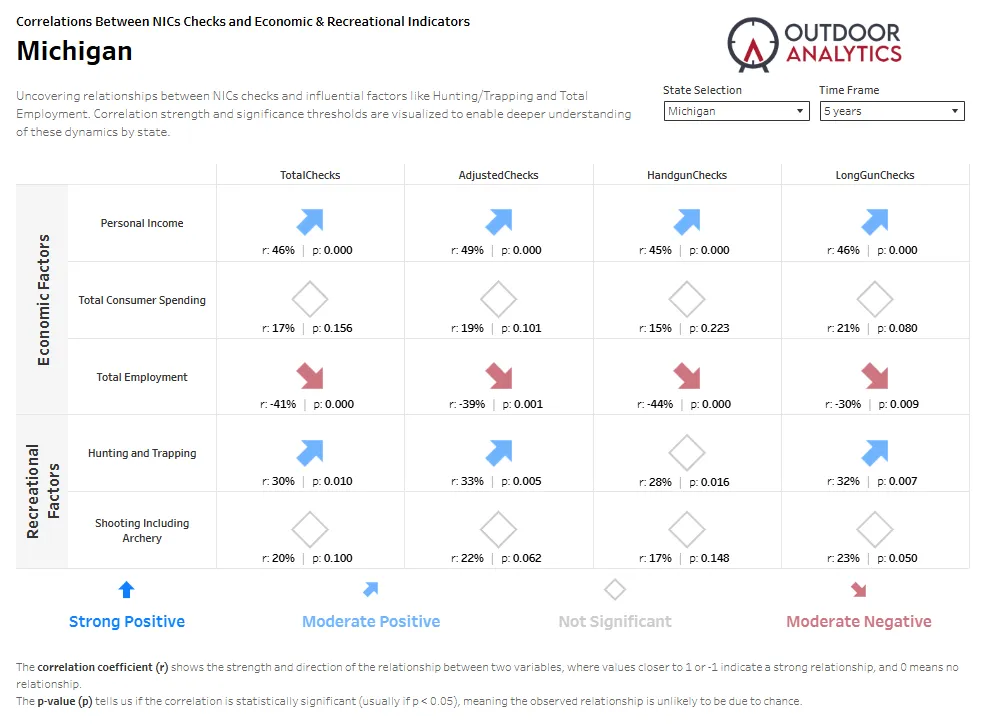
Ever wonder what nudges firearm background checks up or down in Michigan? We put five years of data under the microscope to see how NICS checks line up with everyday forces like income, employment, and time spent outdoors. The short version: Michigan NICS checks rise with personal income and outdoor recreation activity, and they dip when employment is roaring.
What This Chart Shows
The dashboard compares four flavors of NICS activity—Total, Adjusted, Handgun, and Long Gun checks—against key economic and recreational indicators. Each cell shows two things:
- r: how strongly two things tend to move together (closer to 1 or -1 = stronger pattern; positive means they rise together, negative means they move opposite).
- p: whether the pattern is likely real and not random. Values under 0.05 are typically considered “statistically significant.”
Key Takeaways for Michigan
- Personal income is the clearest tailwind. As income rises, all four NICS categories tend to increase (r ≈ 0.45–0.49; all highly significant). People with a bit more spending power appear more likely to buy firearms or accessories.
- Employment moves the opposite way. When more Michiganders are employed, checks tend to ease off (r ≈ -0.30 to -0.44; all significant). Tight job markets may leave less time for shopping or range days, or lower uncertainty that often spurs purchases.
- Outdoor activity matters. Hunting & trapping show a consistent, moderate positive relationship with checks across the board (r ≈ 0.28–0.33; significant). Long gun checks are especially aligned with seasonal field time.
- Shooting sports signal, but softer. “Shooting including archery” trends positive but sits right on the edge of significance (p ≈ 0.05–0.15). The pattern’s there—it’s just subtler than hunting & trapping.
- Household spending isn’t the driver here. Total consumer spending shows small, not-very-certain relationships with checks (r ≈ 0.15–0.21; p often above 0.05). Big-picture spending isn’t as telling as outdoors participation or income.
How to Use This Insight
- Retailers: Expect stronger demand when income trends up and hunting seasons are active. Plan inventory for long guns and related accessories accordingly.
- Ranges & clubs: Lean into seasonal programming; hunting prep courses and sight-in events align with the recreational bump.
- Manufacturers: Michigan’s sensitivity to income suggests promotions that stretch dollars—rebates, bundles, and “season-ready” kits—can move the needle.
- Marketers: Employment easing and outdoor calendars provide timely hooks for campaigns tied to preparedness, training, and tradition.
What’s in the Picture
- Product specs: Categories reference NICS checks by type—handgun and long gun—rather than specific models or calibers.
- Activity/event: Hunting, trapping, and shooting sports participation.
- Location/setting: State-level view focused on Michigan over a five-year timeframe.
- People & roles: Implicitly includes hunters, target shooters, and retailers affected by demand shifts.
- Noteworthy features: Clear significance cues—many income and employment relationships are statistically rock-solid.
Bottom Line on Michigan NICS Checks
Michigan NICS checks tend to rise with higher personal income and more time in the woods, while strong job markets slightly cool the pace. If you’re planning inventory, training calendars, or marketing pushes, align with income trends and the outdoor season to stay a step ahead. Check out our interactive NICs Checks Dashboard page for more insights.