
Maine NICS Checks: When Hunting Activity Drives Demand
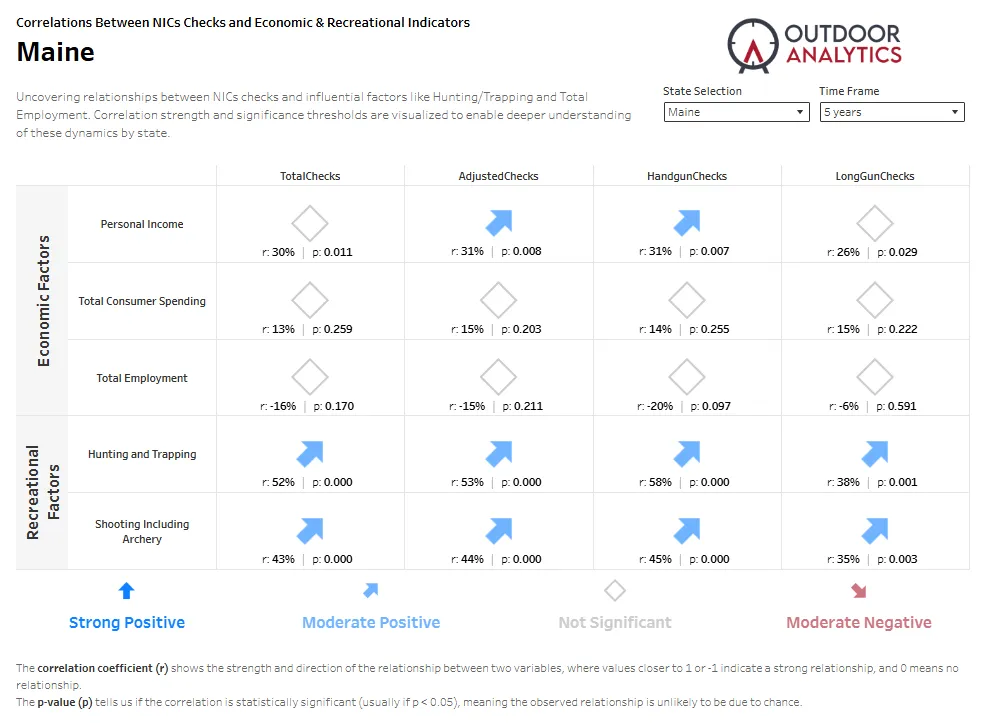
If you’ve ever tried to guess when firearm demand is about to heat up in Maine, you’ve probably heard a dozen theories: “It’s the economy,” “It’s the election cycle,” “It’s ammo prices,” and so on. This Outdoor Analytics view takes a simpler angle—looking at how Maine’s background checks tend to move alongside a handful of economic signals (income, spending, employment) and outdoor participation signals (hunting/trapping, shooting including archery) over a five-year window.
The big story in this chart is pretty straightforward: in Maine, NICS checks appear to “walk in step” more with hunting and shooting participation than with broad economic measures. That’s useful for retailers, ranges, clubs, and anyone planning inventory or programming around the real-world rhythm of the season.
How to Read This Correlation Chart Without the Stats Headache
Think of the “r” value as a simple “togetherness” score. When it’s higher, the two lines tend to rise and fall in the same direction more often. When it’s negative, they tend to move opposite ways. The icon tells you whether the dashboard considers that relationship solid enough to trust: blue arrows signal a meaningful positive relationship in this view, while gray diamonds are treated as not meaningful here.
One interesting nuance: Personal Income has a mild “togetherness” score with several NICS measures, but two of those cells are still marked as not meaningful in this view—suggesting they’re close, but not quite clearing the dashboard’s confidence test.
Maine’s Strongest Pattern: Recreation Leads the Conversation
The recreational indicators are the clear winners:
- Hunting and trapping participation shows the tightest “move-together” relationship with NICS checks—especially for handgun checks.
- Shooting (including archery) also tracks strongly across all NICS categories, again standing out more than the economic rows.
In plain terms: when more folks are out hunting, trapping, or training, Maine’s background check activity tends to climb with it. That lines up with what many of us see on the ground—gear gets upgraded, new hunters jump in, and range time ramps up as seasons approach.
Economics: Present, But Not Steering the Wheel
On the economic side, the chart suggests a softer connection:
- Personal income shows a modest relationship with adjusted checks and handgun checks (both marked meaningful in this view).
- Consumer spending doesn’t show a meaningful relationship with any NICS category here.
- Employment leans slightly the opposite direction in the numbers, but it’s not treated as meaningful in this view.
That doesn’t mean the economy doesn’t matter. It just means that, in this five-year slice for Maine, participation in outdoor and shooting activities does a better job of “explaining the vibe” of NICS swings than broad economic headlines.
Data Table: Maine (5-Year) Correlations Shown in the Dashboard
| Indicator | TotalChecks | AdjustedChecks | HandgunChecks | LongGunChecks |
|---|---|---|---|---|
| Personal Income | r: 30% | p: 0.011 | r: 31% | p: 0.008 | r: 31% | p: 0.007 | r: 26% | p: 0.029 |
| Total Consumer Spending | r: 13% | p: 0.259 | r: 15% | p: 0.203 | r: 14% | p: 0.255 | r: 15% | p: 0.222 |
| Total Employment | r: -16% | p: 0.170 | r: -15% | p: 0.211 | r: -20% | p: 0.097 | r: -6% | p: 0.591 |
| Hunting and Trapping | r: 52% | p: 0.000 | r: 53% | p: 0.000 | r: 58% | p: 0.000 | r: 38% | p: 0.001 |
| Shooting Including Archery | r: 43% | p: 0.000 | r: 44% | p: 0.000 | r: 45% | p: 0.000 | r: 35% | p: 0.003 |
What to Do With This If You Sell, Train, or Schedule Events
- Retail & FFL planning: Treat hunting/trapping and shooting participation as an early “weather report” for demand. If participation rises, plan for more questions at the counter and more movement in common accessories.
- Ranges & clubs: When participation climbs, it’s a great time to add intro classes, sight-in days, and safety refreshers—folks are already leaning in.
- Content & marketing: Lean into seasonal utility: maintenance, optics, sling setups, storage, and training plans—because the audience is already in an “active outdoors” mindset.
Bottom Line for Maine NICS Checks
This five-year snapshot suggests Maine’s background checks aren’t simply a mirror of jobs or consumer spending. Instead, they line up more tightly with the outdoor reality of the state—hunting, trapping, range time, and the broader shooting/archery ecosystem.
How does this compare to what you’re seeing locally—busy weekends at the range, packed hunter ed classes, or seasonal buying waves? Drop a comment with what you’re noticing, and share this with a buddy who loves data almost as much as they love the woods. Check out our interactive NICs Checks Dashboard page for more insights.