
Iowa NICS Trends: Handgun Checks Track Income & Shooting Sports
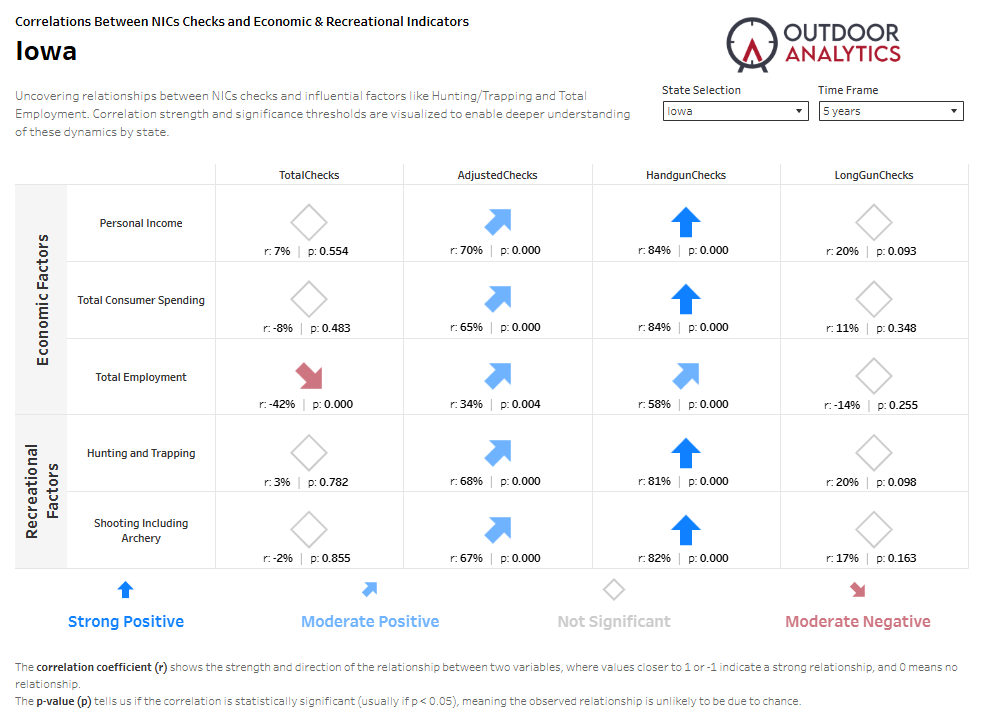
If you’ve ever wondered what actually moves firearm background checks in Iowa, this dashboard lays it out like a trail map. Over the last five years, handgun checks climb alongside rising personal income, strong consumer spending, and more time on the range—while long-gun checks mostly sit tight. Below, I break it down in plain English so you can use it for planning, buying, or just winning arguments at deer camp.
What the Chart Shows
The matrix compares four flavors of NICS activity—Total Checks, Adjusted Checks, Handgun Checks, and Long-Gun Checks—against Iowa’s economic and recreational indicators. Arrows point to the strength and direction of each relationship, and small notes underneath show the numbers behind them. Think of it as a quick read on “when X goes up, Y tends to go up (or down) too,” plus whether that pattern is likely real and not just random noise.
Key Takeaways for Iowa
- Handgun demand rides with the economy. Handgun checks rise strongly with personal income (about mid-80s% relationship, highly significant) and consumer spending (again mid-80s%, significant). In short: when wallets are healthier, Iowans file more handgun checks.
- Range time matters. Handgun checks also track closely with shooting participation and hunting & trapping (roughly low-80s% relationships, significant). More folks afield or on the line, more handgun activity.
- Adjusted checks mirror the same story. Adjusted checks—meant to strip out some administrative noise—show consistent, solid ties to income, spending, and participation (mid-60s to high-60s%, significant). That confirms the signal isn’t just paperwork.
- Long guns are steadier. Long-gun checks show only weak, not-quite-significant ties to income and participation (teens to about 20%). Translation: rifles and shotguns don’t swing much with the economy in this period.
- Total employment sends a mixed signal. Total checks dip when employment rises (around −40%, significant), but handgun and adjusted checks still move up modestly with employment. This suggests the broad total may be pulled by categories outside of pure retail demand.
What This Means for Retailers and Ranges
If you operate a shop or range in Iowa, treat handguns as the bellwether. Watch local income and consumer spending reports: when they tick up, expect stronger interest in carry pistols, training classes, and holster/optic add-ons.
For long guns, plan inventory on seasonality, platforms, and product launches rather than macro trends. Their steadier behavior suggests hunters and target shooters buy rifles and shotguns on their own schedules—new tags, a kid’s first season, a match calendar—not necessarily because the economy is roaring.
Plain-English Notes on the Stats
- The “relationship strength” is shown as a percentage: the closer it is to 100% (or −100% for an opposite move), the tighter the pattern between two lines.
- The “p-value” tells us if the pattern is likely real. When it’s under 0.05, we treat the relationship as statistically meaningful, not a fluke.
- In this Iowa view, the strongest, most reliable patterns are between handgun checks and income/spending/participation. Long guns hover near “not significant.”
Bottom Line
Iowa’s handgun background checks are closely tied to how folks are earning, spending, and participating in shooting sports. Long guns? More independent. If you’re planning inventory, classes, or content, put your early chips on handguns when the economy brightens—and keep long-gun plans anchored to the hunting calendar and local events.