
Idaho NICS Checks: What’s Really Moving the Needle?
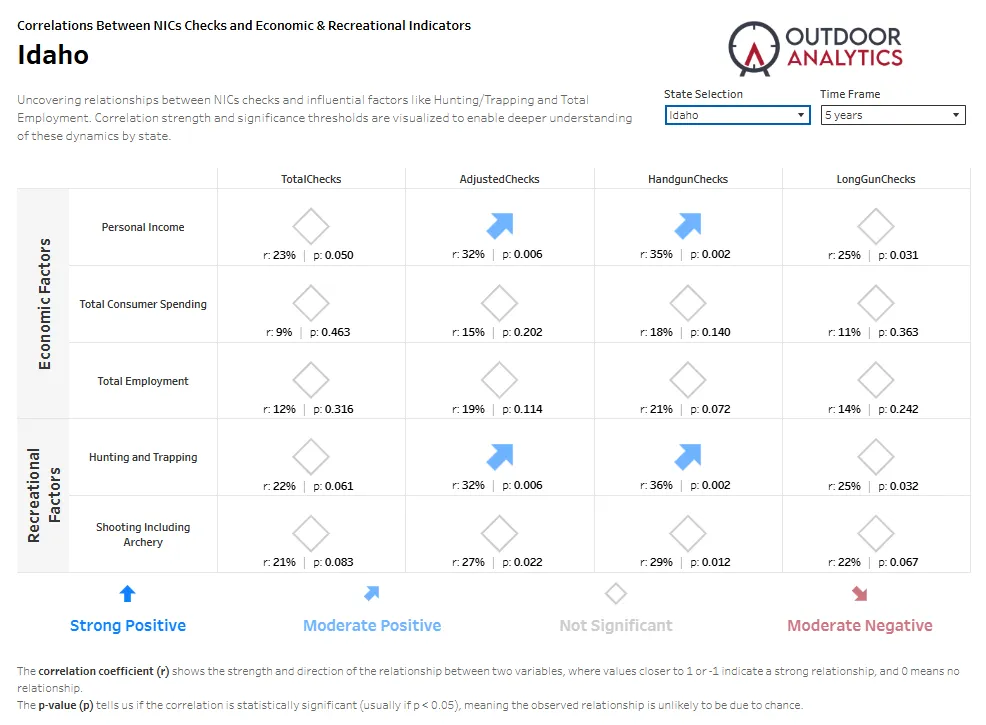
Ever wonder what actually lines up with Idaho’s firearm background checks? We dug into a five-year snapshot from Outdoor Analytics and found a few clear (and a few surprising) relationships hiding in plain sight. If you’re in the Gem State hunting, competing, training, or simply following the market, this quick read will help you make sense of the ebb and flow in NICS activity—without the math headache.
What This Dashboard Shows
The chart compares Idaho’s background check activity—Total Checks, Adjusted Checks (which filters out permit-type noise), Handgun Checks, and Long Gun Checks—against two buckets of drivers:
- Economic factors: personal income, consumer spending, employment
- Recreational factors: hunting & trapping, shooting (including archery)
Each cell lists a correlation “r” (how closely two things move together) and a “p-value” (whether that pattern is likely real rather than random). In plain English: when p is below 0.05, we treat it as meaningful.
Big Takeaways for Idaho
- Personal income is a consistent, meaningful driver—especially for Adjusted Checks and Handgun Checks. When Idaho incomes tick up, these checks tend to rise too.
- Hunting & trapping participation matters, and it matters most for Handgun Checks and Adjusted Checks. That suggests seasons, licenses, and field time influence store traffic and background check volume.
- Shooting & archery participation shows a similar pattern, but a little softer. It’s meaningful for Adjusted and Handgun, borderline or not significant elsewhere.
- Consumer spending and employment are weak or not significant here. Broad “economy good/bad” signals don’t explain Idaho’s checks as well as income and recreation behavior do.
- Long gun checks connect with income and hunting & trapping, but less tightly than handguns.
Plain-English Read: What Should Idaho Shops and Shooters Do?
- Merchandise with income swings in mind. When wages and salaries bump up, be ready with more handgun inventory, training slots, and accessories—those categories rise fastest with income.
- Lean into “seasonal readiness.” Use license dates and local events to time long gun inventory, ammo buys, and range promotions. Hunting activity links to checks—meet that demand early.
- Grow the pie with participation. Range nights, intro classes, and league shoots don’t just help the community—they correlate with more background checks, especially on the handgun side.
- Read Adjusted Checks first. They strip out some permit noise, and in Idaho they track most cleanly with income and participation. If you want one headline gauge, that’s it.
Image Notes (What We Spotted)
- Activity/event: recreational shooting, hunting, trapping, training participation
- Noteworthy features: significance coded by p-values; positive relationships throughout; strongest arrows appear in the Personal Income and Hunting/Trapping rows for Adjusted & Handgun checks
- People & roles: Idaho hunters, recreational shooters, retailers, instructors
- Location/setting: Idaho statewide, 5-year time frame
Final Word
Idaho’s background checks rise most reliably with personal income and time on the range or in the field. If you’re planning inventory, training calendars, or just watching the market, keep those two levers front and center. Check out our interactive NICs Checks Dashboard page for more insights.