
Best Gauges for Hunting Ring-necked Pheasant: Comparisons & Picks
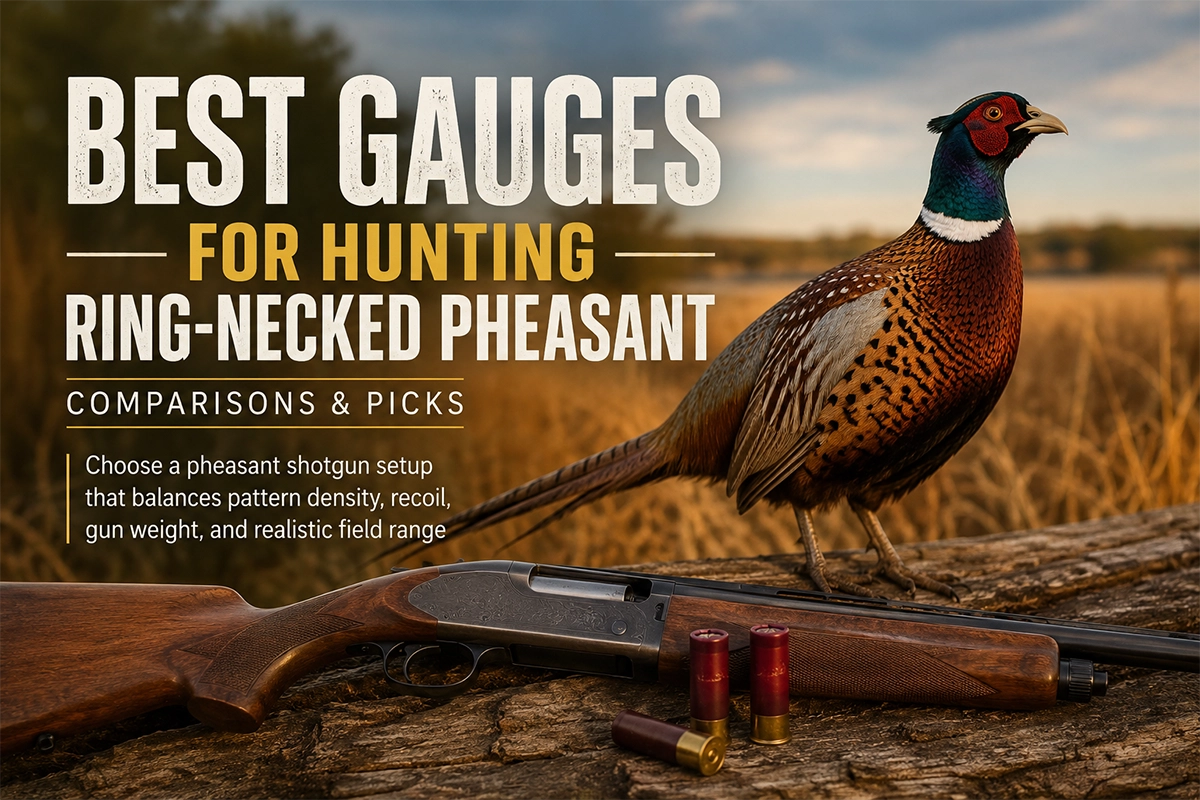
Choose a pheasant shotgun setup that balances pattern density, recoil, gun weight, and realistic field range.
The best ring-necked pheasant hunting gauges are the ones you can carry comfortably, mount consistently, and pattern well with a legal hunting load. For most hunters, 12 gauge and 20 gauge offer the easiest combination of versatility, while 16 gauge and 28 gauge can be excellent specialized choices.
Where/When: Ring-necked pheasants are commonly hunted across agricultural regions, grasslands, shelterbelts, cattail sloughs, brushy field edges, and conservation cover in much of the northern and central United States, with additional populations and stocked hunting opportunities in other regions. Pheasants often use food edges, nearby water, bedding or loafing cover, and travel corridors between feeding areas and dense escape cover. Early-season pheasants may hold tighter in lighter cover, while later-season birds often become more wary and may favor thicker, more isolated cover. Morning and evening movement can concentrate around feeding areas, while wind, snow, heat, or heavy pressure may change where birds sit and how far they flush. Timing and regulations vary by region, so check current local requirements before hunting.
Gauge Comparisons
| Feature | 12 Gauge | 20 Gauge | 16 Gauge | 28 Gauge |
|---|---|---|---|---|
|
Recoil How much kick you can expect from common pheasant loads. |
Moderate to heavy, depending on gun weight and load | Light to moderate with many field loads | Moderate in typical upland guns | Light with standard field loads |
|
Effective Range Practical distance at which a properly patterned hunting load can remain effective. |
Excellent flexibility at close to longer upland distances | Very capable at common pheasant distances | Very capable at common pheasant distances | Best with disciplined shots inside proven pattern range |
|
Typical Load Range Common shot payloads used in field ammunition; exact offerings vary. |
About 1 to 1 1/4 oz common in upland loads | About 7/8 to 1 1/8 oz common in upland loads | About 1 to 1 1/8 oz common in upland loads | About 3/4 to 1 oz common in upland loads |
|
Versatility How well the gauge serves other upland or general shotgun uses. |
Excellent; broadest general-purpose choice | Excellent; light, versatile upland option | Very good; classic upland balance | Good; best for lighter-duty upland use |
|
Ammo Availability How easy it is to find suitable field ammunition. |
Generally excellent | Generally excellent | Usually more limited than 12 or 20 gauge | Generally available, but with fewer choices than 12 or 20 gauge |
12 Gauge
The 12 gauge solves the problem of needing one shotgun setup that can handle everything from close-flushing birds in heavy cover to tougher late-season pheasants that may rise farther out. Its biggest advantage is flexibility: hunters can choose from a wide range of shot sizes, payloads, velocities, and nontoxic options.
PROS
- Broad selection of field loads and shot materials.
- Strong pattern density with moderate or heavier payloads.
- Easy to match with many common choke and shotgun configurations.
CONS
- Heavier loads can produce noticeable recoil.
- Some 12-gauge field guns are tiring on long walking hunts.
- Extra payload is unnecessary if your shooting is consistently close.
Interesting Fact: The 12 gauge became a dominant all-around sporting choice largely because it supports an unusually wide range of practical load weights without requiring a specialized shotgun.
Consider this Gauge If…
Choose 12 gauge if you want maximum flexibility, regularly hunt wild late-season birds, or expect mixed cover and uncertain flush distance. A well-fitting gun matters more than raw payload capacity, so compare stock dimensions, balance, and total carry weight before buying. Pattern your chosen load at realistic distances, and consider moderate loads before assuming heavier or faster shells will improve results. Where lead is legal, No. 5 or No. 6 shot is common; when nontoxic shot is required, choose a suitable load and verify patterns.
20 Gauge
The 20 gauge addresses one of the biggest practical problems in upland hunting: carrying a shotgun for miles without giving up useful pheasant capability. Lighter guns are common, recoil can be easier to manage, and modern 20-gauge field loads can pattern very well. It matters most for hunters who walk large tracts, prefer faster-handling shotguns, or simply shoot better with less recoil.
PROS
- Often available in lighter, easy-carry field guns.
- Usually softer shooting than comparable 12-gauge setups.
- Plenty of capability for typical pheasant distances with good patterns.
CONS
- Less payload flexibility than 12 gauge.
- Very light guns can still feel sharp with heavy field loads.
- Pattern quality becomes especially important at longer distances.
Interesting Fact: Many upland hunters favor 20-gauge shotguns because reducing gun weight can matter more over a full day of walking than adding a small amount of shot to each shell.
Consider this Gauge If…
Consider 20 gauge if you value low carry weight, moderate recoil, and quick handling. It is especially attractive for hunters following pointing dogs, working rolling grasslands, or covering many miles. Look for a shotgun that mounts naturally and is not so light that it becomes difficult to swing smoothly. Match your choke and load to expected cover, and pattern at several distances rather than relying on the choke marking alone.
16 Gauge
The 16 gauge offers a classic middle ground for hunters who want more payload capacity than many 20-gauge loads without carrying a full-size 12-gauge shotgun. In a properly scaled frame, it can provide excellent balance and lively handling. That combination matters in grass, brush, and shelterbelt hunting where fast mounts and smooth swings are more important than maximum shell capacity.
PROS
- Useful balance between payload, recoil, and field-gun weight.
- Well suited to traditional upland hunting styles.
- Can deliver dense pheasant patterns without a heavy 12-gauge platform.
CONS
- Fewer ammunition choices than 12 or 20 gauge in many markets.
- Fewer new shotgun models are chambered for it.
- Some guns are built on heavier frames that reduce the expected weight advantage.
Interesting Fact: The 16 gauge has long been associated with upland hunting because a well-proportioned gun can approach 20-gauge handling while carrying a payload closer to traditional 12-gauge field loads.
Consider this Gauge If…
Pick 16 gauge if you appreciate a traditional upland setup and have reliable access to suitable ammunition. Confirm that the shotgun is built on a frame that actually gives you the handling and weight you want. It suits moderate distances well but is less convenient when ammunition must be replaced while traveling.
28 Gauge
The 28 gauge solves a different problem: it gives experienced upland hunters a very light, low-recoil platform that can be exceptionally pleasant to carry and shoot. It is most useful when birds are expected to flush within controlled distances and the hunter is willing to pass on marginal shots.
PROS
- Light recoil and comfortable shooting for many hunters.
- Commonly offered in trim, easy-carry upland shotguns.
- Fast handling can be excellent over pointing dogs or in close cover.
CONS
- Smaller payload gives less margin for poor centering.
- Not ideal for routine long or heavily quartering shots.
- Ammunition can cost more and offer fewer pheasant-specific choices.
Interesting Fact: Despite its small bore diameter, the 28 gauge has a strong upland following because efficient patterns and light, well-balanced guns can make it surprisingly capable within sensible limits.
Consider this Gauge If…
Choose 28 gauge if you already shoot shotguns well, hunt over dogs that often produce controlled flushes, and prioritize low recoil and minimal gun weight. Pattern the shell-and-choke combination you plan to carry, then limit shots to distances where pellet distribution remains adequate. Avoid treating the gauge as a challenge that justifies stretching range.
Choosing the Right Pheasant Gauge
For most pheasant hunters, 12 gauge is the most flexible choice and 20 gauge is the best blend of carry comfort, recoil, and practical field performance. The 16 gauge remains a strong upland option for hunters who value its balance and can source appropriate loads, while 28 gauge fits experienced shooters who keep shots within proven pattern distance. Whatever you choose, gun fit, mounting consistency, choke selection, and pattern testing matter more than gauge alone. Handle every shotgun as loaded, keep the muzzle in a safe direction, identify the bird positively before firing, and avoid low shots when dogs, partners, roads, buildings, or livestock could be in the line of fire. Take only shots your pattern testing and skill support, and check current local rules for seasons, bag limits, shooting hours, legal methods, shot-material requirements, magazine restrictions, and any area-specific blaze-orange or access rules.