
Best Gauges for Hunting Plain Chachalaca: Comparisons & Picks
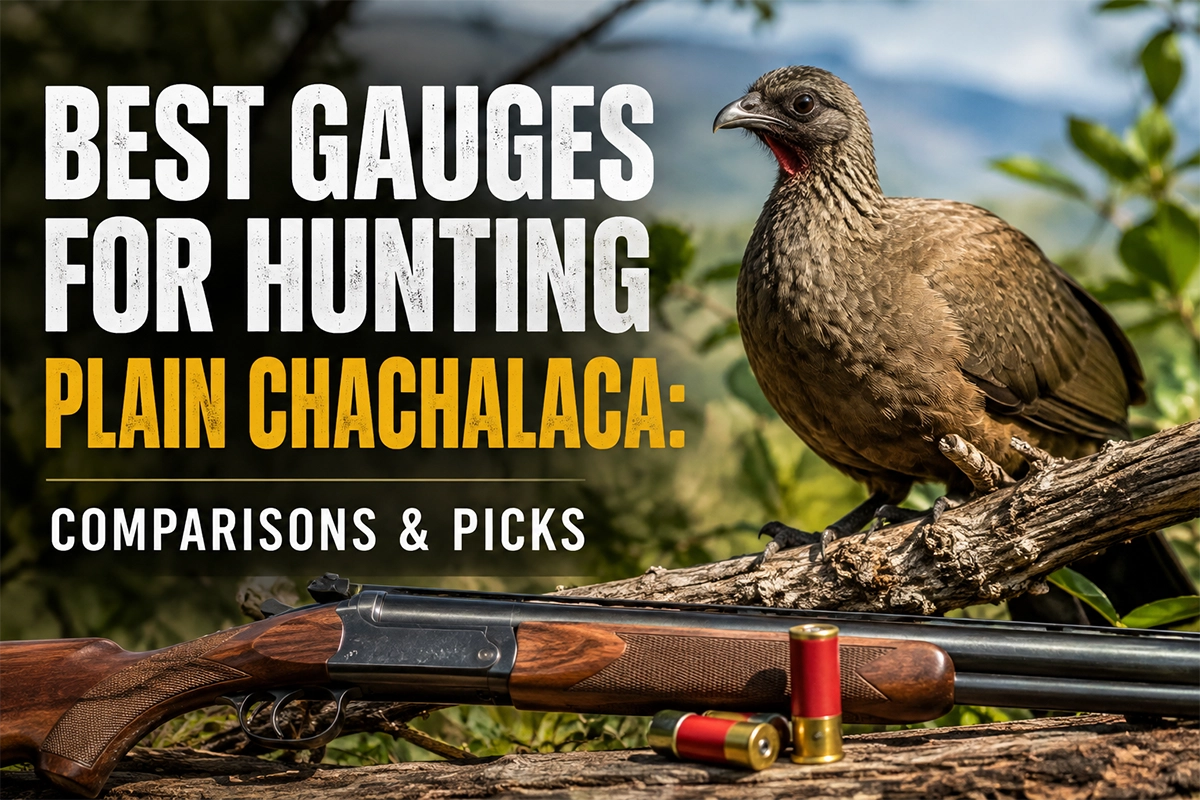
Practical shotgun options for close-range hunting in brush, woodland edges, and thick cover.
Choosing among Plain Chachalaca hunting gauges is mainly about balancing pattern density, recoil, firearm weight, and the short shot opportunities common in dense habitat. Plain Chachalacas are relatively large, chickenlike game birds that spend considerable time in shrubs and trees, so hunters often encounter partially screened targets and quick opportunities rather than long, open shots. A 20 gauge is an excellent all-around starting point, while a 12 gauge provides more payload flexibility. The 28 gauge rewards hunters who want a light, responsive shotgun, and the .410 bore can work for experienced shooters who carefully limit distance. Whatever you carry, pattern the exact shotgun, choke, and hunting load before the season rather than relying solely on gauge or shell specifications.
Where/When: Plain Chachalacas occur from southern Texas through Mexico and parts of Central America, commonly using thornscrub, brushy forest, stream corridors, woodland edges, and other cover with fruiting vegetation, water, and dense understory. They often feed around fruit, seeds, buds, insects, and other concentrated food sources, while thick shrubs, wooded drainages, travel corridors, and protected loafing or roosting cover can hold birds through the day. Family groups commonly become vocal and active during morning and evening periods, and weather changes may also affect calling and movement. In the United States, current Texas opportunities are geographically limited: for the 2026–2027 season, Texas lists Chachalaca hunting in Cameron, Hidalgo, Starr, and Willacy counties from November 1, 2026 through February 28, 2027, with a daily bag limit of five, possession limit of 15, and an Upland Game Bird Endorsement requirement. Early- and late-season food patterns, pressure, cover conditions, morning and evening movement, and weather can change where birds are encountered. Timing, seasons, shooting hours, permitted methods, ammunition rules, public-land requirements, and other regulations vary by region, so always verify current rules where you hunt.
Gauge Comparisons
| Feature | 12 Gauge | 20 Gauge | 28 Gauge | .410 Bore |
|---|---|---|---|---|
| Recoil Relative kick varies with shotgun weight, shell length, payload, and velocity. |
Moderate to high | Low to moderate | Generally light | Generally very light |
| Practical Hunting Range Actual ethical range depends on pattern testing, shooter skill, cover, and load performance. |
Often about 20–40 yards | Often about 20–35 yards | Often about 20–30 yards | Usually best kept around 15–25 yards |
| Typical Shot Payload Common field payloads; always match ammunition to the shotgun chamber and local rules. |
About 1–1 1/4 oz | About 7/8–1 oz | About 3/4–7/8 oz | About 1/2–11/16 oz |
| Versatility How readily the option adapts to other upland, small-game, or sporting uses. |
Excellent | Excellent | Very good for upland use | Best for specialized close-range use |
| Ammo Availability Availability varies by load, shot material, location, and season. |
Generally excellent | Generally excellent | Moderate | Moderate |
12 Gauge
The 12 gauge solves the problem of maintaining a forgiving pattern when vegetation, changing distances, or quick shooting angles make opportunities unpredictable. It is especially useful for hunters who want one shotgun that can cover Plain Chachalaca hunting plus a wide range of other upland and field uses. Loads around 1 to 1 1/8 ounces of No. 6 or No. 7 1/2 shot are sensible starting points where that shot material and size are legal, with non-toxic alternatives used whenever regulations or hunting areas require them. Rather than automatically choosing a heavy load, test several combinations on paper at realistic distances. An improved-cylinder or modified choke may provide the balance of pattern width and density needed in brushy habitat, but the best choke is the one your particular shotgun patterns consistently. A lighter field gun carries easily, while a heavier 12 gauge can reduce felt recoil.
PROS
- Broad ammunition and payload selection for different terrain and hunting conditions.
- Dense patterns can provide more margin for quick shots at moderate upland ranges.
- Highly versatile if the shotgun will also be used for other game or clay shooting.
CONS
- Can produce noticeably more recoil than lighter shotgun options.
- Many 12-gauge field guns are heavier to carry through dense brush.
- Heavy loads are unnecessary if typical opportunities are very close.
Interesting Fact: The 12 gauge does not need maximum payload to be effective for this type of upland hunting; a well-patterned moderate field load can be easier to shoot accurately and comfortably.
Consider This Gauge If…
Choose a 12 gauge if you prioritize pattern density, ammunition selection, and all-around versatility. It is also a strong fit if you already own a well-fitting 12-gauge field shotgun and shoot it confidently. Check chamber length before purchasing shells, and never fire ammunition longer than the chamber marking permits.
20 Gauge
For many hunters, the 20 gauge offers the most balanced combination of effective pattern performance, manageable recoil, and easy carrying weight. That matters when walking brush lines, senderos, river corridors, or other thick habitat where a quick-handling shotgun can be more useful than extra payload. Common 7/8- to 1-ounce field loads provide plenty of pellets for sensible Plain Chachalaca distances when the gun patterns them well. No. 6 shot can offer useful pellet energy, while No. 7 1/2 provides greater pellet count; pattern both if legal where you hunt. Improved-cylinder and modified chokes are practical starting points. Hunters sensitive to recoil should still compare gun weight and ammunition velocity, because an extremely light 20 gauge firing stout loads can kick more sharply than expected.
PROS
- Excellent balance of pattern density, recoil, and firearm weight.
- Common ammunition makes it easy to test multiple field loads.
- Light, quick-handling shotguns work well in brush and tight shooting lanes.
CONS
- Provides less payload flexibility than a 12 gauge.
- Very light shotguns can still produce sharp recoil with heavy loads.
- Longer shots demand careful pattern testing rather than assumptions about capability.
Interesting Fact: A 20 gauge often gives hunters enough shot volume for upland birds while allowing a lighter shotgun that is comfortable to carry through dense vegetation.
Consider This Gauge If…
Choose a 20 gauge if you want a practical do-it-all option with less recoil and weight than many 12-gauge setups. It is particularly appealing for mobile hunters, smaller-framed shooters, and anyone who values fast handling without stepping down to a specialized small-bore shotgun.
28 Gauge
The 28 gauge is appealing when low firearm weight and smooth handling matter more than maximum payload. In close brush or along wooded edges, a light 28-gauge over-under, side-by-side, or semi-automatic can come to the shoulder quickly and remain pleasant to carry throughout the hunt. Typical 3/4- to 7/8-ounce loads can perform well at conservative distances when matched with an effective choke and confirmed on a pattern board. Because pellet count is lower than in heavier 12- or 20-gauge loads, hunters should be disciplined about range and avoid treating the 28 gauge as a substitute for pattern testing. Ammunition selection may also be narrower or more expensive depending on location, so verify compatible hunting loads before committing to the platform.
PROS
- Light shotguns are comfortable for extended walking and brush hunting.
- Generally mild recoil encourages smooth, controlled shooting.
- Well suited to close and moderate upland-style opportunities.
CONS
- Lower pellet payload leaves less margin as range increases.
- Hunting ammunition may be less widely stocked than 12- or 20-gauge shells.
- Requires disciplined shot selection in dense or partially obstructed cover.
Interesting Fact: The 28 gauge is popular among upland enthusiasts because its smaller payload can still produce useful field patterns without requiring a heavy shotgun.
Consider This Gauge If…
Choose a 28 gauge if you are an experienced upland shooter who values a lightweight gun and expects mostly close opportunities. Confirm that suitable ammunition is available for your shotgun, budget, and any non-toxic-shot requirements before hunting.
.410 Bore
The .410 bore solves a different problem: minimizing firearm weight and recoil for highly controlled, close-range shooting. Its smaller payload gives substantially less pattern density than the larger gauges, so it is not the best choice for stretching distance or taking marginal opportunities. Hunters considering a .410 bore should pattern several loads and restrict themselves to distances where sufficient pellet coverage is consistently demonstrated. Shell length also matters; .410 bore shotguns may be chambered for 2 1/2-inch or 3-inch shells, and ammunition must match the firearm’s chamber marking. For Plain Chachalaca hunting, the .410 bore is best viewed as an expert, close-range option rather than the easiest general recommendation.
PROS
- Very light recoil in many hunting configurations.
- Compact firearms can be easy to maneuver in dense vegetation.
- Rewarding option for disciplined shooters working at close range.
CONS
- Small payload produces substantially fewer pellets than larger gauges.
- Effective range should remain conservative and pattern-dependent.
- Ammunition selection can be more limited and costly in some markets.
Interesting Fact: Despite commonly being grouped with shotgun gauges in conversation, .410 is correctly described as a bore rather than a gauge.
Consider This Option If…
Choose a .410 bore only if you shoot it well, understand its pattern limitations, and expect close, clearly presented birds. It is less forgiving than the larger gauges, making careful range judgment and positive target identification especially important.
Choosing the Right Shotgun for Plain Chachalaca
For most hunters, the 20 gauge is the strongest overall choice because it combines useful pattern density with modest recoil and easy carrying weight. A 12 gauge offers the greatest ammunition flexibility, while a 28 gauge is attractive for hunters who prioritize lightweight upland handling. The .410 bore is best reserved for experienced shooters willing to keep shots close. Regardless of option, fit and familiarity matter more than theoretical advantages: use a shotgun you can mount consistently, confirm the chamber and ammunition are compatible, and pattern the exact load and choke at realistic distances. Never shoot at movement or sound alone; positively identify the bird and ensure the background and firing direction are safe before pressing the trigger. Keep the muzzle controlled, treat every firearm as loaded, and use only shots that your tested pattern and shooting ability support for a clean harvest. Regulations can include seasons, bag and possession limits, required licenses or endorsements, legal shooting hours, ammunition restrictions, non-toxic-shot requirements on some lands, magazine limits, and approved hunting methods. Check current agency and property-specific rules before every hunt.