
Best Gauges for Hunting Northern Pintail: Comparisons & Picks
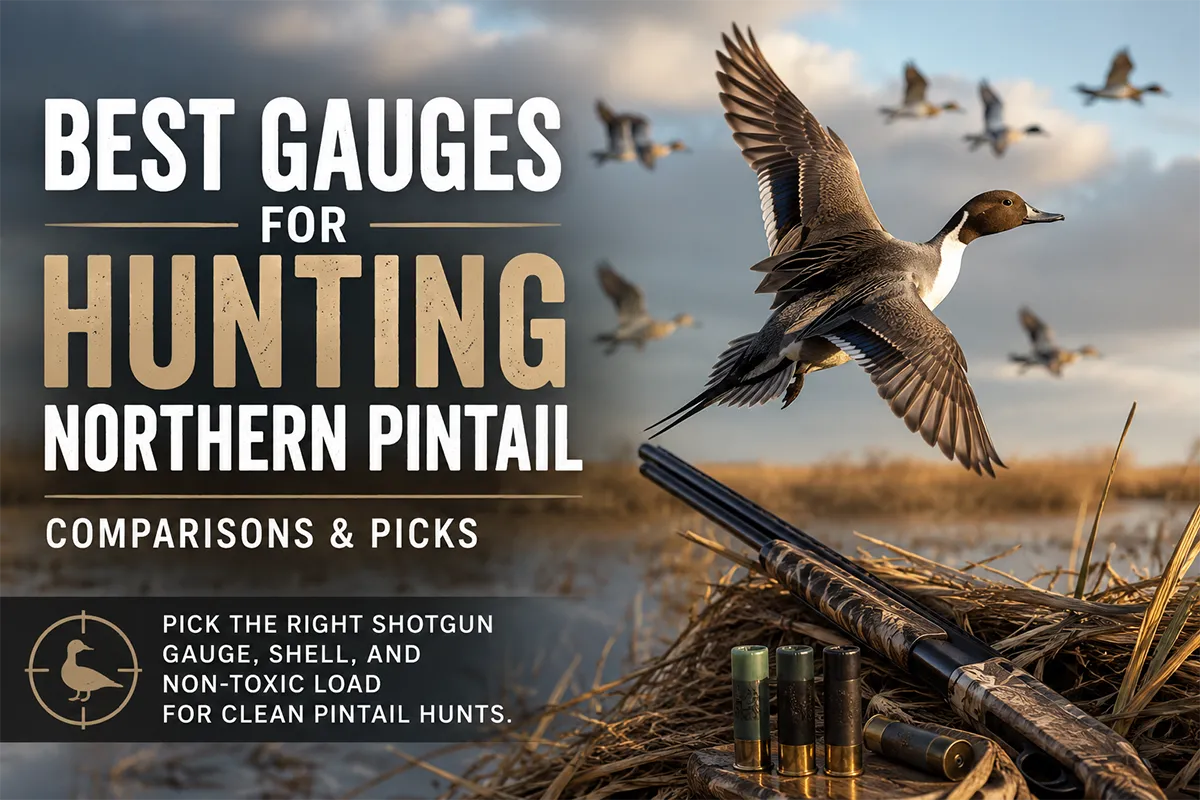
Pick the right shotgun gauge, shell, and non-toxic load for clean pintail hunts.
Northern pintails are fast, wary ducks that often work open water, flooded fields, marsh edges, and windy migration corridors. Although many hunters search for northern pintail hunting calibers, the practical choice is shotgun gauge, shell length, pellet material, choke, and your ability to make clean shots. The best setup gives enough pattern density for crossing birds without so much recoil that follow-up shots suffer.
Where/When: Northern pintails commonly move through prairie potholes, coastal marshes, river bottoms, flooded agricultural fields, managed wetlands, and broad open-water systems across much of North America. Hunters often find patterns around feeding flats, loafing water, grain fields, shallow sheet water, wind-protected edges, and travel corridors between food and roosting areas. Seasons and migration timing vary by flyway and regulation, but pintails are often active during morning flights, evening returns, cold fronts, wind shifts, and fresh water after weather changes. Early-season birds may respond to subtle spreads, while late-season birds can be wary, so always confirm local seasons, limits, and non-toxic shot rules.
Caliber Comparisons
| Feature | 12 gauge | 20 gauge | 16 gauge | 28 gauge |
|---|---|---|---|---|
|
Recoil How much kick you can expect when firing. |
Moderate to heavy with 3-inch or 3 1/2-inch loads | Mild to moderate with 2 3/4-inch or 3-inch loads | Moderate, usually softer than heavy 12 gauge loads | Light with standard loads; sharper with dense non-toxic loads |
|
Effective Range The distance at which the caliber remains accurate and lethal. |
Typically 35 to 50 yards with a proven pattern | Typically 30 to 45 yards with quality shells | Typically 30 to 45 yards, depending on load availability | Best inside 35 yards for most pintail setups |
|
Bullet Weight Range The range of bullet weights typically available for the caliber. |
Common shot payloads around 1 1/8 to 1 1/2 ounces | Common shot payloads around 7/8 to 1 1/4 ounces | Common shot payloads around 1 to 1 1/8 ounces | Common shot payloads around 3/4 to 1 ounce |
|
Versatility How well the caliber or gauge performs for other game species besides your primary target. |
Excellent for ducks, geese, turkeys, and upland use with proper loads | Very good for ducks, upland birds, and smaller-framed hunters | Good all-around field gauge, but waterfowl loads can be harder to find | Useful for close ducks and upland birds when paired with dense shot |
|
Ammo Availability How easy it is to find ammunition for the caliber. |
Excellent; broadest waterfowl shell selection | Very good; many modern non-toxic options | Fair; check availability before committing | Improving, especially with bismuth or tungsten-based shells |
12 gauge
The 12 gauge is the most practical all-around gauge for Northern pintail hunting because it handles wind, open water, and mixed duck hunts better than smaller options. It offers the widest choice of 2 3/4-inch, 3-inch, and 3 1/2-inch non-toxic shells, though many pintail hunters do well with balanced 3-inch steel or bismuth loads instead of the hardest-kicking shells. Choose it for marshes, fields, and reservoirs where birds may finish at varied angles. Pattern the exact shell and choke you plan to hunt, because ethical performance comes from pattern quality and shot placement, not shell size alone.
PROS
- Best selection of legal non-toxic waterfowl shells
- Strong pattern density for windy crossing shots
- Works across decoys, pass lanes, and mixed duck hunts
CONS
- Heavy loads can create flinching
- More gun than needed for close calm-water hunts
- Still requires honest range limits and good patterns
Interesting Fact: The 12 gauge lets hunters tune performance by changing shell length, pellet size, pellet material, and choke without changing shotguns.
Consider this Caliber If…
You hunt big marshes, coastal blinds, open reservoirs, or grain-field spreads where pintails may finish at different distances. It is also the safest one-gun choice for ducks and occasional geese. For pintails, consider non-toxic No. 2, No. 3, or No. 4 shot based on pattern results and typical range. Check local laws for magazine limits, seasons, daily limits, and shot requirements.
20 gauge
The 20 gauge is a smart pintail gauge for hunters who want lighter recoil, lighter guns, and better control during quick doubles. It solves the problem of overgunning smaller-framed hunters or anyone who shoots poorly with heavy 12 gauge loads. Modern 3-inch steel, bismuth, or tungsten-based 20 gauge shells can be very effective when birds are worked into honest decoy range. The key is restraint: choose a load that patterns evenly, use an appropriate choke, and pass on birds stretching the edge of the pattern.
PROS
- Manageable recoil helps many hunters shoot better
- Lighter shotguns are comfortable in walk-in marshes
- Good modern non-toxic loads are widely available
CONS
- Less pellet count than comparable 12 gauge loads
- Requires disciplined range limits on wary birds
- Premium dense-shot shells can be expensive
Interesting Fact: Many hunters shoot a 20 gauge cleanly because lower recoil helps them keep their head on the stock and maintain swing through the bird.
Consider this Caliber If…
You hunt decoying pintails over shallow water, potholes, timber edges, or small field spreads where shots are controlled. It is a good fit for youth hunters, recoil-sensitive hunters, and experienced shooters who value a light gun. Select shells by pattern performance, not marketing claims, and prioritize clean head and forward-body hits.
16 gauge
The 16 gauge sits between 12 gauge and 20 gauge, giving a useful balance of payload and handling for pintail hunters who already own a suitable shotgun. It solves the problem of wanting more pattern than a small gauge without moving to a heavier 12 gauge setup. The drawback is shell selection: non-toxic 16 gauge waterfowl loads are less common, so confirm availability before building a season around it. With appropriate bismuth or other legal non-toxic loads, it can be effective on decoying pintails at moderate distances.
PROS
- Balanced handling with useful payload capacity
- Often softer than heavy 12 gauge setups
- Good for hunters who already own a proven 16 gauge
CONS
- Waterfowl shell selection is limited
- Replacement ammo can be harder to find while traveling
- Not ideal if you need broad load choices
Interesting Fact: The 16 gauge has long been valued as a field compromise because it carries nicely while still throwing a useful hunting pattern.
Consider this Caliber If…
You hunt controlled decoy spreads, prefer classic field guns, and can secure legal non-toxic loads before the season. It is best for hunters who pattern carefully and keep shots realistic. Verify chamber length, choke compatibility with modern non-toxic shot, and all local waterfowl regulations.
28 gauge
The 28 gauge is a specialized pintail option for close decoy work, careful shooters, and hunters willing to pay for dense non-toxic loads. It solves recoil and carry-weight problems, but it does not solve the pellet-count problem unless birds are close and the pattern is excellent. For Northern pintails, the 28 gauge makes the most sense over tight decoys, small-water blinds, or early-season hunts where birds finish low and close. Avoid using it as a pass-shooting tool, and let distant birds go.
PROS
- Very light recoil encourages smooth shooting
- Easy to carry on long walk-in hunts
- Can work with premium dense non-toxic shot at close range
CONS
- Small payload leaves little room for poor range judgment
- Quality waterfowl shells are specialized
- Not suited for windy long-range pintail shooting
Interesting Fact: The 28 gauge can pattern efficiently for its size, but pattern efficiency does not replace pellet count when birds are far or heavily feathered.
Consider this Caliber If…
You are an experienced wingshooter hunting decoying pintails at close distances and you will pattern premium shells before the opener. It can be rewarding in the right blind, but it demands restraint. Make sure every shot is inside the range where your pattern still places enough pellets in the vital area.
Choosing the Best Gauge for Northern Pintail Hunting
For most hunters, 12 gauge is the most versatile Northern pintail choice, while 20 gauge is the best blend of lighter recoil and real waterfowl performance. The 16 gauge can work well if you have dependable non-toxic loads, and the 28 gauge should be reserved for close, controlled shots by hunters who understand their pattern limits. Whatever you carry, safe handling comes first: control your muzzle, identify birds clearly, know what is beyond the target, and never let excitement override judgment. Ethical pintail hunting depends on clean shot placement, honest distance limits, quick recovery, and respect for regulations. Laws can vary by state, province, refuge, season, shot material, plug requirements, and daily limit, so check current local rules before every hunt.