
Best Gauges for Hunting Mourning Dove: Comparisons & Picks
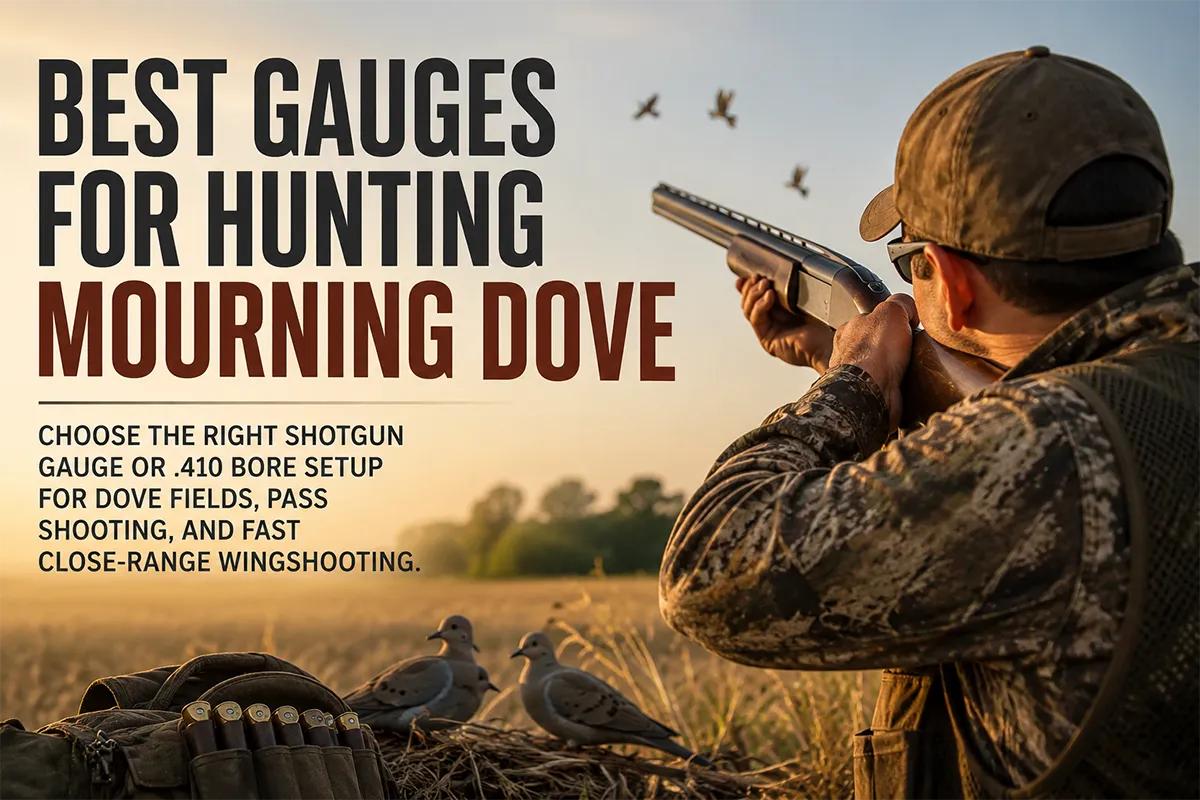
Choose the right shotgun gauge or .410 bore setup for dove fields, pass shooting, and fast close-range wingshooting.
The best mourning dove hunting calibers are really shotgun gauges and bore options, because doves are typically hunted with shotguns rather than rifles. Your choice should solve a practical field problem: enough pattern density to cleanly hit a small, fast bird without carrying more recoil, gun weight, or shell cost than you need. For most hunters, 12 gauge and 20 gauge are the safest starting points because ammunition is common, load choices are broad, and patterns are forgiving. Smaller options like 28 gauge and .410 bore can be excellent for experienced wingshooters who keep shots close and know their limits. Always handle firearms safely, identify your target and background, use ethical shot distances, and check local regulations for seasons, bag limits, plug requirements, magazine limits, licensing, and non-toxic shot rules.
Where/When: Mourning doves are commonly found across much of the United States and in many agricultural, grassland, desert-edge, and open woodland habitats, especially near grain fields, weed patches, water sources, roosting trees, gravel, and travel corridors between feeding and watering areas. Hunters often pattern birds by watching field edges, power lines, bare ground, and flight paths in the days before a hunt. Seasons vary by region and regulation, but dove hunting often centers on early-season flights, with birds moving most actively during morning and evening windows. Weather, local pressure, crop harvest, cold fronts, and regional migration timing can all change daily movement, so confirm legal dates and conditions where you hunt.
Gauge Comparisons
| Feature | 12 Gauge | 20 Gauge | 28 Gauge | .410 Bore | 16 Gauge |
|---|---|---|---|---|---|
| Recoil How much kick you can expect when firing. |
Moderate to stout, depending on load and gun weight | Mild to moderate and comfortable for most hunters | Light, smooth, and easy to shoot well | Very light, but less forgiving | Moderate, usually between 12 gauge and 20 gauge |
| Effective Range The distance at which the caliber remains accurate and lethal. |
Typically 20–40 yards with suitable choke and shot size | Typically 20–35 yards with good patterning | Typically 20–30 yards in capable hands | Typically inside 25 yards for ethical consistency | Typically 20–35 yards with quality field loads |
| Bullet Weight Range The range of bullet weights typically available for the caliber. |
Common dove loads around 1 to 1 1/8 oz of shot | Common dove loads around 7/8 to 1 oz of shot | Common dove loads around 3/4 oz of shot | Common dove loads around 1/2 to 11/16 oz of shot | Common dove loads around 1 to 1 1/8 oz of shot |
| Versatility How well the caliber or gauge performs for other game species besides your primary target. |
Excellent for doves, waterfowl where legal, upland birds, and turkeys with proper loads | Excellent for doves, quail, pheasant in some setups, and small game | Great for doves, quail, woodcock, and light upland use | Best for close doves, small game, and expert-level wingshooting practice | Good upland crossover option, though less common today |
| Ammo Availability How easy it is to find ammunition for the caliber. |
Excellent and usually the easiest to find | Excellent in most sporting goods and gun shops | Fair to good, but sometimes limited locally | Good for general shells, more limited for ideal dove loads | Fair and often more limited than 12 or 20 gauge |
12 Gauge
The 12 gauge solves the biggest problem in mourning dove hunting: small birds crossing fast at unpredictable angles. Its larger payload gives more pellets in the pattern, which helps new and average shooters make clean hits when birds flare, quarter, or pass at the edge of comfortable range. A 12 gauge is not automatically better if it makes you flinch, so choose a field gun that fits well and use light target or dove loads when legal and effective. Many hunters prefer No. 7 1/2 or No. 8 shot for typical dove work, with improved cylinder or modified choke depending on distance and pattern results.
PROS
- Most forgiving pattern density for mixed shot angles
- Very strong ammunition availability and load variety
- Works well for hunters who also pursue other game
CONS
- More recoil than smaller gauges, especially in light guns
- Can feel heavy during long walks or hot early-season hunts
- Easy to choose more payload than doves require
Interesting Fact: A light 12 gauge dove load can feel much softer than many hunters expect, especially in a gas-operated semi-auto or a properly weighted over-under.
Consider this Caliber If…
Choose 12 gauge if you want the most flexible dove setup, hunt larger fields, take occasional longer passing shots, or want one shotgun for multiple seasons. Pattern your gun before opening day, avoid skybusting, and keep shots inside the range where your load places enough pellets in the vital area.
20 Gauge
The 20 gauge is one of the best all-around choices for dove hunters who want a lighter gun and less recoil without giving up practical field performance. It solves the comfort problem: you can shoot more naturally, recover faster for follow-up shots, and carry the gun easily along field edges, water holes, or fence lines. A 20 gauge with a quality 7/8 oz or 1 oz load is highly capable when paired with good wingshooting fundamentals. For many hunters, it is the best balance of pattern, recoil, shell cost, and field handling.
PROS
- Comfortable recoil for most adults and many youth hunters
- Light, quick-handling guns are common
- Plenty of pattern for ethical dove ranges
CONS
- Less forgiving than 12 gauge on marginal range estimates
- Very light guns can still feel snappy
- Load selection is good but not as broad as 12 gauge
Interesting Fact: Many experienced dove hunters shoot a 20 gauge better than a 12 gauge simply because they mount it faster and do not anticipate recoil.
Consider this Caliber If…
Choose 20 gauge if you hunt typical dove fields, want a pleasant gun for high-volume shooting, or are buying a shotgun for a smaller-framed hunter. Look for reliable cycling if using a semi-auto, pattern improved cylinder and modified chokes, and select legal shot material for your area.
28 Gauge
The 28 gauge is a refined dove option for hunters who value light recoil, lively handling, and deliberate shot selection. It solves the fatigue problem on long, hot hunts because many 28 gauge shotguns are trim and easy to carry. It also rewards smooth swings and close-to-moderate shots over raw pellet count. The tradeoff is that you have fewer pellets than 12 or 20 gauge loads, so pattern quality and distance discipline matter. It is excellent over decoys, near water, along predictable flyways, or in fields where birds are working within practical range.
PROS
- Very mild recoil helps maintain good shooting form
- Fast, natural handling for crossing birds
- Effective on doves when shots are kept reasonable
CONS
- Ammo can be more expensive or harder to find
- Less forgiving for beginners than 12 or 20 gauge
- Not ideal for long pass shooting or poor range judgment
Interesting Fact: The 28 gauge often patterns surprisingly well for its size, which is why many upland hunters trust it far more than its small shell might suggest.
Consider this Caliber If…
Choose 28 gauge if you already shoot well, want a low-recoil dove gun, and can source shells before the season. It is best for hunters who pass on marginal birds, pattern their loads carefully, and prefer a nimble shotgun over maximum payload.
.410 Bore
The .410 bore is the lightest and least forgiving option in this comparison. It solves a very specific problem: giving skilled hunters an ultra-low-recoil, lightweight platform for close birds and disciplined shooting. It does not solve the beginner problem, because its small shot charge leaves little room for poor leads, rushed mounts, or long shots. For mourning doves, the .410 bore is best used where birds are close and predictable, such as small water holes, decoy setups, or tight flyways. It can be ethical, but only when the shooter keeps distance conservative and patterns the gun thoroughly.
PROS
- Extremely light recoil and easy carry weight
- Useful for expert shooters seeking a challenge
- Can be effective on close, well-presented doves
CONS
- Small pattern gives very little margin for error
- Not recommended for most new dove hunters
- Ammo choices may be limited and costly
Interesting Fact: The .410 is correctly called a bore, not a gauge, because its naming does not follow the same gauge system used for 12, 20, 28, and 16 gauge shotguns.
Consider this Caliber If…
Choose .410 bore only if you are confident in your wingshooting and committed to close-range shots. Pattern different loads, avoid stretching range, and remember that low recoil does not matter if the pattern is too thin for clean kills.
16 Gauge
The 16 gauge is a classic middle-ground dove choice that sits between the common 12 gauge and 20 gauge. It solves the balance problem for hunters who want more payload than many 20 gauge loads but prefer a trimmer field gun than a typical 12 gauge. On mourning doves, it is fully capable with sensible shot sizes and chokes, especially for hunters who already own a well-fitting 16 gauge. The main drawback is ammunition availability. If you plan to hunt doves regularly with a 16 gauge, buy shells early and verify that your selected load patterns well in your specific shotgun.
PROS
- Good balance of payload, recoil, and field carry
- Excellent for hunters who enjoy classic upland shotguns
- Capable pattern density for typical dove ranges
CONS
- Shells are usually less common than 12 or 20 gauge
- Fewer modern shotgun options are available
- Not necessary unless you already like the platform
Interesting Fact: The 16 gauge has long been admired as an upland gauge because it can carry like a lighter gun while still throwing a useful field payload.
Consider this Caliber If…
Choose 16 gauge if you already own one that fits well, enjoy traditional upland shotguns, and can find suitable dove loads. It is not the most convenient choice for every hunter, but it remains practical when ammunition planning is handled before the season.
Choosing the Best Mourning Dove Gauge
For most hunters, 20 gauge is the best all-around dove choice because it is light, pleasant, and effective at normal field ranges. The 12 gauge is the most forgiving and versatile, especially for newer hunters or larger fields. The 28 gauge is excellent for skilled shooters who want mild recoil and quick handling, while the .410 bore should be reserved for close shots and experienced wingshooters. The 16 gauge remains a capable classic if you can source shells. Whatever you choose, pattern your shotgun, match choke to distance, use legal shot, avoid unsafe shots, and make ethical shot placement your first priority.