
Best Gauges for Hunting Montezuma Quail: Comparisons & Picks
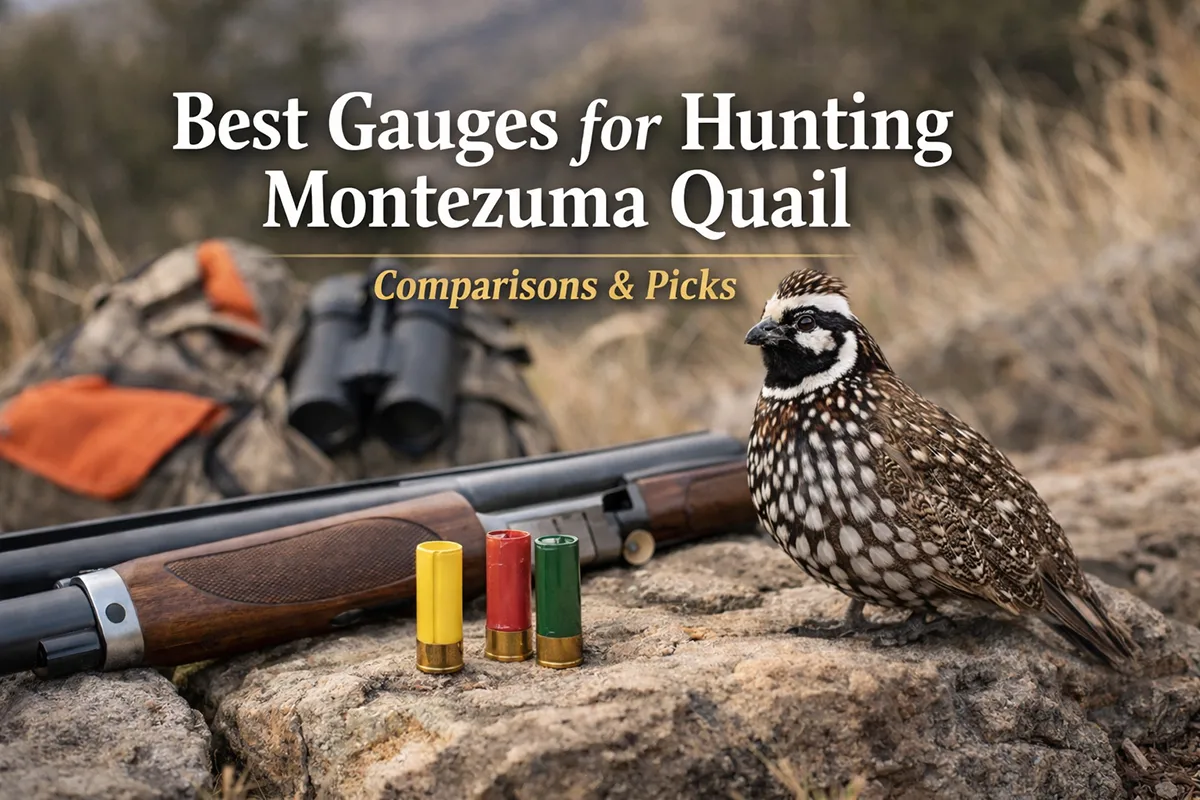
Field-ready gauge picks for close, fast, and often surprise flushes in steep country.
Choosing the right Montezuma quail hunting gauges usually means choosing the right shotgun gauge (or .410 bore). These birds often sit tight and then rocket out at close range, so prioritize a quick-handling gun, an open choke (Improved Cylinder is a great start), and loads that pattern well with #8 or #7.5 shot. Always follow safe gun handling, take only ethical shots, and check local regulations for seasons, bag limits, and any non-toxic shot requirements.
Gauge Comparisons
| Feature | 20 Gauge | 28 Gauge | .410 Bore | 12 Gauge | 16 Gauge |
|---|---|---|---|---|---|
| Shot Payload How much shot you’re sending, affecting pattern density and recoil. |
7/8–1 oz (#8/#7.5) | 3/4 oz (#8) | 1/2 oz (#8/#9) | 7/8–1 oz (#8) | 1 oz (#8) |
| Recoil How much kick you can expect from the gauge. |
Low–Moderate | Low | Very Low | Moderate | Moderate |
| Effective Range The distance at which the load remains effective on birds with good patterns. |
20–35 yd | 18–32 yd | 15–25 yd | 20–40 yd | 20–38 yd |
| Versatility How well the gauge or bore performs for other game species besides your primary target. |
High (upland, dove, rabbits) | Medium (upland/clays) | Low–Medium (close-range small game) | Very High (most bird/hunt uses) | Medium–High (upland-focused) |
| Ammo Availability How easy it is to find ammunition for the gauge or bore. |
High | Moderate | Moderate | Very High | Low–Moderate |
20 Gauge (Shotgun Gauge)
The 20 gauge is the do-it-all upland gauge for Montezuma quail: light to carry in steep, grassy canyons, but still throws a forgiving pattern with 7/8–1 oz of #8 or #7.5 shot. Pair it with an Improved Cylinder (or Light Modified) choke for close, explosive flushes and quick second shots.
PROS
- Great balance of pattern and carry weight
- Plenty of effective upland loads in 2¾”
- Works well with IC/LM chokes at typical quail distances
CONS
- Ultralight guns can feel whippy on hard crossers
- High-brass loads add recoil in featherweight field guns
- Not as “effortless” as a 12 gauge on longer shots
Interesting Fact: A 20 gauge’s smaller bore often patterns very evenly with 7/8 oz quail loads, which helps on snap shots in thick cover.
Consider this Option If…
You want one versatile upland gun that’s easy to hike with and easy to feed, without giving up pattern density.
28 Gauge (Shotgun Gauge)
If you love a fast-handling upland gun, the 28 gauge shines on Montezuma quail. With 3/4 oz of #8 shot and an Improved Cylinder choke, it’s deadly inside normal ranges while keeping recoil extremely mild—perfect for all-day walk-ups and quick mounts.
PROS
- Very low recoil for fast follow-ups
- Sweet handling in trim upland guns
- Excellent patterns with 3/4 oz #8 loads
CONS
- Ammo selection can be thinner in small towns
- Shells usually cost more than 12/20 gauge
- Less forgiving if shots stretch past your pattern’s comfort zone
Interesting Fact: The 28 gauge has a reputation for “punching above its weight” because many loads pattern efficiently for their payload size.
Consider this Option If…
You keep shots honest (typically under ~30 yards) and want a lightweight, low-recoil upland setup.
.410 Bore (Shotgun Bore)
The .410 bore is a specialist’s option for Montezuma quail. It can absolutely work at close range with 1/2 oz of #8 or #9 shot, but it demands clean fundamentals: tight shooting lanes, disciplined distances, and precise leads. Consider an IC choke and treat 25 yards as a hard ceiling for most hunters.
PROS
- Light recoil and minimal muzzle blast
- Very light guns for steep terrain
- Rewarding for experienced wingshooters
CONS
- Small payload means thin patterns quickly
- Distance mistakes become wounded-bird risks
- Ammo can be pricey and sometimes seasonal
Interesting Fact: Because the shot column is small, a .410’s pattern can open quickly—patterning your exact load is especially important.
Consider this Option If…
You’re an experienced shotgunning quail hunter who enjoys a challenge and will pass shots that aren’t clean and close.
12 Gauge (Shotgun Gauge)
The 12 gauge is the most forgiving option when you want maximum pattern density and the widest load selection. For Montezuma quail, stick with lighter 1 oz (or even 7/8 oz) #8 loads and an Improved Cylinder choke to avoid over-shooting birds at close range while keeping the pattern even.
PROS
- Most forgiving patterns and pellet counts
- Best ammo availability and load variety
- Easy to tune with choke and lighter loads
CONS
- Heavier guns can be tiring on long hikes
- More recoil if you run stout loads
- Can be “too much” up close without the right choke/load
Interesting Fact: Many 12 gauge hunters downsize to 1 oz or 7/8 oz loads for quail to get softer recoil without sacrificing pattern quality.
Consider this Option If…
You want the easiest ammo sourcing, the most versatility, and the most forgiving patterns—especially if some shots may be a bit longer.
16 Gauge (Shotgun Gauge)
The classic “sweet sixteen” splits the difference between 12 and 20 gauge. With 1 oz of #8 shot and an IC or Light Modified choke, it delivers excellent patterns in a lively field gun. For Montezuma quail, it’s a great choice if you already own one and can source shells reliably.
PROS
- Excellent patterns with 1 oz upland loads
- Nice balance of weight and authority
- Great classic upland gun feel
CONS
- Ammo availability can be spotty
- Fewer modern load options than 12/20 gauge
- Not ideal if you rely on last-minute shell runs
Interesting Fact: The 16 gauge earned the “sweet sixteen” nickname because many hunters feel it carries like a 20 but hits closer to a 12 with 1 oz loads.
Consider this Option If…
You enjoy classic upland guns and want a balanced, effective gauge—while planning ahead for ammo.
Final Thoughts
For most hunters, a 20 gauge with an IC choke and quality #8/#7.5 loads is the easiest, most practical Montezuma quail setup. If you want lighter recoil and a classic upland feel, the 28 gauge is a joy—just keep shots inside your patterned range. The .410 bore can be effective but demands strict distance discipline to avoid cripples. Whatever you choose, pattern your load, keep your swing smooth, and hunt within the rules.