
Best Gauges for Hunting Merriam’s Wild Turkey: Comparisons & Picks
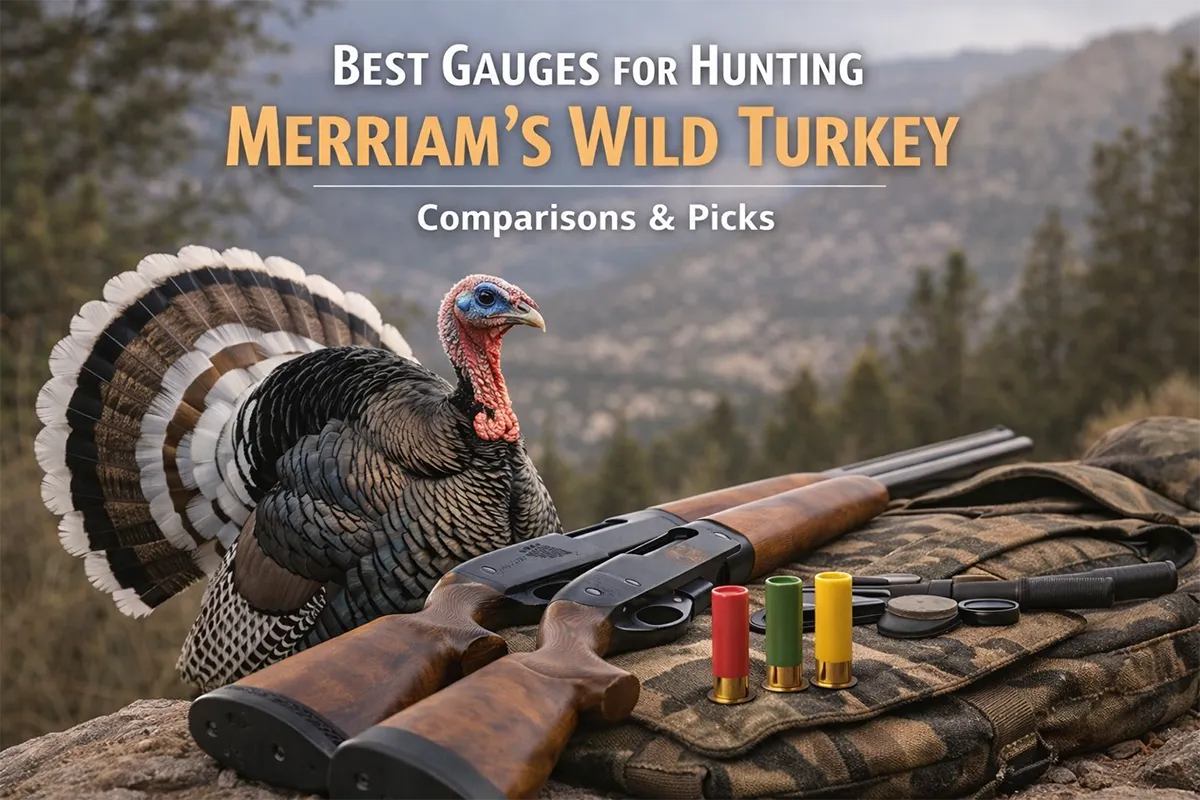
Choose the right turkey gauge or .410 bore for recoil, pattern density, and the open-country reality of Merriam’s hunts.
When you are hunting Merriam’s wild turkeys, the conversation is about gauges and .410 bore, not rifle calibers. These birds are usually hunted with shotguns, and success depends on a tight, even pattern in the head-and-neck area at realistic turkey distances. In open pine ridges, grassy parks, and broken mountain draws, Merriam’s gobblers can appear close one minute and hang up the next, so your best setup is the one you can carry comfortably, shoot confidently, and pattern thoroughly with your chosen choke and shell. The goal is not simply “more power.” The goal is an ethical, dense pattern at the distances you actually plan to shoot.
Where/When: Merriam’s wild turkeys are commonly found across parts of the Rocky Mountain West and nearby regions, often using ponderosa pine country, mountain meadows, creek bottoms, oak brush foothills, and open ridges broken by timber pockets. Hunters typically locate birds near roost trees, strut zones, field edges, water in dry country, and travel routes between feeding areas and cover. In many places, spring hunting centers on breeding activity, with birds often vocal and mobile after fly-down, then again later in the day, though pressure, wind, snow, and cold snaps can slow movement or keep birds in sheltered timber. Early season and later season behavior can differ by elevation and weather, and exact timing varies by state, local conditions, and regulations.
Because turkey hunting is so pattern-dependent, no gauge should be chosen on reputation alone. A 20 gauge with the right turkey choke and shell can outperform a poorly matched 12 gauge, while a .410 bore can be effective only when the hunter keeps shots close and patterns carefully. Below, we compare the most practical gauge options for Merriam’s wild turkey hunting, with an emphasis on recoil, range, carry weight, shell availability, and the kind of mountain and foothill terrain where these birds are commonly pursued. As always, safe firearm handling, ethical shot placement, and local laws matter. Check your state regulations for legal shot types, season rules, magazine restrictions, and any method-of-take requirements before hunting.
Gauge Comparisons
| Feature | 12 gauge | 20 gauge | 28 gauge | .410 bore | 10 gauge |
|---|---|---|---|---|---|
| Recoil How much kick you can expect when firing. |
Moderate to heavy, especially with 3-inch and 3.5-inch turkey loads | Light to moderate | Light | Very light | Heavy |
| Effective Range The distance at which the setup can remain effective with a proper turkey pattern. |
Commonly 35 to 50 yards, depending on choke and shell | Commonly 30 to 45 yards, depending on choke and shell | Commonly 25 to 40 yards, usually with tuned turkey loads | Commonly 20 to 35 yards with disciplined patterning | Commonly 40 to 55 yards, depending on the setup |
| Shot Payload Range The amount of shot commonly carried in turkey shells. |
About 1 3/4 to 2 1/4 ounces | About 1 1/4 to 1 5/8 ounces | About 7/8 to 1 1/4 ounces | About 11/16 to 13/16 ounce | About 2 to 2 1/4 ounces |
| Versatility How useful the gauge is for other hunting roles. |
Very high | High | Moderate | Low to moderate | Moderate |
| Ammo Availability How easy it is to find turkey loads for the gauge. |
Excellent | Very good | Fair to good | Fair | Limited |
12 gauge
For most hunters, 12 gauge is still the benchmark for turkey hunting because it offers the broadest shell selection, the highest pellet counts, and the most flexibility in choke pairing. That matters on Merriam’s birds, which often travel through open timber and meadows where a gobbler may stop just outside comfortable calling range. A 12 gauge gives you the easiest path to a dense pattern at practical turkey distances, especially if you want multiple shell options to test before season. It is also the easiest gauge to shop for if you want standard lead-free or premium turkey loads without hunting all over for ammunition.
PROS
- Offers the widest variety of turkey shells and choke options
- Higher pellet counts can create denser, more forgiving patterns
- Well suited for hunters who may face slightly longer open-country shots
CONS
- Recoil can be stout with heavy turkey loads
- Many 12 gauge shotguns are heavier on steep hikes
- Can be more gun than necessary for hunters who keep shots close
Interesting Fact: A properly patterned 12 gauge often earns its reputation not from raw power, but from how many shell and choke combinations are available to fine-tune performance for your exact shotgun.
Consider this Gauge If…
You want the most forgiving and easiest-to-source turkey option, expect some birds to stall in open terrain, or simply prefer the widest margin for pattern density. It is a smart pick for hunters who value flexibility and do not mind moderate to heavy recoil.
20 gauge
The 20 gauge is one of the best all-around choices for Merriam’s wild turkey hunting because it balances carry comfort, lower recoil, and strong turkey performance. In mountain country, where hunters may climb ridges, drop into draws, and cover ground to relocate vocal birds, a lighter shotgun matters. The 20 gauge is especially appealing for hunters who sit well within their pattern limits and want a gun that is easier to shoulder smoothly from awkward setups against trees, brush, or uneven ground. With modern turkey loads and a good choke, it is a highly capable option.
PROS
- Lighter recoil than 12 gauge for better shooting comfort
- Often found in lighter shotguns that carry well in mountain terrain
- Can pattern extremely well with modern turkey-specific loads
CONS
- Lower pellet counts than 12 gauge reduce pattern margin at distance
- Still requires careful shell and choke testing for best results
- Some hunters may outgrow it if they want maximum reach
Interesting Fact: Many experienced turkey hunters consider the 20 gauge the practical sweet spot because it trims recoil and gun weight without giving up much real-world performance inside responsible ranges.
Consider this Gauge If…
You want an easier-carrying turkey shotgun, prefer lighter recoil, or hunt rough country where mobility matters as much as pattern performance. It is often the best choice for hunters who value balance over maximum payload.
28 gauge
The 28 gauge is a specialized but increasingly respected turkey option for hunters who want a very light shotgun and manageable recoil. It is not usually the first recommendation for beginners, because it rewards disciplined range limits and careful pattern testing, but in the right hands it can be extremely effective on Merriam’s birds. This gauge is especially attractive for hunters who cover a lot of ground in broken country and care about ounces on the shoulder. It is best viewed as a precision-oriented turkey gauge rather than a broad-margin choice.
PROS
- Low recoil and comfortable shooting characteristics
- Often chambered in lightweight shotguns that are easy to carry
- Can be very effective when paired with the right turkey load and choke
CONS
- Turkey shell availability is narrower than 12 or 20 gauge
- Less pellet payload means less room for poor aiming or extra distance
- Usually better for hunters who already understand patterning well
Interesting Fact: The 28 gauge’s strong reputation among some turkey hunters comes less from tradition and more from how efficiently modern loads can perform when paired with careful setup work.
Consider this Gauge If…
You prioritize a lightweight field gun, keep shots conservative, and are willing to test loads carefully before season. It is a strong fit for hunters who like a refined, low-recoil shotgun without stepping all the way down to .410 bore.
.410 bore
.410 bore is not a gauge, and that distinction matters. It is its own bore designation, and while it can be used effectively for turkey hunting, it demands the most discipline of any option here. Merriam’s turkeys often offer beautiful calling setups, but they also move unpredictably through open spaces and broken cover. That means a .410 bore hunter must be especially careful about range, shooting angle, and pattern verification. This is not the choice for careless distance estimation or rushed shooting. It is a close-range, precision tool.
PROS
- Very light recoil for youth and recoil-sensitive hunters
- Compact platforms are easy to carry and position in tight cover
- Can be effective at close range with a well-patterned turkey setup
CONS
- Has the narrowest margin for error on moving or partially obscured birds
- Requires strict distance discipline and careful aiming
- Turkey ammunition choices are more limited than common gauges
Interesting Fact: The main reason .410 bore has gained attention in turkey hunting is not because it suddenly became “bigger,” but because modern shell technology can place useful pellet counts into a very tight pattern at close range.
Consider this Gauge If…
You are recoil-sensitive, want a compact turkey gun, and are fully committed to close-range hunting with conservative shot selection. It is best for disciplined hunters who understand that ethical success comes from restraint, not hype.
10 gauge
The 10 gauge remains a niche choice for turkey hunting, but it still appeals to hunters who want very heavy payloads and maximum pattern density. On Merriam’s birds, that usually matters most in broad, open country where gobblers may hang up and refuse to close the final distance. Even so, 10 gauge comes with clear tradeoffs: heavier guns, heavier recoil, and fewer shell choices. For many hunters it is more specialty tool than general recommendation, but for those who truly want the biggest practical turkey gauge, it still has a place.
PROS
- Heavy payloads can support very dense turkey patterns
- Can help open-country hunters who want maximum pattern margin
- Often appreciated by hunters who prefer dedicated turkey or waterfowl guns
CONS
- Heavy recoil can reduce shooter comfort and consistency
- Shotguns are usually bulkier and less pleasant on long hikes
- Ammo is harder to find than 12 gauge or 20 gauge options
Interesting Fact: The 10 gauge’s real advantage in turkey hunting is payload capacity, but for many hunters a well-patterned 12 gauge provides nearly all the practical field performance they actually need.
Consider this Gauge If…
You specifically want a maximum-payload turkey setup, do not mind extra gun weight, and hunt country where birds may stay farther out. For most hunters it is optional, but for some specialists it remains appealing.
Final Picks for Merriam’s Wild Turkey Hunting
For Merriam’s wild turkeys, the most accurate language is straightforward: you are choosing a gauge or .410 bore, not a caliber. In practical terms, 12 gauge is the easiest recommendation for hunters who want broad ammo availability, strong pattern potential, and flexibility across different field situations. 20 gauge is the best balance for many mountain and foothill hunts because it reduces recoil and carry weight while remaining very capable inside responsible turkey ranges. 28 gauge is a smart specialist’s option for hunters who want a light gun and are willing to pattern carefully. .410 bore can absolutely work, but it should be approached with close-range discipline and a strong emphasis on ethical shot limits. 10 gauge remains a niche heavy-hitter for those who specifically want maximum payload.
No matter which option you choose, pattern your shotgun with the exact shell and choke you plan to hunt with. Confirm point of impact, count meaningful hits in the head-and-neck zone, and set a personal maximum range based on what your pattern actually does on paper. Use safe gun handling at all times, wait for a clean shot angle, and prioritize ethical shot placement over stretching distance. Regulations vary widely by state and season, including legal shot materials, season structure, and equipment rules, so always check current local laws before heading out.