
Best Gauges for Hunting Japanese Quail: Comparisons & Picks
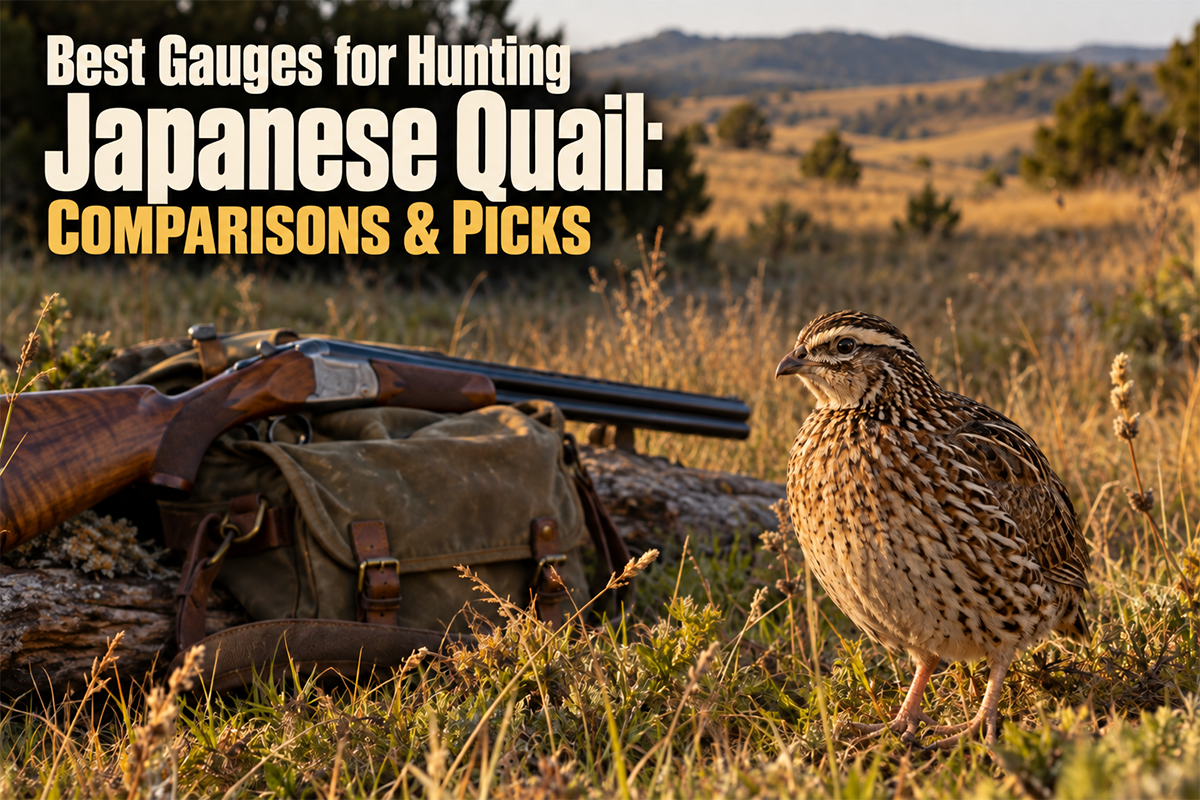
Four practical shotgun choices for close-range Coturnix hunting on licensed preserves and game-bird clubs.
The best Japanese quail hunting gauges balance a forgiving pattern with low recoil, quick handling, and enough pellet density for a very small, fast bird. In North America, Japanese quail—also called Coturnix quail—are primarily relevant to managed hunting rather than typical wild public-land seasons. California, for example, allows domestically propagated Coturnix quail on licensed game bird clubs and notes that the species does not exist there as a wild game bird.
Where/When: Japanese quail hunting in North America generally means licensed preserves, game-bird clubs, or other lawful managed properties where pen-raised birds are released. Expect short grass, weedy strips, field edges, and planted cover that can hold birds for pointing or flushing dogs. Quail may sit tightly before flushing low and fast, making roughly 15- to 30-yard opportunities common. Cooler fall through spring conditions are often associated with preserve hunting, although operating seasons and rules vary. Birds can hold differently with wind, temperature, cover density, and hunting pressure. Always confirm current property and state regulations covering species, season dates, licenses, shooting hours, limits, and legal methods.
Japanese Quail Gauge & Bore Comparisons
| Feature | 12 Gauge | 20 Gauge | 28 Gauge | .410 Bore |
|---|---|---|---|---|
| Recoil How much kick you can expect when firing. |
Moderate; lighter loads reduce it | Low to moderate | Low | Very low |
| Effective Range The practical distance where a well-patterned load remains suitable. |
About 15–30 yards | About 15–30 yards | About 15–30 yards | Often best around 15–25 yards |
| Typical Load / Shot Size Common light upland or target-style choices; verify property rules. |
Light loads with No. 7½, 8, or 9 shot | Light loads with No. 7½, 8, or 9 shot | Light loads with No. 7½, 8, or 9 shot | Small payloads with No. 7½, 8, or 9 shot |
| Versatility How well the option crosses over to other lawful shotgun uses. |
Excellent | Excellent | Very good for upland birds | More specialized |
| Ammo Availability How easy appropriate shotshells are generally to find. |
Excellent | Excellent | Moderate | Good, with fewer load choices |
12 Gauge
A 12 gauge offers broad ammunition availability and enough pellets to create a forgiving pattern on a fast-flushing Japanese quail. The important consideration is not maximum power but selecting an appropriately light load. A target or light upland load with No. 7½, 8, or 9 shot can be a sensible starting point where permitted. Cylinder, skeet, or improved-cylinder chokes often deserve testing for close birds. Pattern the exact combination at 20, 25, and 30 yards. A lighter field gun handles quickly, while a heavy 12 gauge may feel slower when a bird suddenly leaves nearby cover.
PROS
- Dense patterns provide useful forgiveness on crossing birds.
- Shotshells, chokes, and suitable shotguns are widely available.
- Highly versatile for hunters pursuing other game birds.
CONS
- More recoil than is usually necessary for Japanese quail.
- Heavier guns can feel slow in close cover.
- Heavy loads and tight chokes may be excessive at short distances.
Interesting Fact: For Japanese quail, the 12 gauge is valuable because it can produce forgiving patterns with light loads, not because maximum payload is required.
Consider this Gauge If…
Choose a 12 gauge if you already own one, want excellent ammunition availability, or prefer a shotgun that can handle many other hunting roles. Look for a field gun that mounts naturally and test lighter loads with open chokes before hunting.
20 Gauge
For many hunters, the 20 gauge is the best-balanced Japanese quail option. It provides ample pattern density for close preserve birds while keeping gun weight and recoil manageable. That combination is useful when walking behind a dog for several hours and needing to mount quickly when a covey flushes. Light No. 7½, 8, or 9 shot loads can perform well when matched to an appropriate choke and verified on a pattern board. Ammunition is generally easier to find than 28-gauge loads, while many 20-gauge field guns remain noticeably trimmer than comparable 12-gauge models.
PROS
- Excellent balance of recoil, payload, and quick handling.
- Common ammunition with many shotgun choices.
- Light field guns are comfortable during longer hunts.
CONS
- Extremely light guns can produce sharper perceived recoil.
- Some loads are still heavier than needed for close birds.
- Choke and ammunition combinations require pattern testing.
Interesting Fact: The 20 gauge occupies a useful middle ground between the 12 gauge’s generous pattern and the lighter feel of smaller upland shotguns.
Consider this Gauge If…
The 20 gauge suits hunters wanting one practical upland shotgun with moderate recoil and readily available ammunition. Prioritize proper stock fit and natural mounting over simply buying the lightest gun. An open choke and light load are good starting points for pattern testing.
28 Gauge
The 28 gauge is an appealing Japanese quail choice when low recoil, light weight, and lively handling are priorities. Properly patterned, its modest payload is well suited to small birds at realistic preserve distances. Many 28-gauge over/unders and side-by-sides are trim enough to carry comfortably while remaining responsive during sudden flushes. The primary tradeoffs are ammunition cost and selection. Local stores may carry fewer loads than they do for 12 or 20 gauge, so hunters should confirm availability before settling on a shotgun. Also verify shell length, choke compatibility, and any required shot material.
PROS
- Low recoil makes practice and repeated shooting comfortable.
- Trim field guns can be fast and pleasant to carry.
- Light payloads pair naturally with small upland birds.
CONS
- Shotshells often cost more than comparable 12- or 20-gauge loads.
- Local ammunition selection may be limited.
- Very light guns can feel overly quick if stock fit is poor.
Interesting Fact: The 28 gauge is popular with many upland enthusiasts because useful pattern performance can be combined with a relatively light shotgun and modest payload.
Consider this Gauge If…
Choose a 28 gauge if you value low recoil and a responsive field gun enough to accept higher ammunition costs. It works especially well for hunters who practice regularly and want more pattern forgiveness than a .410 bore provides.
.410 Bore
The .410 bore produces very little recoil and is available in exceptionally light shotguns, but its smaller payload offers less room for pointing error. That makes it a specialized Japanese quail option rather than an automatic recommendation for beginners. On managed properties where birds flush close, experienced wingshooters may appreciate its easy carry and mild recoil. Pattern density should determine your maximum distance. Test the exact shell and choke at several ranges and stay inside the distance where pellet distribution remains consistently effective. Do not assume a faster load compensates for a sparse pattern.
PROS
- Very low recoil encourages comfortable practice.
- Light shotguns are easy to carry and mount.
- Useful for disciplined close-range shooting in capable hands.
CONS
- The small payload provides less pattern forgiveness.
- Practical range depends heavily on pattern quality.
- It can be challenging for inexperienced wingshooters despite mild recoil.
Interesting Fact: Unlike 12, 20, and 28 gauge, .410 is correctly described as a bore rather than a gauge.
Consider this Bore If…
Select a .410 bore if recoil sensitivity is important, expected shots are close, and you have enough wingshooting experience to center a smaller pattern consistently. Pattern testing is especially important before establishing an ethical maximum range.
Which Shotgun Is Best for Japanese Quail?
For most hunters, the 20 gauge is the easiest recommendation because it combines manageable recoil, common ammunition, light field guns, and sufficient pattern density. A lightly loaded 12 gauge is highly practical, while the 28 gauge is excellent for hunters prioritizing trim handling and low recoil. The .410 bore can work well at close range but demands greater discipline and pattern testing. Whatever you choose, pattern the shotgun with the exact shell and choke you intend to hunt, positively identify every bird before firing, keep the muzzle in a safe direction, and know the location of dogs and other hunters before taking a low crossing shot. Stay within the range where your pattern remains consistently effective. Check current state and preserve rules for licenses, allowed species, seasons, limits, shooting hours, legal shot material, magazine restrictions, and firearm methods because requirements are not universal. California’s current game-bird-club program specifically includes Coturnix quail among domestically propagated birds allowed on licensed clubs.