
Best Gauges for Hunting Indian Peafowl: Comparisons & Picks
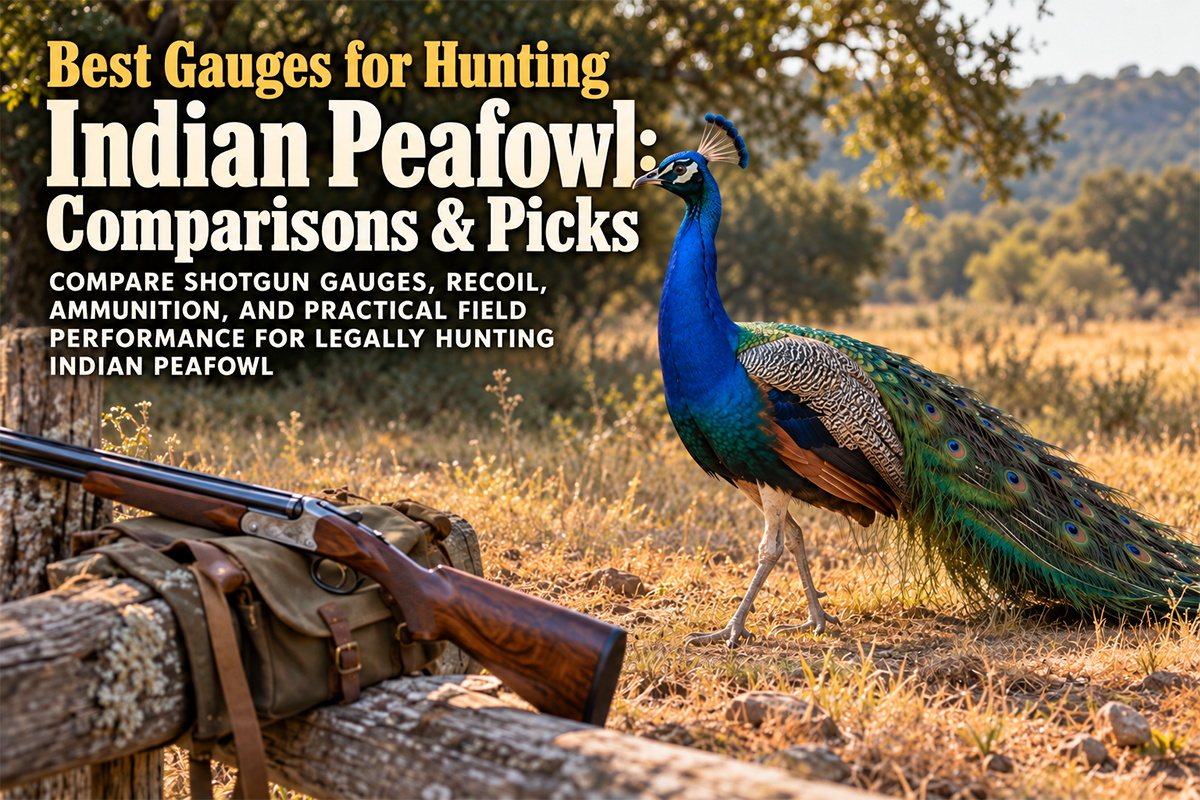
Compare shotgun gauges, recoil, ammunition, and practical field performance for legally hunting Indian peafowl.
Choosing the best Indian peafowl hunting gauges involves balancing dependable shotgun patterns, manageable recoil, firearm weight, and available ammunition. Indian peafowl (Pavo cristatus), also called Indian blue peafowl, are considerably larger than common upland birds such as quail. Their size makes appropriate ammunition and verified pattern performance particularly important. For authorized hunts, the 12 gauge, 20 gauge, 16 gauge, and 28 gauge offer different advantages. This guide compares their strengths, limitations, and suitability for hunters who prioritize responsible equipment selection. Because peafowl hunting opportunities are geographically limited, confirming that the species, hunting location, and firearm method are legal must come before buying equipment.
Where/When: In North America, Indian peafowl hunting is an unusual, location-specific opportunity rather than a widespread upland game tradition. Hawaiʻi officially recognizes Indian peafowl as huntable game birds in designated areas, including Kapāpala and Puʻu Waʻawaʻa on Hawaiʻi Island, with additional recognition on Oʻahu subject to applicable hunting regulations. On Hawaiʻi Island, birds may occupy grassy slopes, open woodland, brushy margins, and areas near reliable water. Hunters may observe tracks, droppings, feathers, and repeated movements between feeding and roosting areas. Peafowl often feed on the ground during daylight and roost in elevated locations at night. Morning and late-afternoon activity may be noticeable, while rain, wind, heat, and seasonal food availability can influence movement. Kapāpala’s published game-bird season generally extends from early November through late January, but hunting days, authorized units, shooting hours, and bag limits vary. Hawaiʻi previously announced a one-bird daily limit for specified areas; hunters must verify currently effective rules before each outing. Elsewhere, such as Texas, exotic-fowl rules may permit taking peafowl on authorized private property, but ownership, local ordinances, and hunting-law requirements still apply.
Indian Peafowl Hunting Gauges Compared
| Feature | 12 Gauge | 20 Gauge | 16 Gauge | 28 Gauge |
|---|---|---|---|---|
| RecoilTypical felt recoil with comparable field loads and firearm weights. | Moderate to substantial | Mild to moderate | Moderate | Generally mild |
| Practical RangeDistance must be established through pattern testing with the actual firearm and ammunition. | Often 20–40 yards | Often 20–35 yards | Often 20–35 yards | Generally closer ranges |
| Common Field PayloadsRepresentative shot-charge weights; availability and legal shot requirements vary. | 1–1 1/4 oz | 7/8–1 oz | 1–1 1/8 oz | 3/4–7/8 oz |
| VersatilityUsefulness for other lawful upland and small-game hunting. | Excellent | Excellent | Very good | Good |
| Ammo AvailabilityTypical U.S. retail selection; local inventory varies. | Excellent | Excellent | Moderate | Moderate |
These ranges are approximate comparisons, not promises of ethical effectiveness. Pattern density, pellet material, shot size, choke, shooter proficiency, and conditions determine the responsible limit. A lighter firearm may also produce more felt recoil than a heavier shotgun of the same gauge.
12 Gauge: Best Overall Versatility
The 12 gauge is a practical starting point for hunters seeking a broadly useful shotgun. Its major advantage is ammunition flexibility, not simply greater power. Standard field ammunition comes in numerous shot sizes, payload weights, and materials. That variety helps hunters select loads compatible with their firearm and the regulations of their hunting area. A properly fitted 12-gauge shotgun can serve for peafowl, pheasants, other legal upland birds, and numerous additional sporting applications.
PROS
- Extensive selection of ammunition and shotgun configurations.
- Flexible payload choices for pattern testing.
- Widely available components and accessories.
CONS
- Heavier loads can produce substantial recoil.
- Some configurations become tiring on long walks.
- Additional payload does not compensate for poor patterns.
For most hunters, a standard 2 3/4-inch field shell is worth evaluating before considering heavier loads. Choose shot material and size according to current law, the intended use, and manufacturer guidance. Steel and other non-toxic alternatives must be matched to approved barrel and choke combinations. Test patterns on paper at realistic distances rather than assuming that a particular choke designation guarantees uniform coverage.
Interesting Fact: Shotgun gauge refers to a traditional bore-size measurement based on the number of bore-diameter lead spheres needed to weigh one pound. Consequently, a 12-gauge bore is larger than a 20-gauge bore.
Consider This Gauge If…
You want one shotgun for several lawful hunting activities, prioritize ammunition selection, and are comfortable carrying a potentially heavier firearm. A 12-gauge shotgun with a stock that fits correctly often makes more sense than purchasing specialized equipment for an uncommon peafowl hunting opportunity. Compare overall weight, balance, and length of pull before choosing.
20 Gauge: Best Balance of Recoil and Carry Weight
The 20 gauge combines common ammunition choices with potentially lighter shotgun configurations. It is particularly appealing for hunters who spend extended periods walking through uneven terrain or prefer a comfortable, easily handled firearm. With suitable loads and verified pattern performance, it remains a credible choice for lawful peafowl hunting. Its effectiveness depends on proper ammunition selection and realistic range discipline, not the assumption that smaller gauges automatically produce inferior field results.
PROS
- Often available in lighter, easier-carrying shotguns.
- Generally comfortable recoil with moderate field loads.
- Common ammunition and versatile upland applications.
CONS
- Usually offers less shot payload capacity than 12 gauge.
- Very lightweight models may have unexpectedly sharp recoil.
- Specialty ammunition choices can be more limited.
Evaluate common 2 3/4-inch field ammunition first, ensuring that both shell length and load specifications match the shotgun. Test different approved loads and chokes to determine which delivers sufficiently even patterns. A well-balanced 20-gauge shotgun may be preferable to a heavier alternative on rocky slopes, particularly when much of the outing involves walking rather than shooting.
Interesting Fact: A 20-gauge shotgun does not automatically recoil less than every 12-gauge shotgun. Firearm weight, velocity, payload, and stock geometry all influence felt recoil.
Consider This Gauge If…
You want a versatile field shotgun with manageable recoil and practical portability. It is particularly attractive to hunters who already own a properly fitted 20 gauge and have confidence in its pattern performance. Budget-conscious buyers can compare basic pump-action models with more expensive lightweight doubles, remembering that comfort and reliability are more important than decorative features.
16 Gauge: Best Traditional Upland Alternative
The 16 gauge occupies a middle position between 12 and 20 gauge in bore diameter. It remains popular among some traditional upland enthusiasts who appreciate its balance of payload capacity and handling characteristics. For peafowl hunting in authorized locations, its primary appeal is familiarity and versatility when paired with a suitable field shotgun. However, buyers should consider ammunition availability before making it their only hunting firearm.
PROS
- Useful traditional upland field-load options.
- Potentially comfortable balance in purpose-built shotguns.
- Versatile for several species of legally huntable birds.
CONS
- Less ammunition variety than 12 or 20 gauge.
- Modern shotgun selection is comparatively narrow.
- Specialty non-toxic ammunition may require advance planning.
Many 16-gauge field loads use approximately one ounce of shot, although other configurations exist. Hunters should confirm chamber length and pressure compatibility, particularly with older shotguns. Vintage firearms may require professional inspection before using modern ammunition. Locating compliant non-toxic loads can also be important where lead restrictions apply. Before traveling, identify a dependable ammunition source and pattern the exact shells intended for the hunt.
Interesting Fact: The 16 gauge has a long history in upland hunting, but its historical popularity does not guarantee that modern ammunition will be stocked by every retailer.
Consider This Gauge If…
You already own a reliable 16-gauge shotgun, appreciate traditional field firearms, and can obtain compatible ammunition without difficulty. It is harder to justify buying one exclusively for Indian peafowl when more commonly supported alternatives are available. Compare carrying comfort, shell costs, and long-term ammunition access rather than choosing on nostalgia alone.
28 Gauge: Best Lightweight Specialty Option
The 28 gauge appeals to experienced upland hunters who favor compact, responsive shotguns with relatively mild recoil. It can be enjoyable to carry across open terrain, but its comparatively limited payload calls for particularly careful pattern evaluation. Indian peafowl are substantial birds, so the 28 gauge should be considered a specialty option rather than an automatic recommendation for inexperienced hunters. A close, clearly identified bird within a demonstrated effective pattern is essential.
PROS
- Typically comfortable recoil with standard field loads.
- Available in lightweight, responsive upland shotguns.
- Appealing for hunters who value compact equipment.
CONS
- Limited shot payload demands careful pattern verification.
- Ammunition can cost more and be harder to source.
- Less forgiving of poor range judgment or sparse patterns.
Standard 28-gauge ammunition often carries approximately 3/4 ounce of shot, with additional loads available for compatible firearms. Shot composition matters because pellet count and individual pellet characteristics change with material and size. Check firearm chamber markings, approved choke combinations, and ammunition instructions. Do not extend your effective range merely because a manufacturer advertises a high-performance load.
Interesting Fact: Some 28-gauge shotguns are built on proportionally smaller frames, while others use larger shared platforms. The number stamped on the barrel alone does not establish firearm weight.
Consider This Gauge If…
You are an experienced shotgun hunter with a well-fitted 28 gauge, dependable access to suitable ammunition, and a conservative approach to effective range. For a first peafowl-related purchase, a 20 or 12 gauge will generally offer greater flexibility and stronger retail support.
Which Gauge Should You Choose for Indian Peafowl Hunting?
For most prospective buyers, the 12 gauge provides the broadest ammunition selection, while the 20 gauge offers an attractive combination of handling, recoil comfort, and versatility. The 16 gauge makes sense for owners who already possess suitable equipment, and the 28 gauge is best reserved for experienced hunters who understand its limitations. Regardless of gauge, ethical hunting requires positive species identification, a safe background, correct firearm handling, and demonstrated shotgun pattern performance. Never fire toward a bird without a clear and safe shooting opportunity. Maintain muzzle control, keep the safety engaged when appropriate, and unload firearms when crossing obstacles or entering vehicles. Verify current licensing, stamps, seasons, daily bag limits, legal methods, shooting hours, land access, magazine restrictions, and any non-toxic shot requirements. These rules are not universal. Hawaiʻi hunters should consult the Hawaiʻi Division of Forestry and Wildlife game-bird regulations, while Texas hunters should review the Texas exotic-fowl regulations and obtain landowner authorization. Responsible preparation matters more than choosing the largest available shotgun.