
Best Gauges for Hunting Greater Prairie-Chicken: Comparisons & Picks
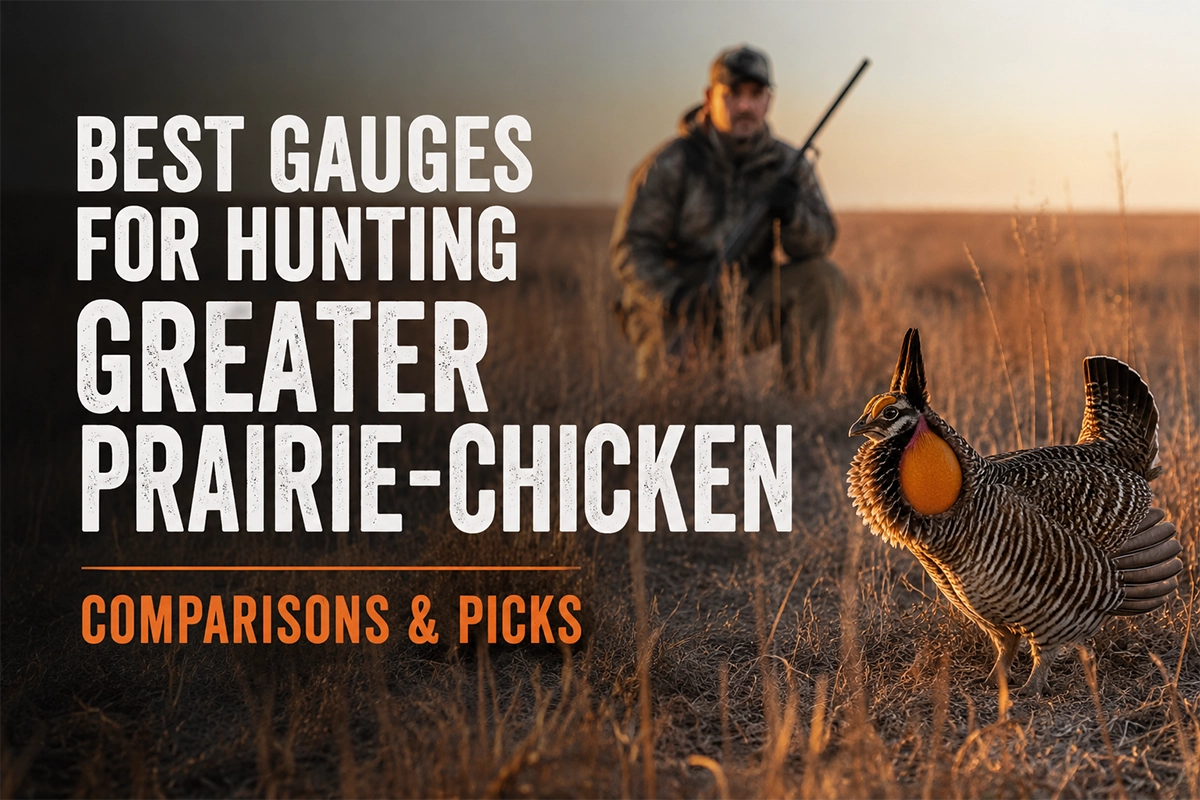
Choose a shotgun gauge that balances pattern density, recoil, gun weight, and the open-country shots prairie chickens often present.
The best Greater Prairie-Chicken hunting gauges balance reliable patterns, manageable recoil, and a shotgun light enough for long walks across open grassland. Birds can flush suddenly and fly hard across the wind, so gun fit, a smooth mount, and a proven hunting load matter more than choosing the largest gauge. For most hunters, 12 gauge and 20 gauge provide the easiest mix of ammunition choice and practical range. The 16 gauge offers a traditional middle ground, while the 28 gauge favors hunters who value low recoil and disciplined, moderate-range shooting. Whatever you choose, pattern the exact gun, choke, and load before hunting.
Where/When: Greater Prairie-Chickens are commonly associated with broad grasslands of the central Great Plains, including native tallgrass and mixed-grass prairie, grazed pasture, conservation grass, and prairie edges near grain or crop fields. Hunters often find birds near feeding areas, loafing or roosting cover, and travel routes between secure grass and food; water may matter locally. Legal hunting timing varies by state and management unit and generally falls in autumn and winter, not during spring booming activity. Early-season birds may be more scattered and sometimes hold better in thicker cover, while late-season birds often gather into larger, warier flocks. Morning and evening travel can be productive, and wind, cold, heat, or changing weather may alter where birds sit and how they flush. Regulations vary by region, so confirm current dates, unit boundaries, bag limits, shooting hours, legal methods, access rules, and shot-material requirements.
Gauge Comparisons
| Feature | 12 Gauge | 20 Gauge | 16 Gauge | 28 Gauge |
|---|---|---|---|---|
|
Recoil How much kick you can expect with typical upland loads. |
Moderate to stout, depending on gun weight and load | Mild to moderate in many field guns | Moderate; highly dependent on gun weight | Generally mild with standard upland loads |
|
Practical Pattern Range The distance at which your specific gun, choke, and load still produce an ethical pattern. |
Often about 25–45 yards after pattern testing | Often about 20–40 yards after pattern testing | Often about 25–40 yards after pattern testing | Often about 20–35 yards after pattern testing |
|
Typical Shot Charge Common payload territory for upland-oriented factory loads. |
Broad range, commonly around 1 to 1 1/4 oz | Commonly around 7/8 to 1 oz | Commonly around 1 to 1 1/8 oz | Commonly around 3/4 to 1 oz |
|
Versatility How well the gauge can cover other upland and general shotgun uses. |
Excellent; widest overall load flexibility | Excellent for upland birds and lighter field use | Very good for upland hunters who already own one | Very good for close-to-moderate upland work |
|
Ammo Availability How easy it is to find suitable hunting shells. |
Generally excellent | Generally very good | Usually more limited than 12 or 20 gauge | Usually good, but hunting-load selection may be narrower |
12 Gauge
The 12 gauge is the most flexible option for hunters who may see both close flushes and longer crossing shots. Its advantage is the broad choice of payloads, pellet sizes, choke options, and shotgun configurations, letting you tune recoil and pattern density to the hunt. Moderate upland loads are often enough; heavy shells add recoil without fixing poor placement. Pattern at realistic distances such as 25, 35, and 40 yards, then choose the choke and load that give an even, useful pattern. Match shot material to local rules, and re-pattern whenever you change load type or pellet material.
PROS
- Wide selection of upland loads, shot materials, and pellet sizes
- Strong pattern density for open-country shots when properly choked
- Easy to adapt for pheasant, waterfowl, turkey, and other shotgun uses
CONS
- Can produce more recoil than needed with heavy loads
- Some 12 gauge field guns are heavier to carry all day
- Extra payload does not compensate for poor gun fit or weak shooting fundamentals
Interesting Fact: Lighter 12 gauge field loads can reduce recoil while still producing useful hunting patterns.
Consider this Gauge If…
Choose 12 gauge if you want broad ammunition choice, strong pattern density, and one shotgun that can cover many upland situations. It suits hunters who already shoot a well-fitting 12 gauge confidently and do not mind the weight of some models.
20 Gauge
The 20 gauge is an excellent balance of carry weight, recoil, and useful prairie-chicken performance. A properly fitted 20 can be quick to mount after a sudden flush and comfortable during long grassland walks. Standard upland payloads work well inside the range proven on your pattern board. Test improved-cylinder, modified, or similar chokes rather than assuming one is best. Because pellet count is lower than many 12 gauge loads, stretching distance reduces forgiveness. Choose pellet size and shot material for expected range and local rules, and pass on marginal birds beyond your tested pattern.
PROS
- Lighter guns are comfortable for long prairie walks
- Recoil is often easier to manage than comparable 12 gauge setups
- Widely available ammunition with plenty of upland-oriented choices
CONS
- Less payload margin than 12 gauge at longer distances
- Ultra-light guns can still feel sharp with heavier loads
- Requires careful patterning if you switch between lead and non-toxic shot
Interesting Fact: A light 20 gauge can be especially comfortable on hunts dominated by walking.
Consider this Gauge If…
Choose 20 gauge if you want moderate recoil and a lighter field gun without giving up practical upland versatility. It is a strong fit for newer hunters, smaller-framed shooters, or anyone who values easy carry and quick handling.
16 Gauge
The 16 gauge is a classic upland choice that generally falls between 12 and 20 gauge in payload. In a trim field gun, it can offer excellent balance for prairie walking and fast shooting. Its drawback is availability: ammunition choices are usually narrower, and some older shotguns need careful attention to chamber length, barrel condition, choke, and compatibility with modern or harder non-toxic shot. Have questionable older guns inspected by a qualified gunsmith. Once compatibility is confirmed, pattern several loads instead of assuming a 16 gauge will behave like a 12 or 20.
PROS
- Useful middle-ground payloads for upland birds
- Many purpose-built 16 gauge field guns balance and point naturally
- Capable option for hunters who already own and shoot one well
CONS
- Ammunition variety is typically narrower than 12 or 20 gauge
- Some older guns require extra attention to chamber and shot compatibility
- Replacement parts and gun selection can be more limited
Interesting Fact: The 16 gauge has a long tradition in light, well-balanced upland field guns.
Consider this Gauge If…
Choose 16 gauge if you already own a sound, well-fitting field gun and can reliably obtain suitable hunting shells. It rewards hunters who prioritize traditional upland balance and handling over maximum ammunition variety.
28 Gauge
The 28 gauge is a light, low-recoil option for hunters who value quick handling and are willing to keep shots inside a proven pattern range. It can be effective on prairie chickens with an appropriate upland load, but the smaller payload leaves less margin on distant flushes or wind-stretched crossing shots. Pattern carefully at realistic distances and resist using excessive choke merely to chase range. Also confirm that your barrel and choke system are rated for the shot material you plan to use, especially with non-toxic loads.
PROS
- Low recoil encourages smooth follow-through and frequent practice
- Light, responsive guns are easy to carry across open prairie
- Excellent fit for hunters who consistently take moderate-range shots
CONS
- Lower pellet count reduces forgiveness on long or poorly centered shots
- Premium and non-toxic hunting loads may be less widely stocked
- Not ideal if your typical opportunities are beyond about 35 yards
Interesting Fact: The 28 gauge is popular with upland hunters who value light guns and low recoil.
Consider this Gauge If…
Choose 28 gauge if low recoil and light carry weight matter most and you are comfortable passing birds outside moderate range. It best suits disciplined shooters who center birds consistently and trust their pattern testing.
Choosing the Best Gauge for Greater Prairie-Chicken Hunting
For most hunters, 12 gauge and 20 gauge are the simplest choices because they combine useful pattern density with broad ammunition availability. The 16 gauge works well for hunters already committed to it, while the 28 gauge favors moderate-range discipline. Whatever you carry, pattern the exact gun, choke, and load and set your maximum range from actual pattern performance. Keep the muzzle controlled, keep the safety on until ready to fire, positively identify the bird and what lies beyond it, and avoid low shots around partners or dogs. Take only shots that offer a reasonable chance of a clean kill. Before hunting, check current local seasons, bag and possession limits, shooting hours, permits, legal methods, magazine limits where applicable, and non-toxic shot requirements.