
Best Gauges for Hunting Gray Francolin: Comparisons & Picks
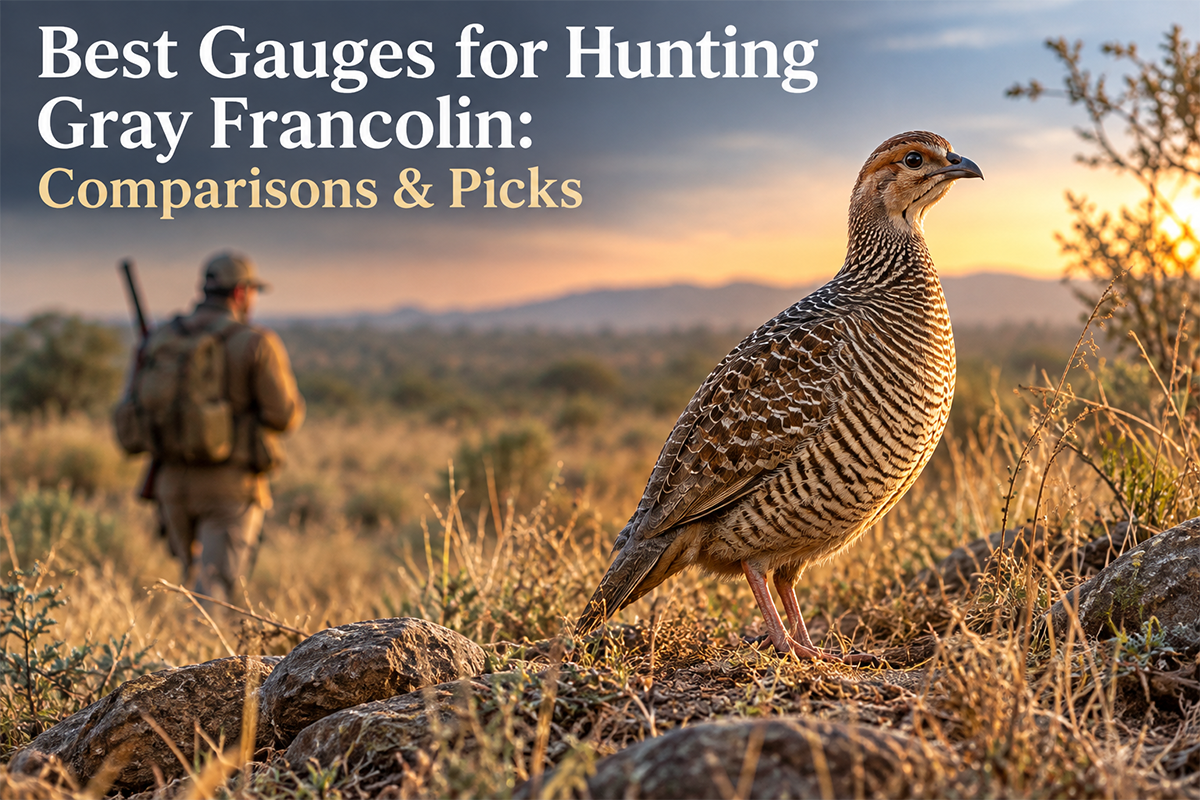
Choose a light, pattern-efficient shotgun setup for fast-flushing francolin in Hawaiʻi.
Gray francolin hunting gauges should match the bird’s small size, quick flush, and the open-to-brushy ground hunters often cover in Hawaiʻi. A shotgun that mounts quickly, patterns evenly with small upland shot, and carries comfortably is usually more useful than simply choosing the largest gauge. For many hunters, 20 gauge and 28 gauge balance recoil and handling, while 12 gauge brings broad load selection and .410 bore rewards disciplined shooting at close range.
Where/When: In the United States, the clearest established hunting context for Gray Francolin is Hawaiʻi, where the species is introduced and the state currently lists it as a legal game bird on Hawaiʻi Island, Maui, Molokaʻi, Lānaʻi, Oʻahu, and Kauaʻi. Gray Francolin generally favor dry, open country such as grasslands, scrub, ranch edges, and agricultural ground, and they may be easier to locate when feeding or moving during cooler morning and late-afternoon periods. Heat, wind, rain, cover height, and hunting pressure can change daily movement. Season dates, hunting days, bag limits, units, access rules, and temporary changes vary by island, so confirm the current Hawaiʻi Division of Forestry and Wildlife rules before each hunt.
Gray Francolin Hunting Gauges Compared
| Feature | 12 Gauge | 20 Gauge | 28 Gauge | .410 bore |
|---|---|---|---|---|
| Recoil Relative recoil depends on gun weight, action type, and load. |
Moderate; can be mild with lighter field loads | Low to moderate | Low | Low, though very light guns can feel sharper than expected |
| Practical Patterned Range The distance where your specific shotgun and load still produce adequate pattern density. |
Often about 25–40 yards | Often about 20–35 yards | Often about 20–35 yards | Often about 15–25 yards |
| Typical Upland Payloads Common field-load payloads; verify what your shotgun is chambered to use. |
About 1 to 1 1/8 oz | About 7/8 to 1 oz | About 3/4 oz | About 1/2 to 11/16 oz |
| Versatility How broadly the gauge or bore can cover other lawful upland hunting. |
Very broad | Broad | Strong upland focus | Specialized, close-range use |
| Ammo Availability General relative availability; local stock can change. |
Usually excellent | Usually very good | More limited | Common, but upland load selection can be narrower |
12 Gauge
A 12 gauge is the most flexible choice for hunters who want one shotgun for Gray Francolin and other upland birds. Its main advantage is load variety: light field loads can reduce recoil while still providing a dense pellet count. For a bird this size, heavy loads are rarely necessary. A quick-handling gun with an improved-cylinder or modified choke and a patterned No. 7½ or No. 8 load can make more sense than a heavy magnum setup. The tradeoff is weight; many 12-gauge field guns are heavier than comparable 20- or 28-gauge models during long walks.
PROS
- Broad ammunition and choke availability
- Dense patterns are easy to build with light upland loads
- Useful if one shotgun must cover several game-bird species
CONS
- Typically heavier to carry than smaller-gauge field guns
- Standard loads can produce more recoil than needed for small birds
- Easy to over-gun the task if load selection is not kept sensible
Interesting Fact: Shot size is independent of gauge, so a No. 7½ pellet is the same diameter whether it comes from a 12-gauge or 20-gauge shell; the difference is mainly how many pellets the shell carries and how the gun handles them.
Consider this Gauge If…
Choose 12 gauge if you already own a well-fitting field shotgun, want the easiest ammunition sourcing, or plan to hunt multiple upland species. Favor lighter loads and pattern the gun on paper at 20, 30, and 40 yards before deciding your real maximum range. If the pattern develops thin gaps, shorten the distance rather than assuming a larger gauge automatically solves the problem.
20 Gauge
For many Gray Francolin hunters, 20 gauge is a practical middle ground. It is commonly chambered in lighter shotguns than 12 gauge, produces manageable recoil, and still carries enough payload for ordinary upland distances. A 7/8-ounce load of No. 7½ or No. 8 shot is a useful patterning starting point. In thicker scrub, an open choke can suit close shots; in open country, modified may hold density farther out. Only your specific gun-and-load combination can confirm that.
PROS
- Good balance of low recoil and useful pellet count
- Often available in light, fast-handling field shotguns
- Broad enough for many other upland birds
CONS
- Less payload flexibility than 12 gauge
- Very light guns may still produce noticeable recoil
- Pattern quality can fall off quickly with poor load-and-choke matching
Interesting Fact: The old gauge system is based on how many round lead balls of bore diameter total one pound; that is why a 20 gauge has a smaller bore than a 12 gauge.
Consider this Gauge If…
Choose 20 gauge if you expect to walk a lot, want moderate recoil, and prefer a shotgun that still offers generous pattern performance without the bulk of many 12-gauge guns. Check length of pull, balance, and total loaded weight, especially if you will carry the gun for several hours. Fit matters because a quick, repeatable mount is more important on a flushing bird than a few ounces of extra payload.
28 Gauge
The 28 gauge is an upland specialist for hunters who value light weight, mild recoil, and quick handling. A typical 3/4-ounce field load carries fewer pellets than larger gauges, so pattern quality deserves attention, but a well-fitted 28 gauge can be effective inside the range where its pattern stays even. It is attractive in open Hawaiian country where hunters may cover substantial ground. The main drawback is ammunition cost and availability, which can be less predictable than 12 or 20 gauge.
PROS
- Lightweight and easy to carry for long upland walks
- Mild recoil encourages smooth follow-through
- Well matched to small birds at sensible distances
CONS
- Fewer pellets in typical field payloads
- Ammunition can cost more and be harder to find
- Requires disciplined range limits if patterns thin out
Interesting Fact: Despite its smaller bore, the 28 gauge has long been favored by upland hunters because efficient field loads can produce surprisingly even patterns from light, lively shotguns.
Consider this Gauge If…
Choose 28 gauge if you prioritize carrying comfort and already shoot a light shotgun well. Pattern several loads with No. 7½ or No. 8 shot and avoid extending beyond the distance where pellet distribution stays dense and centered. Budget for ammunition before committing to the platform, and confirm that the shell length and pressure are appropriate for your shotgun.
.410 bore
The .410 bore is the most specialized choice here. Its narrow shot column and small payload make precise pointing and strict range control important. It can suit experienced hunters who enjoy light guns and close shots, but it offers less margin for error than 20 or 28 gauge. Pattern testing is essential: start close, evaluate pellet distribution, and set a personal distance limit from repeatable patterns rather than published velocity. With fewer pellets, long crossing shots may not be responsible once pattern density drops.
PROS
- Very light guns are available
- Low payload can reduce recoil
- Rewarding for skilled hunters who keep shots close
CONS
- Small payload leaves less room for pointing error
- Practical range is usually shorter
- Not the easiest option for windy conditions or inconsistent flush distances
Interesting Fact: The .410 bore is named for its approximate bore diameter in inches rather than by the traditional gauge system.
Consider this Bore If…
Choose .410 bore if you are an experienced shotgunner, expect close flushes, and can resist taking marginal shots. Use pattern paper to determine where your gun places its pattern and how quickly density falls off. It is not automatically the best youth option simply because recoil is low; the smaller payload can make clean hits harder for a new shooter.
Choose the Gauge You Can Carry, Mount, and Pattern Well
For Gray Francolin in Hawaiʻi, 20 gauge and 28 gauge are natural upland choices, 12 gauge offers the broadest load flexibility, and .410 bore is a close-range specialist. Pattern the exact shotgun, choke, and load before hunting, keep the muzzle in a safe direction, keep your finger off the trigger until the shot is appropriate, and positively identify the bird and what lies beyond it. Pass on shots beyond the range where your pattern remains adequate for a clean kill. Hawaiʻi currently permits shotguns and bow and arrow for game birds and prohibits BB or larger shot except during the spring turkey hunt. Hunters must follow current licensing, stamp, season, unit, bag-limit, shooting-hour, access, and public-area blaze-orange rules. Check current island-specific DOFAW information and any landowner or non-toxic-shot requirements before hunting.