
Best Gauges for Hunting Eurasian Collared-Dove: Comparisons & Picks
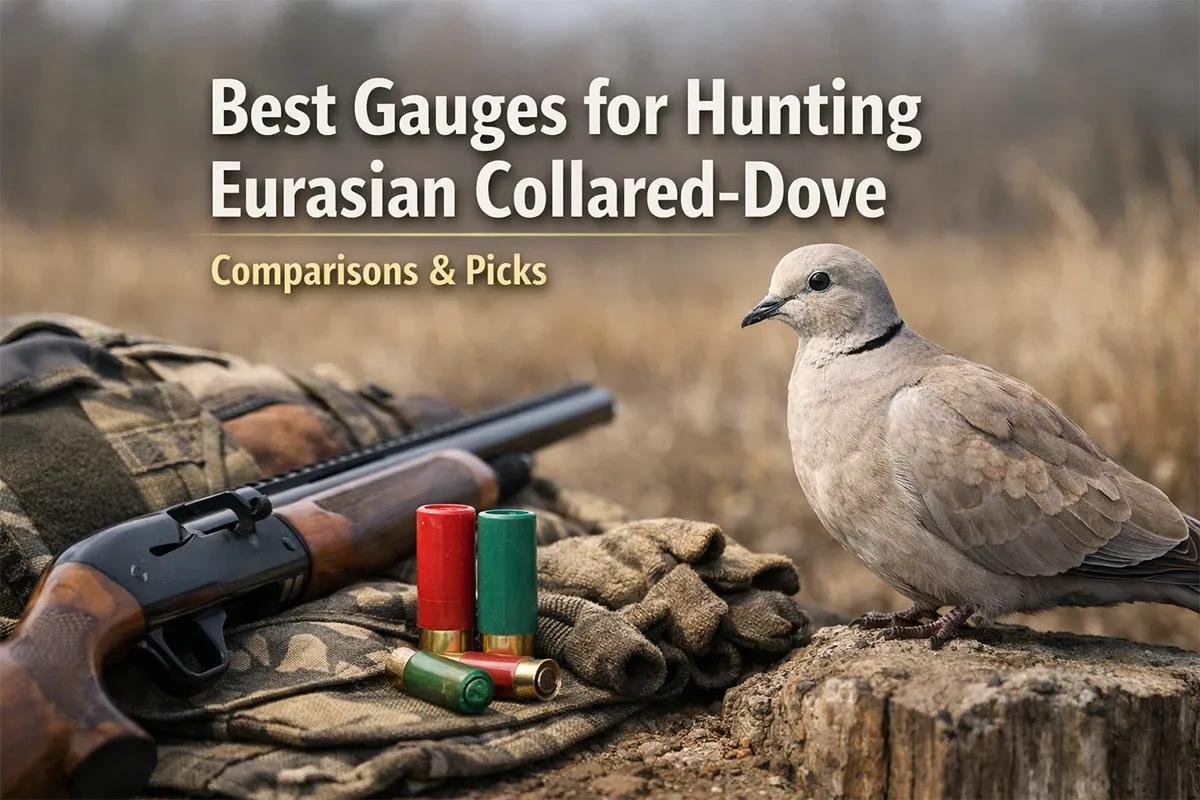
Shotgun gauges that match your range, recoil tolerance, and hunting style for fast, field-flying doves.
Choosing the right setup for Eurasian collared-dove hunting is mostly a shotgun question: which gauge (or bore), what shot size, and what choke give you reliable patterns at the distances you actually shoot. Collared doves can pour into a field and then suddenly “wise up,” forcing longer crossing shots on the edges. They’re also quick, which means you’ll often shoot in odd body positions—twisting on a stool, standing in cover, or rotating through multiple lanes. The best gauge for you is the one that keeps recoil manageable so you stay smooth, while still throwing a dense enough pattern to deliver multiple pellet hits inside your ethical range.
A useful way to think about dove performance is “pattern quality over raw speed.” Fast shells can help a little on longer leads, but even, consistent patterns matter more for clean kills. Start by patterning your shotgun with your exact load and choke at 20, 30, and (if you take them) 40 yards. Then pick the lightest recoil setup that still gives you a dependable pattern where you hunt most. Always handle firearms safely, take ethical shots you can finish cleanly, and check local regulations—seasons, limits, magazine rules, and non-toxic shot requirements vary by state and even by specific wildlife areas.
Gauge Comparisons
| Feature | 12 gauge | 20 gauge | 28 gauge | .410 bore | 16 gauge |
|---|---|---|---|---|---|
| Recoil How much kick you can expect when firing. |
Moderate to high (depends on gun weight/load) | Low to moderate | Low | Very low | Moderate |
| Practical Dove Range Typical distance where patterns stay dense enough for clean kills (with good shooting and proper choke). |
Commonly ~25–40+ yds | Commonly ~25–40 yds | Commonly ~20–35 yds | Best inside ~20–30 yds | Commonly ~25–40 yds |
| Typical Shot Charge Common payloads for dove-style shells (varies by load and shell length). |
~7/8–1 1/8 oz shot | ~7/8–1 oz shot | ~3/4 oz shot | ~1/2 oz (2.5″) to ~11/16 oz (3″) shot | ~1–1 1/8 oz shot |
| Versatility How well it transitions to other hunting and clays. |
Very high (upland, waterfowl, clays) | High (upland, some waterfowl, clays) | Medium (upland/clays; less waterfowl flexibility) | Low to medium (close-range small game/clays) | Medium to high (upland/clays; some waterfowl) |
| Ammo Availability How easy it is to find suitable shells. |
Excellent | Excellent | Moderate | Moderate | Limited to moderate |
Quick load starting points for collared doves (adjust to your rules and patterns): #7.5 or #8 is a common place to begin, with improved cylinder for close, early birds and modified when shots consistently stretch. If non-toxic shot is required in your area, pattern those shells too—steel and bismuth can print differently than lead, and choke selection may need to change.
12 gauge
12 gauge is the most forgiving choice for Eurasian collared-dove hunting when shots run long, the wind is up, or birds are sliding wide on field edges. It solves the pattern-density problem: common 1 oz to 1 1/8 oz dove loads of #7.5 or #8 typically put enough pellets in the air that a good swing still produces multiple hits out to about 35–40+ yards. That extra pellet count matters when you’re shooting fast crossing birds or when you misjudge lead by a touch.
It’s also the easiest gauge to tune. If you’re pounding volume and recoil starts to affect your timing, drop down to a lighter 1 oz load (or even a soft-shooting target-style shell) and keep your mount consistent. For chokes, improved cylinder is a strong start in tight setups or early-season flights; modified often helps once birds are consistently higher or farther. If meat damage is a concern, avoid overly tight chokes at close range and pass “too close” birds—doves can be fragile.
PROS
- Most forgiving patterns at longer dove distances
- Huge selection of loads (including many non-toxic options)
- Ammo is easy to find almost anywhere
- Easy to tailor recoil by choosing lighter loads
CONS
- More recoil than you need for many dove hunts
- Heavier guns can feel slow or tiring
- Close shots can cause extra meat damage
Interesting Fact: Many “dove” loads are essentially light target-style shells chosen for consistent patterns and manageable recoil.
Consider this Gauge If…
Pick 12 gauge if you want maximum pattern forgiveness, expect 35–40+ yard shots, or use the same shotgun for waterfowl and clays.
20 gauge
20 gauge is the “shoot-all-day” favorite for collared doves because it balances recoil, gun weight, and effective pattern density. It solves fatigue: 7/8 oz to 1 oz loads commonly feel softer than comparable 12 gauge loads, which helps you stay relaxed and consistent through a long sit. That matters because dove misses often come from rushing the mount or checking your swing—both get worse as recoil stacks up.
A solid baseline is #8 shot with an improved cylinder choke for close-to-midrange birds. If you’re seeing birds flare wide or you’re hunting open fields where crossings are longer, step up to modified and confirm on paper that your pattern stays even without “holes.” If non-toxic shot is required, 20 gauge is usually easier than smaller gauges to source, but still pattern it—different shot materials can tighten or open patterns unexpectedly.
PROS
- Excellent balance of recoil, carry weight, and pattern density
- Fast-handling guns for snap shots on passing doves
- Wide availability of target and field loads
- Great choice for high-volume dove days
CONS
- Less forgiving than 12 gauge on very long shots
- Very light guns can still feel snappy with heavier loads
- Non-toxic selection is usually smaller than 12 gauge
Interesting Fact: A well-patterned 1 oz 20 gauge load can overlap the real-world performance of light 12 gauge shells at common dove ranges.
Consider this Gauge If…
Choose 20 gauge if you want lower recoil without giving up practical dove range, especially if you walk between spots or shoot a lot.
28 gauge
28 gauge is a fantastic dove gauge when you keep your shots honest—roughly 20–35 yards—and you value low recoil and a lively shotgun. It solves the “overgunned” feeling: many 28 gauge shotguns are light and quick to mount, which helps on sudden close passes. Typical payloads are about 3/4 oz of #8 or #9, which can be very effective on collared doves when your pattern is even and your lead is right.
Because you’re working with fewer pellets than 12 or 20 gauge, it’s smart to be disciplined about shot selection and choke choice. Improved cylinder is a great starting point for decoyed or close traffic; light modified can help if birds consistently skirt the edge of your comfort range. Plan ahead on shells—availability varies by region, and non-toxic options can be limited depending on local requirements.
PROS
- Very mild recoil for long, high-volume days
- Light, quick-handling guns that mount fast
- Excellent performance on close-to-midrange dove setups
- Encourages smooth shooting rather than forcing the gun
CONS
- Lower pellet count means less forgiveness
- Ammo availability can be spotty in some areas
- Non-toxic options may be limited
Interesting Fact: Many shooters love 28 gauge because it often produces very consistent patterns for its payload size.
Consider this Gauge If…
Pick 28 gauge if your typical shots are inside 35 yards and you prioritize low recoil and a light, fast shotgun.
.410 bore
.410 bore is the precision (and fun) option for collared doves—effective, but far less forgiving than the gauges above. It solves recoil almost completely, which can be great for new shooters sensitive to kick or experienced wingshooters who enjoy a challenge. The tradeoff is pellet count: typical loads are 1/2 oz (2.5″) or up to about 11/16 oz (3″), so patterns thin out sooner. For most hunters, the best ethical window is usually inside about 20–30 yards.
To make .410 work, hunt where birds commit: over water, narrow travel lanes, or decoys that pull doves into predictable flight paths. Keep your shots disciplined, focus on clean leads, and pass anything that feels “iffy.” Also note the nomenclature—.410 is a bore, not a gauge—and it’s best treated as a close-range tool where your pattern still holds together.
PROS
- Extremely low recoil and very light carry
- Rewarding challenge for experienced wingshooters
- Great on close, committed birds
- Excellent choice for tight lanes or over-water passes
CONS
- Least forgiving option due to small payload
- Shorter ethical range demands disciplined shot selection
- Ammo variety and availability can vary
Interesting Fact: .410 is named for its bore diameter (~0.410 inches), not the gauge system.
Consider this Bore If…
Choose .410 bore if you can keep shots close and want the lightest, softest-shooting setup—ideally with solid wingshooting fundamentals.
16 gauge
16 gauge is a classic field gauge that can be excellent for collared doves—especially if you already shoot one well. It solves the “middle ground” question by offering stout patterns with common 1 oz to 1 1/8 oz payloads while often coming in a slimmer, lively platform compared to many 12 gauge guns. In practical dove terms, it overlaps 12 and 20 gauge performance inside about 35–40 yards when your pattern is even and your swing is consistent.
The main challenge is logistics. 16 gauge shells can be harder to find, and the exact dove-friendly loads you prefer may not be sitting on every shelf. Buy early, pattern what you plan to hunt with, and pay attention to choke—many older 16 gauge guns have fixed chokes, which can be perfectly fine if you match them to your typical shot distance. If your gun is tightly choked and your birds are close, consider moving your position or waiting for longer passes to keep things ethical and clean.
PROS
- Strong patterns with common dove payloads
- Often slimmer handling than 12 gauge
- Great “use what you shoot well” choice
- Capable at typical collared-dove distances
CONS
- Ammo availability is usually less reliable than 12/20
- Load variety can be limited in some stores
- Older fixed-choke guns reduce flexibility
Interesting Fact: The 16 gauge is often called the “Sweet Sixteen” for its balanced field handling.
Consider this Gauge If…
Pick 16 gauge if you already shoot it confidently and can plan ahead on shells—especially if you like a steady swing on crossing birds.
Final Pick: Match Your Gauge to Distance, Volume, and Comfort
For most Eurasian collared-dove hunts, 20 gauge is the best all-around pick: comfortable recoil, easy-to-carry guns, and effective patterns at typical dove distances. Choose 12 gauge when birds consistently fly higher or farther, wind pushes shots long, or you want the widest selection of shells (including many non-toxic options). Pick 28 gauge when your shots are mostly inside 35 yards and you want a light, low-recoil setup that’s still very capable with good patterns. Treat .410 bore as a close-range specialist: it can be deadly over water or tight lanes, but it rewards disciplined shot selection and clean fundamentals. And if you already shoot a 16 gauge well, it’s absolutely viable—just plan ahead on shell availability.
No matter what you bring, pattern your shotgun with the exact shell and choke you’ll hunt with, and build your setup around ethical shot placement and realistic ranges. If your patterns are thin at your typical distance, move closer, change choke, or choose a larger gauge before the season starts. Finally, confirm local rules every season—bag limits, shooting hours, magazine restrictions, and non-toxic shot requirements can change depending on where you hunt.