
Best Gauges for Hunting California Quail: Comparisons & Picks
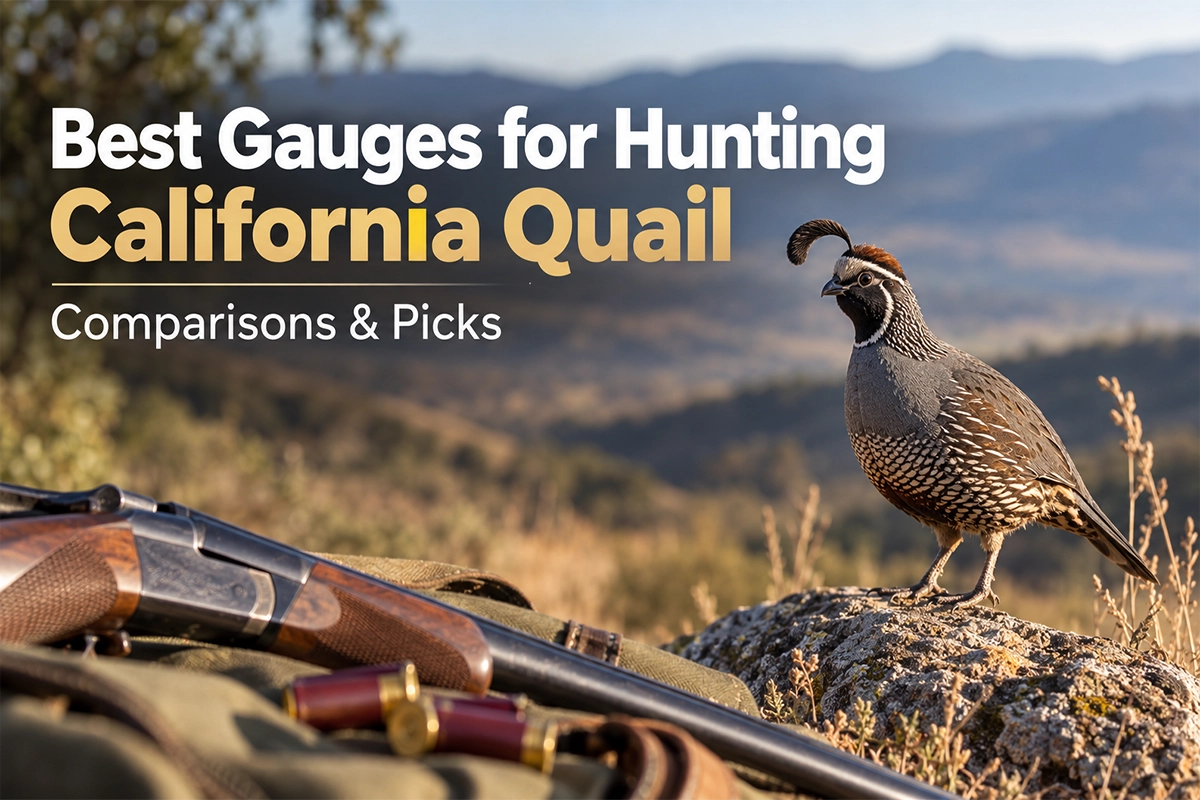
Compare 12 gauge, 20 gauge, 28 gauge, and .410 bore options for California quail hunting.
Choosing among California quail hunting gauges comes down to balancing fast handling, manageable recoil, effective patterns, ammunition availability, and the terrain you expect to cover. California quail frequently demand quick shots at flushing birds in brush, chaparral, oak country, foothills, and desert-edge habitat, so a shotgun that mounts naturally and patterns dependable nonlead ammunition is generally more useful than simply choosing the largest option. The 20 gauge is an especially versatile starting point, while 12 gauge offers greater load flexibility, 28 gauge provides a lightweight and soft-shooting alternative, and .410 bore rewards hunters who carefully manage shot distance.
Where/When: California quail commonly occur across a broad range of California landscapes, including coastal foothills, chaparral, oak woodland, brushy canyons, agricultural edges, desert washes, and other areas combining food, water, escape cover, and travel corridors. Coveys often concentrate near seed-producing vegetation, brushy loafing or roosting cover, springs and seeps, creek bottoms, field margins, and transitions between feeding and protective cover. Early in the season, birds may remain in larger coveys and may be easier to locate near dependable water, while later-season hunting often involves more educated birds that flush farther or use thicker cover. Morning and late-afternoon movement can be productive, and cooler, damp, or calm weather may make walking and scenting conditions better than hot, dry periods. California’s 2026–2027 quail seasons vary by zone: all-quail general seasons begin September 26 in Zone Q2 and October 17 in Zones Q1 and Q3, with January 31 closing dates; hunters should confirm the zone map, shooting hours, access restrictions, and current regulations before every trip because timing and legal requirements vary by region.
Gauge Comparisons
| Feature | 12 Gauge | 20 Gauge | 28 Gauge | .410 Bore |
|---|---|---|---|---|
| Recoil How much kick you can expect when firing. |
Moderate to stout depending on gun weight and load | Mild to moderate | Generally mild | Generally very mild in suitable loads |
| Practical Quail Range Distance should always be limited by your tested pattern and ability. |
Strong flexibility at common upland distances | Excellent for common quail distances | Very capable within a well-tested pattern | Best kept conservative because of limited pellet payload |
| Typical Shot Payloads Common payload ranges vary by shell length, manufacturer, and shot material. |
Often about 1 to 1 1/4 oz for upland-style loads | Often about 7/8 to 1 oz | Often about 3/4 oz | Often about 1/2 to 11/16 oz |
| Versatility How well the shotgun option works for other hunting applications. |
Excellent; broadest overall load flexibility | Excellent for many upland and small-game uses | Very good for upland birds where light weight is valued | More specialized and pattern-dependent |
| Ammo Availability How easy it is to find suitable hunting ammunition. |
Generally excellent | Generally very good | More limited than 12 or 20 gauge | Available, but nonlead hunting choices may be more limited |
12 Gauge
The 12 gauge solves the problem of hunters wanting maximum ammunition choice and a forgiving pellet payload without buying a quail-specific shotgun. It is particularly useful when shots may vary from close brush flushes to more open-country opportunities. For California quail, lighter upland loads can keep recoil and unnecessary pellet density under control while preserving the 12 gauge’s flexibility. Choose a shotgun that fits properly and is light enough to carry comfortably; a heavy waterfowl-style gun can become tiring during miles of uphill walking.
PROS
- Broad selection of shotguns and hunting loads
- Generous pellet payload can produce forgiving patterns
- Highly versatile for quail and other game birds
CONS
- Can produce more recoil than smaller gauges
- Some 12-gauge field guns are heavier than ideal for long walks
- Heavy loads are usually unnecessary for small quail
Interesting Fact: A 12 gauge does not have to mean a heavy-recoiling quail setup; gun weight, stock fit, shell velocity, and payload all influence felt recoil.
Consider this Gauge If…
Choose 12 gauge if you already own a well-fitting field shotgun, want readily available ammunition, or hunt several bird species with one gun. Pattern prospective nonlead loads at realistic distances and use an appropriate choke rather than assuming a particular load will perform well. California requires nonlead ammunition when taking wildlife with a firearm, so confirm that your selected hunting shells comply with current requirements.
20 Gauge
For many hunters, 20 gauge offers the best overall balance for California quail. It solves the common tradeoff between carrying a light, fast-handling shotgun and retaining enough payload for dependable patterns at normal upland distances. A trim 20-gauge over-under, side-by-side, pump, or semiautomatic can be especially comfortable when climbing ridges or working brush for several hours. Look for reliable function with the nonlead loads you intend to hunt with, proper stock dimensions, and a total gun weight you can mount smoothly rather than merely choosing the lightest firearm available.
PROS
- Excellent compromise between payload, recoil, and gun weight
- Fast-handling shotguns are widely available
- Suitable for both new and experienced upland hunters
CONS
- Usually offers fewer load choices than 12 gauge
- Extremely lightweight guns can still feel sharp with faster loads
- Patterns must be tested with the exact nonlead shell and choke combination
Interesting Fact: The manageable size of many 20-gauge shotguns can make them particularly comfortable in steep, brushy quail country where quick mounting matters.
Consider this Gauge If…
The 20 gauge is a strong choice if your priority is a versatile upland shotgun with moderate recoil and enough pattern density for typical quail shots. It also makes sense for hunters who expect substantial walking and want less firearm weight without moving to a more specialized small-bore setup. Select shells based on tested pattern quality, approved shot material, chamber length, and compatibility with your shotgun and choke.
28 Gauge
The 28 gauge appeals to hunters who want a lively upland gun with mild recoil and enough capability for quail when shots are disciplined. It matters most when long days of walking make gun weight and handling a priority. Because its typical payload is smaller than 12 or 20 gauge, pattern quality becomes particularly important. Before hunting, test the exact nonlead load through the choke you plan to use and determine the distance where pellet distribution remains consistently adequate.
PROS
- Light and responsive in many upland shotgun designs
- Generally mild recoil
- Well suited to close and moderate quail opportunities with good patterns
CONS
- Ammunition selection is generally narrower than 12 or 20 gauge
- Nonlead loads may be harder to find locally
- Less pellet payload leaves less margin for poor shooting or marginal patterns
Interesting Fact: Many dedicated upland hunters favor 28 gauge not because quail require it, but because well-balanced 28-gauge shotguns can be exceptionally pleasant to carry and swing.
Consider this Gauge If…
Consider 28 gauge if you value low recoil, responsive handling, and a lightweight upland package and are willing to plan ammunition purchases in advance. Confirm that suitable nonlead ammunition patterns effectively in your gun before committing to it for the season.
.410 Bore
The .410 bore is the most specialized option here. Its advantage is light recoil and compact firearm dimensions, but its smaller pellet payload gives hunters less margin for error than the larger gauges. It therefore solves a different problem: providing an efficient small-bore challenge for disciplined shooters rather than making difficult quail shots easier. Choose it only after patterning suitable nonlead shells and establishing a conservative personal range where your gun consistently delivers adequate pellet distribution.
PROS
- Very light recoil with many loads
- Compact, lightweight shotguns are available
- Effective on quail when pattern quality and distance are carefully managed
CONS
- Small payload provides less room for aiming or range-estimation errors
- Requires conservative shot selection
- Suitable nonlead hunting ammunition can be less widely available
Interesting Fact: Unlike 12, 20, and 28 gauge, .410 is correctly described as a bore rather than a gauge.
Consider this Bore Option If…
Choose .410 bore if you are an experienced, controlled wingshooter hunting situations that normally produce close opportunities. It should not be selected simply because a new or recoil-sensitive hunter is small; a well-fitting 20 or 28 gauge may provide more forgiving pattern density. Whatever option you use, positively identify the bird before firing, keep the muzzle controlled around partners and dogs, know what lies beyond the target, and take shots only within the effective range established through pattern testing.
Which Shotgun Option Is Best for California Quail?
For most California quail hunters, 20 gauge is an excellent all-around choice because it combines practical payload capacity, moderate recoil, widespread shotgun availability, and comfortable field weight. The 12 gauge is equally effective for hunters who prefer maximum ammunition flexibility or already own a suitable upland gun. A 28 gauge is attractive for shooters prioritizing low recoil and lively handling, while .410 bore is best treated as a more demanding, short-range option. Whatever you choose, firearm fit and pattern performance matter more than the marking on the barrel. Pattern your shotgun with the exact legal hunting load and choke you will carry, establish a realistic maximum range, and use ethical shot selection rather than stretching marginal opportunities. California requires nonlead ammunition when wildlife is taken with a firearm, and current CDFW information lists a hunting license plus an upland game bird validation for upland bird hunters unless the hunter is operating under a Junior Hunting License. The 2026–2027 quail daily bag limit is 10 with a possession limit of three times the daily bag, but zones, seasons, shooting hours, land-access rules, and other requirements can change. Always consult current CDFW regulations for the specific area and date you intend to hunt.