
Best Calibers for Hunting Striped Skunk: Comparisons & Picks
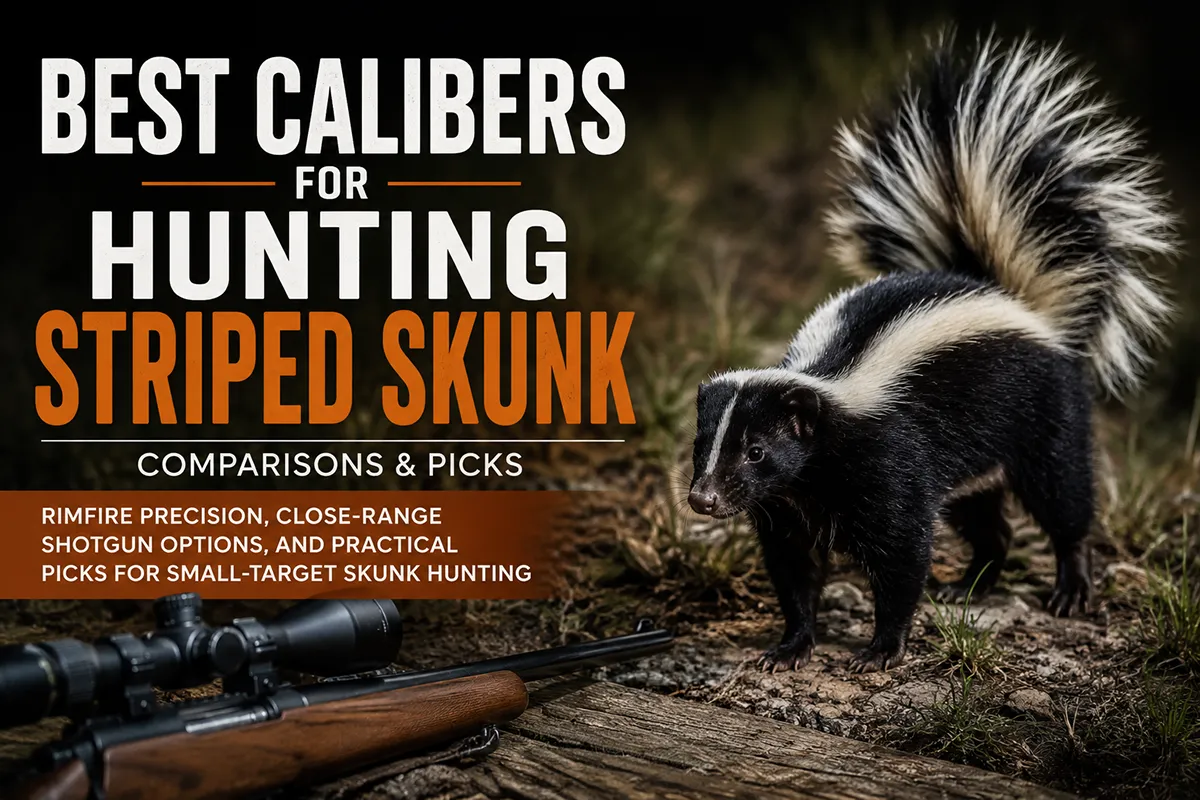
Rimfire precision, close-range shotgun options, and practical picks for small-target skunk hunting.
Choosing striped skunk hunting calibers is less about raw power and more about control. Skunks are small, close-range animals, and many encounters happen around field edges, farm lanes, creek bottoms, brush piles, barns, and poultry areas. The right option should make a precise, ethical shot while limiting pelt damage, ricochet risk, excessive noise, and unnecessary destruction. Rimfire rifles are often practical when safe backstops are available, while shotguns can be useful in thicker cover. Always confirm seasons, licensing, night-hunting rules, suppressor rules, magazine limits, discharge ordinances, and whether non-toxic shot is required in your area.
Where/When: Striped skunks are common across much of the United States and southern Canada, often using grasslands, mixed farmland, suburban edges, creek corridors, shelterbelts, and broken timber where food, den sites, and cover overlap. Hunters commonly look for tracks, digging, den holes, travel routes along fence lines, and patterns near water, feed sources, bedding cover, and old outbuildings. In many areas, activity is typically highest from dusk through night, with movement influenced by weather, breeding activity, food availability, and pressure. Cooler early-season evenings, mild winter breaks, and spring dispersal can all change patterns, but legal timing varies by region and regulations.
Caliber Comparisons
| Feature | .22 LR | .22 WMR | .17 HMR | .410 bore | 12 gauge |
|---|---|---|---|---|---|
|
Recoil How much kick you can expect when firing. |
Very low | Low | Very low | Low to mild | Moderate, depending on load |
|
Effective Range The distance at which the caliber remains accurate and lethal. |
Typically 10-50 yards | Typically 20-90 yards | Typically 30-120 yards | Usually inside 25 yards | Usually inside 35 yards with small shot |
|
Bullet Weight Range The range of bullet weights typically available for the caliber. |
Commonly 36-40 grains | Commonly 30-50 grains | Commonly 15.5-20 grains | Commonly small shot or light slugs | Commonly small game shot loads |
|
Versatility How well the caliber or gauge performs for other game species besides your primary target. |
Excellent for small game and close pests | Good for varmints and tougher small game | Excellent for small varmints in open terrain | Good for close pests and small game | Very versatile with legal, appropriate loads |
|
Ammo Availability How easy it is to find ammunition for the caliber. |
Usually excellent | Usually good | Usually good | Fair to good | Usually excellent |
.22 LR
The .22 LR is often the best starting point for striped skunk hunting when shots are close and the backstop is certain. It solves the main problem: enough accuracy for a small vital zone without excessive blast, recoil, or hide damage. A reliable rimfire with a clear low-power scope or red dot can work well. Choose accurate loads that group well in your rifle, and avoid hard ground, rocks, metal, or water where ricochets are possible.
PROS
- Very low recoil helps newer hunters place careful shots.
- Usually affordable and easy to find in many load types.
- Limits pelt damage compared with faster varmint cartridges.
CONS
- Requires close range and precise shot placement.
- Not ideal in wind or across open ground.
- Ricochet risk still demands a safe backstop.
Interesting Fact: The .22 LR remains popular for small-game hunters because mild report and low recoil make it easier to practice often.
Consider this Caliber If…
Choose .22 LR if you hunt close cover, want a budget-friendly setup, and can pass on shots without a clean background. It is especially useful for hunters who value simple rifles and minimal pelt damage.
.22 WMR
The .22 WMR, often called .22 Magnum, gives skunk hunters more reach and authority than .22 LR while staying manageable. It matters when shots stretch across hay fields, pasture lanes, or open creek bottoms. The extra velocity can improve terminal performance, but it can also increase noise and hide damage, especially with explosive varmint bullets. Favor controlled, accurate loads over the fastest option, sight in carefully, and keep shot angles conservative.
PROS
- More range and energy than .22 LR.
- Low recoil with practical accuracy in lightweight rifles.
- Good for mixed small varmints where legal.
CONS
- More expensive than .22 LR in many areas.
- Can damage hides with aggressive varmint loads.
- Still needs disciplined backstop awareness.
Interesting Fact: .22 WMR fills the gap between quiet close-range rimfire work and faster centerfire varmint cartridges.
Consider this Caliber If…
Pick .22 WMR if you commonly see skunks beyond .22 LR distance but do not want the blast or hide damage of a centerfire. It fits open farms, ranch roads, and calling setups with safe backstops.
.17 HMR
The .17 HMR is a flat-shooting rimfire for hunters who value precision on small targets. It solves the problem of aiming at a skunk-sized vital area in open country where range estimation and wind calls start to matter. Its light bullets can be accurate, but they are also wind-sensitive and may be hard on hides at close distances. Use a quality scope, confirm zero in the conditions you hunt, and avoid marginal quartering shots.
PROS
- Flat trajectory helps with precise shots on small targets.
- Very low recoil makes impacts easier to spot.
- Useful for other small varmint hunting in open terrain.
CONS
- Light bullets drift noticeably in wind.
- Can be more destructive than needed at close range.
- Ammo may cost more than basic .22 LR loads.
Interesting Fact: The .17 HMR became popular with varmint hunters because it offers a flatter rimfire trajectory than traditional .22 rimfire rounds.
Consider this Caliber If…
Choose .17 HMR if your skunk hunting happens in open ground and you want a precise rimfire that rewards careful shooting. It is less ideal in thick brush, strong wind, or pelt-focused hunting.
.410 bore
The .410 bore is not a gauge, but it can be practical for very close striped skunk hunting in tight cover where legal discharge and safe angles allow. It solves the problem of hitting a small, moving target at close distance without the heavier recoil of larger shotguns. Choose small-game shot loads that pattern well in your shotgun, and test them on paper before hunting. The .410 bore has a small payload, so keep ranges short and avoid shooting toward buildings, livestock, roads, or hard surfaces.
PROS
- Low recoil in compact, easy-carry shotguns.
- Useful for very close shots in thick cover.
- Can reduce overkill compared with larger shotgun loads.
CONS
- Small shot payload leaves little room for poor aim.
- Limited effective range compared with rifles.
- Ammo selection can be narrower than 12 gauge or .22 LR.
Interesting Fact: The .410 bore is named for its bore diameter rather than a traditional shotgun gauge measurement.
Consider this Caliber If…
Pick .410 bore if your shots are close, your pattern is proven, and you want a light shotgun that is easy to handle around thick cover. Do not use it to stretch distance.
12 gauge
The 12 gauge is the most versatile shotgun option for striped skunk hunting, but it should be used with restraint. It solves close-range problems in cover, especially when a rifle shot is unsafe because the animal is moving. A 12 gauge with heavy loads can be loud, destructive, and excessive for a small animal. Choose appropriate small-game loads, pattern your gun, and keep shots close enough for clean penetration without unnecessary hide damage. In wetlands or some regulated areas, non-toxic shot may be required.
PROS
- Excellent ammo availability and load variety.
- Forgiving pattern at close range when properly matched to the shot.
- Useful for hunters who already own one shotgun for multiple species.
CONS
- More recoil and noise than rimfire options.
- Can cause excessive pelt damage with poor load choice.
- May be restricted by local discharge or non-toxic shot rules.
Interesting Fact: The strength of the 12 gauge is flexibility; the same shotgun can serve many hunting roles when paired with the right legal load.
Consider this Caliber If…
Choose 12 gauge if you need a close-cover tool and already understand how your shotgun patterns with small-game loads. It is best for fast handling in brush, not long-range precision.
Final Pick for Striped Skunk Hunting
For most hunters, .22 LR is the practical baseline for striped skunk hunting calibers because it is accurate, mild, affordable, and adequate at close range with careful shot placement. Step up to .22 WMR when you need more reach, or choose .17 HMR when open-country precision matters more than pelt preservation. The .410 bore and 12 gauge are close-range tools for cover, not excuses to rush shots. Whatever you choose, handle firearms safely, know what lies beyond the target, avoid unnecessary contact with sick-acting animals, and make ethical decisions before the shot. Regulations can vary widely for hunting, lights, suppressors, non-toxic shot, and season dates, so check local laws before hunting.