
Best Calibers for Hunting Springbok: Comparisons & Picks
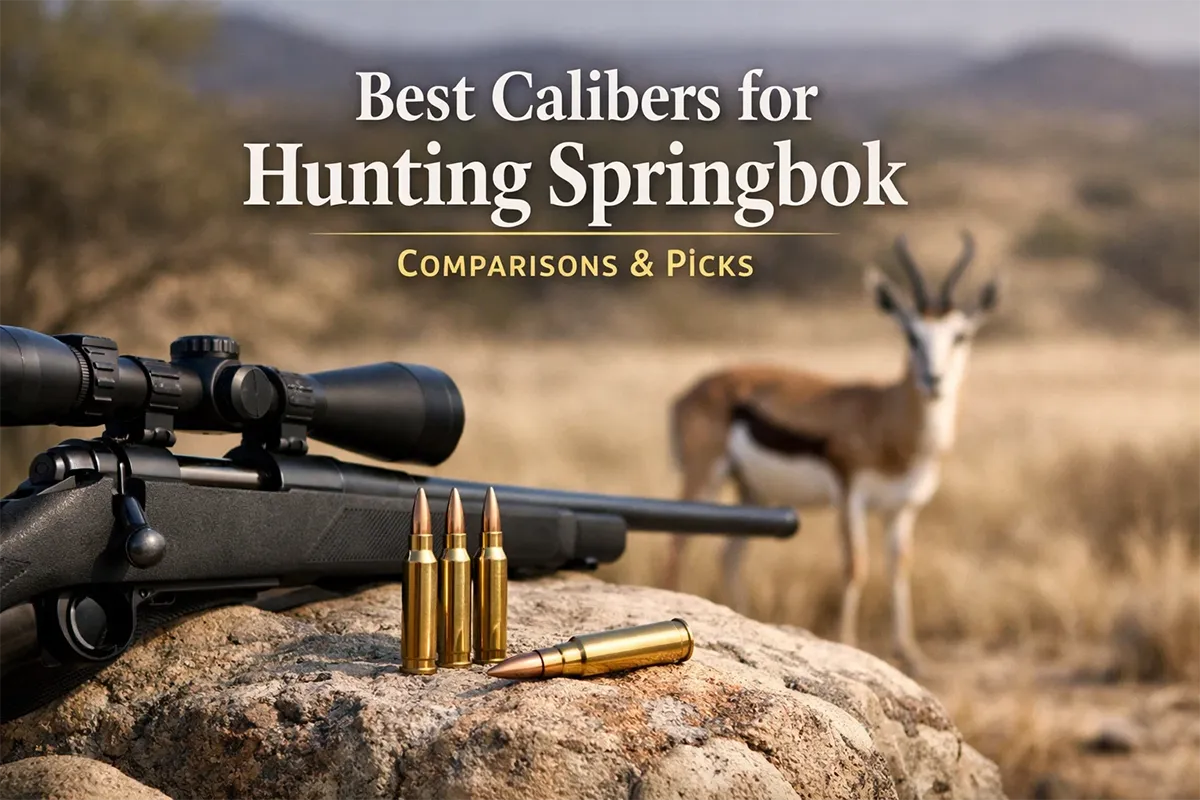
Flat-shooting favorites for windy plains, smart bullet choices, and ethical shot placement on Africa’s most classic open-country antelope.
Springbok hunting is usually an open-country game: bright light, steady wind, and shots that can stretch farther than many first-timers expect. The good news is springbok aren’t especially tough compared to larger plains game, so you don’t need a “big” cartridge to be effective. What you do need is a caliber that helps you place a bullet precisely (often in wind), carries enough energy for clean penetration, and matches your recoil tolerance so you can shoot well from field positions.
In many areas, typical springbok shot distances fall in the 150–300 yard range, with longer opportunities possible in wide, flat terrain. That makes trajectory and wind drift meaningful, especially if you’re not shooting off a rock-solid rest every time. You’ll also want a controlled-expansion hunting bullet that holds together at close range but still opens reliably farther out. As a rule: avoid fragile varmint bullets, prioritize bonded or tougher cup-and-core designs, and pick a bullet weight that stabilizes well in your rifle’s twist rate.
A quick ethics reminder: safe gun handling, knowing your backstop, and disciplined shot selection matter even more in open country where other hunters, trackers, or livestock may be present. Aim for the heart-lung area, pass on hard quartering shots if you’re unsure, and practice from realistic positions (prone over a pack, sticks, kneeling) before the hunt. Regulations vary by country and province/state—some places have minimum caliber/energy rules and restrictions on suppressors, magazine capacity, or certain bullet types—so confirm local requirements before you travel and before you buy ammo.
Below are five proven springbok-friendly rifle calibers. They’re all capable with the right bullet and good shot placement; the “best” choice comes down to your expected distance, wind conditions, rifle availability, and how comfortably you shoot under pressure.
Caliber Comparisons
| Feature | .243 Win | .25-06 Rem | 6.5 Creedmoor | .270 Win | .308 Win |
|---|---|---|---|---|---|
| Recoil How much kick you can expect when firing. |
Low (easy to shoot well) | Low–Moderate | Low–Moderate | Moderate | Moderate (often a bit more than .270 in similar rifles) |
| Effective Range The distance at which the caliber remains accurate and lethal. |
0–300+ yd (best with sturdy bullets) | 0–400+ yd (excellent in wind) | 0–400+ yd (very consistent) | 0–450+ yd (classic open-country reach) | 0–350+ yd (great all-around; drops more at distance) |
| Bullet Weight Range The range of bullet weights typically available for the caliber. |
80–105 gr | 85–120 gr | 120–147 gr | 110–150 gr | 150–180 gr |
| Versatility How well the caliber or gauge performs for other game species besides your primary target. |
Great for small/medium game; limited for larger species in some regs | Excellent for antelope/deer-sized game | Excellent for deer-sized; capable for bigger with proper bullets where legal | Excellent for deer-sized and many plains-game situations | Very versatile; widely used for many big-game hunts |
| Ammo Availability How easy it is to find ammunition for the caliber. |
Common | Moderate (varies by region) | Very common | Very common | Very common |
.243 Winchester
The .243 Win is a springbok classic when you value low recoil and precise shot placement. It shines for hunters who want minimal kick (and maximum confidence) while still carrying enough performance for clean heart-lung kills with the right bullet. Think of it as the “shoot it well” option: if you can place a tough 90–105 grain hunting bullet into the vitals, springbok typically don’t go far.
PROS
- Low recoil helps most hunters shoot tighter groups from field positions
- Flat enough for common springbok distances with simple holdovers
- Plenty of accurate factory loads and bullet choices
- Great option for youth/smaller-framed shooters or anyone recoil-sensitive
CONS
- Bullet selection matters—avoid thin-jacketed varmint bullets
- Less forgiving on steep quartering shots than larger calibers
- Wind drift can be more noticeable with lighter bullets
Interesting Fact: The .243 Winchester has been a staple dual-purpose cartridge for decades because it bridges varmints and deer-sized game with the right bullet.
Consider this Caliber If…
Choose .243 Win if you expect most shots inside ~300 yards, you want the easiest recoil for fast, confident shooting, or you’re bringing a newer hunter on their first plains-game trip. For springbok, a controlled-expansion 90–105 grain hunting bullet is a common sweet spot. If your hunt is likely to include frequent wind and longer shots, consider stepping up to a higher-BC option (like 6.5 Creedmoor) or a faster 25-caliber.
Always confirm local minimum caliber/energy rules, and keep ethics front and center: wait for a broadside or slightly quartering-away angle and place the shot through the heart-lung zone.
.25-06 Remington
If your mental picture of springbok hunting includes long walks, steady wind, and shots that can stretch, the .25-06 Rem is hard to ignore. It’s a fast, flat-shooting caliber that commonly delivers excellent trajectory and strong downrange performance on deer-sized game. For springbok, it offers a very practical balance: mild-to-moderate recoil, speed for flatter holds, and enough bullet weight to handle less-than-perfect angles when you choose them carefully.
PROS
- Very flat trajectory—helpful when distances vary and time is short
- Great wind performance with sleek 115–120 gr bullets
- Effective on a wide range of deer-sized and similar plains game
- Recoil is typically manageable in standard-weight rifles
CONS
- Factory ammo availability can be less consistent than the biggest “mainstream” calibers
- High velocity can be tough on overly soft bullets at close range
- Some rifles are longer-barreled; shorter barrels may give up speed
Interesting Fact: The .25-06 began as a popular wildcat before being standardized, earning a reputation as a true open-country performer.
Consider this Caliber If…
Pick .25-06 Rem if your hunt is likely to feature longer shots (or strong wind) and you want a flatter point-blank range without jumping to a higher-recoil magnum. For springbok, many hunters lean toward 100–120 grain controlled-expansion bullets—especially tougher options if close shots are possible. Zero thoughtfully, confirm your dope at realistic distances, and practice quick wind calls. As always, follow local regs and prioritize safe backstops; on open flats, it’s easy to see far, but bullets also travel far.
6.5 Creedmoor
The 6.5 Creedmoor is a modern “make it easy” choice for springbok: consistent accuracy, moderate recoil, and excellent wind behavior with high-BC bullets. In practical terms, it helps you put a well-constructed 120–143 grain hunting bullet exactly where it needs to go, even when the breeze picks up. That’s a big deal on springbok, where small target zones and alert animals often mean you get one clean opportunity.
PROS
- Strong wind resistance for its recoil level
- Excellent accuracy potential with many factory loads
- Wide selection of hunting bullets designed for controlled expansion
- Comfortable recoil supports better follow-through and spotting impacts
CONS
- Not as flat as the fastest options if you’re trying to minimize holdover
- Performance depends on bullet construction—match bullets aren’t hunting bullets
- Some regions restrict certain bullet types; always verify legal requirements
Interesting Fact: The 6.5 Creedmoor was designed around efficiency and accuracy, which is why it often performs so consistently across different rifles.
Consider this Caliber If…
Choose 6.5 Creedmoor if you want one of the easiest paths to confident wind calls and precise shot placement out to ~400 yards. It’s especially useful if you’ll be shooting off sticks or a pack and want a cartridge that doesn’t punish you in practice. For springbok, controlled-expansion bullets in the 120–143 grain range are common; pick a load that groups well in your rifle, then confirm point of impact at multiple distances. Ethical note: if the wind is switching hard and you can’t call it, wait—springbok are better taken with patience than with hope.
.270 Winchester
The .270 Win is an all-time open-country standard: fast enough to shoot flat, heavy enough to hit with authority, and common enough that you can usually find ammo and rifles without hassle. For springbok, it offers a forgiving blend of reach and terminal performance, especially if your trip might include slightly larger plains game where a bit more bullet weight and energy are welcome (subject to local regulations and your outfitter’s guidance).
PROS
- Flat trajectory with 130–150 gr hunting bullets
- Excellent “do-it-all” caliber for many open-country hunts
- Wide availability of rifles, ammo, and proven hunting loads
- Good balance of wind performance and downrange energy
CONS
- Recoil is moderate—some shooters do better with softer-kicking rounds
- Overpowered for springbok if you choose overly tough/heavy bullets and don’t place shots well
- As distance grows, wind reading still matters; no caliber “solves” wind by itself
Interesting Fact: Introduced in the 1920s, the .270 Winchester became famous for making long shots more practical for everyday hunters.
Consider this Caliber If…
Go with .270 Win if you want a classic, widely supported caliber that handles springbok confidently and leaves room for mixed-bag plains game. For springbok alone, many hunters like 130–140 grain controlled-expansion bullets that open reliably without being overly fragile. Confirm your zero, learn your drops, and practice steady shooting off sticks—common on African hunts. Safety and ethics still rule the day: identify your target clearly, keep muzzle discipline around vehicles and trackers, and only take shots you can place into the heart-lung area.
.308 Winchester
The .308 Win is the practical workhorse: widely available, easy to load for, and effective with a huge range of hunting bullets. For springbok, it’s not the flattest option, but it’s extremely dependable—especially if your hunt is more “stalk and shoot inside reasonable distance” than “stretch it to the horizon.” With good glass and a solid rest, the .308 still performs very well; you just need to respect trajectory and wind drift a bit more at longer distances.
PROS
- Excellent ammo availability and broad bullet selection
- Strong terminal performance with common 150–165 gr hunting loads
- Often very accurate and consistent across many rifle platforms
- Great “one rifle” option if you also hunt larger game elsewhere
CONS
- More drop at distance than flatter calibers—know your holds
- Wind drift can be noticeable compared to high-BC 6.5mm options
- Recoil is moderate; some shooters may prefer lighter-kicking rounds for high-volume practice
Interesting Fact: The .308 Winchester’s popularity helped make it one of the most widely supported hunting and target cartridges in the world.
Consider this Caliber If…
Choose .308 Win if you want maximum availability and proven performance, and you expect most springbok shots to be inside ~300–350 yards. A 150–165 grain controlled-expansion hunting bullet is a common, effective setup; avoid overly tough bullets intended for much larger game if your goal is quick expansion on smaller antelope. Put extra attention into your range confirmation and wind practice, because the .308 rewards disciplined ballistic knowledge. As always, local rules vary—check minimum caliber requirements and any bullet restrictions—and keep ethics paramount: broadside vitals, stable position, and a clear backstop.
Final Picks for Springbok Hunters
If you want the simplest path to confident shooting, start with what you already shoot best—then match it to springbok realities: open terrain, wind, and the need for precise placement. For many hunters, the 6.5 Creedmoor is a standout because it makes wind and accuracy feel more manageable without heavy recoil. The .25-06 Rem is an outstanding “windy plains” specialist if you can source the ammo you like. The .270 Win remains a timeless choice when you want reach and versatility, while the .308 Win is the dependable workhorse if you’re keeping distances reasonable and valuing availability. And if recoil sensitivity (or new-hunter confidence) is a major factor, the .243 Win can be excellent—provided you choose a proper hunting bullet and wait for ethical angles.
Whatever you pick, confirm your zero, verify your trajectory at realistic distances, and practice from the positions you’ll actually use (sticks, prone over a pack, kneeling). Handle firearms safely at all times, identify your target and backstop, and prioritize ethical heart-lung shots over marginal angles. Finally, regulations can differ dramatically—minimum calibers, magazine limits, and allowed bullets—so check the rules for your specific hunt location before you go.