
Best Calibers for Hunting Richardson’s Ground Squirrel: Comparisons & Picks
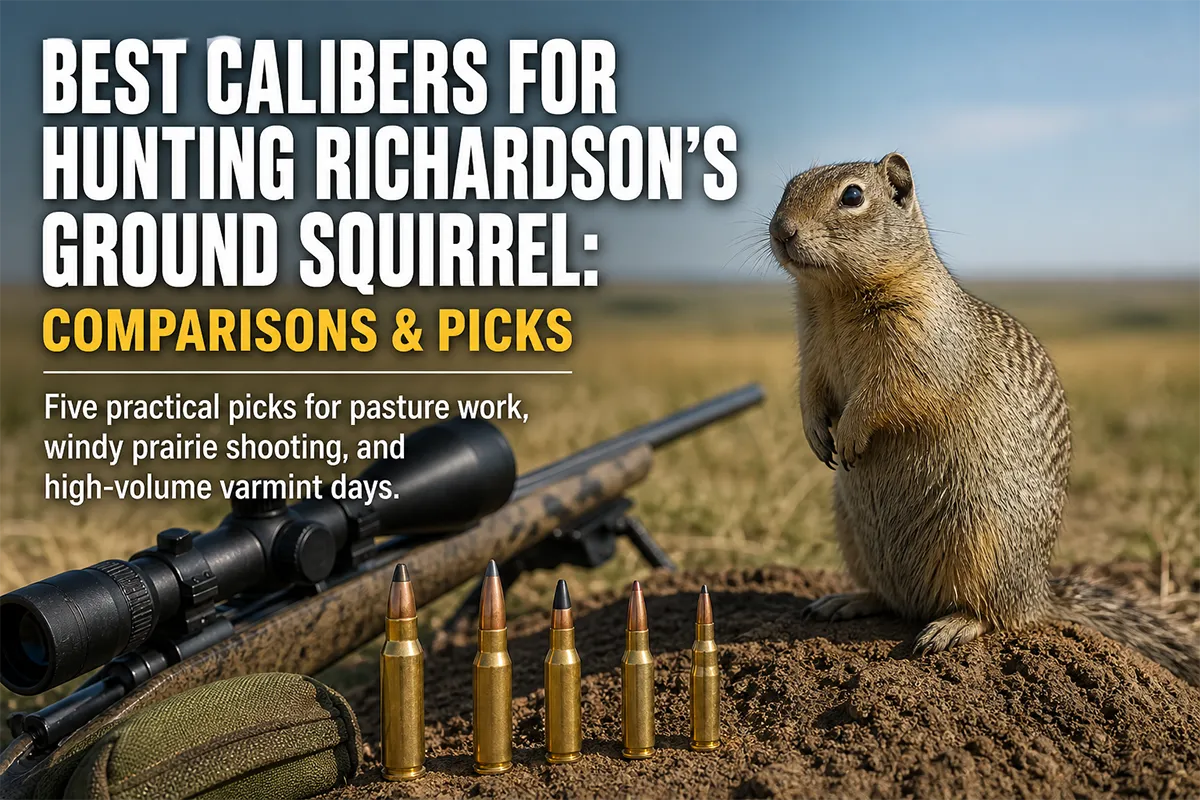
Five practical picks for pasture work, windy prairie shooting, and high-volume varmint days.
Finding the right Richardson’s ground squirrel hunting calibers is about matching distance, wind, noise, and ammo cost to the shooting you actually do. These squirrels are tiny targets in open country, so flat trajectory and precise shot placement matter more than raw power. Rimfires shine when ranges are moderate, while centerfires make more sense when prairie wind starts moving bullets or colonies are farther out. Use a solid rest and take only clean shots. Regulations vary by state, province, and property, so check local rules on seasons, access, firearm use, and lead-free or non-toxic requirements where applicable.
Where/When: Richardson’s ground squirrels are native to the northern Great Plains and Canadian Prairies, including parts of Montana, the Dakotas, Alberta, Saskatchewan, and Manitoba, and they favor short-grass prairie, pasture, alfalfa fields, and other open ground with dry burrow sites. Hunters commonly find active colonies by glassing fresh diggings, clipped vegetation, and busy burrow entrances near feeding areas. In many places, action starts in spring soon after emergence from hibernation; adults may appear as early as late February or March, and young often show up later in spring. Morning and late afternoon are commonly the best windows, while heat, wind, and repeated pressure can send squirrels underground fast. Timing varies by region and regulations.
Caliber Comparisons
| Feature | .17 HMR | .22 LR | .22 WMR | .204 Ruger | .223 Remington |
|---|---|---|---|---|---|
| Recoil How much kick you can expect when firing. | Very low | Very low | Low | Low to moderate | Low to moderate |
| Effective Range The distance at which the caliber remains accurate and lethal. | 50–150 yards | 25–75 yards | 40–125 yards | 100–300+ yards | 75–250+ yards |
| Bullet Weight Range The range of bullet weights typically available for the caliber. | 15.5–20 grain | 30–40 grain | 30–50 grain | 24–40 grain | 35–77 grain |
| Versatility How well the caliber or gauge performs for other game species besides your primary target. | Excellent small-varmint rimfire | Best for close-range practice and small game | Good crossover rimfire | Purpose-built for open-country varmints | Very versatile varmint and predator caliber |
| Ammo Availability How easy it is to find ammunition for the caliber. | Very good | Excellent | Very good | Good | Excellent |
.17 HMR
For many hunters, .17 HMR is the best all-around choice because it solves the biggest Richardson’s ground squirrel problem: precise hits past .22 LR distance without jumping to a louder, pricier centerfire. It matters most when shots cluster between about 60 and 150 yards in open pasture. Choose lighter bullets for calm weather and 20-grain loads when crosswinds start nudging tiny bullets around.
PROS
- Flat enough for simple holds at practical rimfire distances
- Minimal recoil helps you watch impacts through the scope
- Usually quieter and cheaper to feed than centerfires
CONS
- Wind drifts it more than fast centerfires
- Ammo costs more than .22 LR
- Performance falls off once shots stretch well past normal rimfire ranges
Interesting Fact: Many varmint hunters view .17 HMR as the cartridge that turned rimfire prairie shooting into a true precision game.
Consider this Caliber If…
Pick .17 HMR if you want the cleanest balance of reach, recoil, and cost. It is especially strong from a bolt-action rifle with decent glass and a steady rest. Ethically, it rewards careful shot placement instead of trying to overpower a tiny target.
.22 LR
.22 LR is the budget pick and the best answer for close, controlled shooting where most opportunities are inside about 75 yards. What it solves is volume: you can practice more and shoot more for less money. That matters when you are teaching new shooters, confirming holds, or working small colonies where long range is not required. Accuracy in your rifle matters more than hype.
PROS
- Lowest ammo cost of the group
- Extremely light recoil and mild report
- Easy way to build field marksmanship without flinching
CONS
- Trajectory drops fast past moderate range
- Wind affects it heavily in open prairie
- Requires more exact range judgment than the flatter options
Interesting Fact: Cheap .22 LR practice often improves field hit rates more than buying a faster cartridge and shooting it half as often.
Consider this Caliber If…
Choose .22 LR when your shots are short, your budget matters, or you want the least intimidating option for newer hunters. A good bolt gun, a load your rifle likes, and the discipline to pass on long shots are what make it ethical.
.22 WMR
.22 WMR fills the gap between .22 LR and .17 HMR. It solves the common problem of wanting a rimfire with more reach and more punch than .22 LR while still keeping recoil soft. It matters when wind is moderate, angles are not perfect, or you prefer a little more bullet weight. If you hunt mixed small game and varmints, .22 WMR can be the most practical one-rimfire compromise.
PROS
- Noticeably more authority than .22 LR
- Still easy to shoot well
- Useful crossover option for multiple small-game roles
CONS
- Usually not as flat as .17 HMR
- Ammo is pricier than .22 LR
- Does not match centerfires once distances get long
Interesting Fact: .22 WMR stays popular because it offers more margin on tough little pests without forcing a move to centerfire rifles.
Consider this Caliber If…
Go with .22 WMR if you hunt in breezier conditions, want a heavier bullet than .17 HMR, or prefer a rimfire that feels a bit less delicate. Look for reliable feeding and loads your rifle groups well.
.204 Ruger
When the prairie opens up and colonies are living well past rimfire distance, .204 Ruger becomes a specialist tool. What it solves is reach with very light recoil for a centerfire, making it easier to hold on target and still spot many impacts. This matters on windy days and in big alfalfa or grass country where 150- to 300-yard chances are common. It makes the most sense from a stable rest with a heavier varmint rifle.
PROS
- Very flat trajectory for longer shots
- Low enough recoil for good sight picture in many rifles
- Excellent fit for open-country varmint shooting
CONS
- Louder and more expensive than rimfires
- Overkill for short-range, high-volume close work
- Ammo selection can be narrower than .223 Remington
Interesting Fact: .204 Ruger earned its reputation by giving varmint hunters “laser beam” trajectory without the recoil of bigger centerfires.
Consider this Caliber If…
Choose .204 Ruger if you regularly face long shots and crosswinds and you do not mind centerfire cost or blast. Use quality hearing protection, pay close attention to backstops, and avoid casual shots just because the cartridge is fast.
.223 Remington
.223 Remington is the most versatile centerfire on this list. It solves the problem of wanting one rifle that can handle Richardson’s ground squirrels, general varmint work, and even predator duty with the right bullet choice. That matters for hunters who do not want a dedicated niche rifle. Lighter varmint bullets keep recoil mild, and the huge variety of rifles and loads makes it easy to tune the setup to your budget.
PROS
- Excellent ammo availability and rifle choices
- More wind resistance and range than rimfires
- Flexible enough for broader varmint and predator use
CONS
- More blast than .17 HMR, .22 LR, or .22 WMR
- Can be unnecessary for close, high-volume squirrel shooting
- Rifle and ammo costs often run higher than rimfire setups
Interesting Fact: .223 Remington remains the default varmint caliber for many shooters because it is widely available and useful in far more roles than tiny-pest work alone.
Consider this Caliber If…
Pick .223 Remington if you want one do-it-most rifle, expect more wind than a rimfire likes, or already own a good .223. For Richardson’s ground squirrels, lighter varmint-style bullets usually make the most sense. Follow local rules on magazine limits and where shooting is allowed.
Final Picks for Prairie Precision
If you want one simple answer, start with .17 HMR: it is usually the best blend of precision, reach, low recoil, and practical cost for Richardson’s ground squirrel hunting. Choose .22 LR when budget and short-range shooting matter most, .22 WMR for more rimfire authority, .204 Ruger when distance is the challenge, and .223 Remington when versatility matters most. The best cartridge is still the one you can place precisely from real field positions. Use stable rests, watch the wind, avoid risky angles, and remember that ethical shooting means passing when the shot is not there. Confirm local laws before you hunt and make safety your first filter every time.