
Best Calibers for Hunting Red Deer: Comparisons & Picks
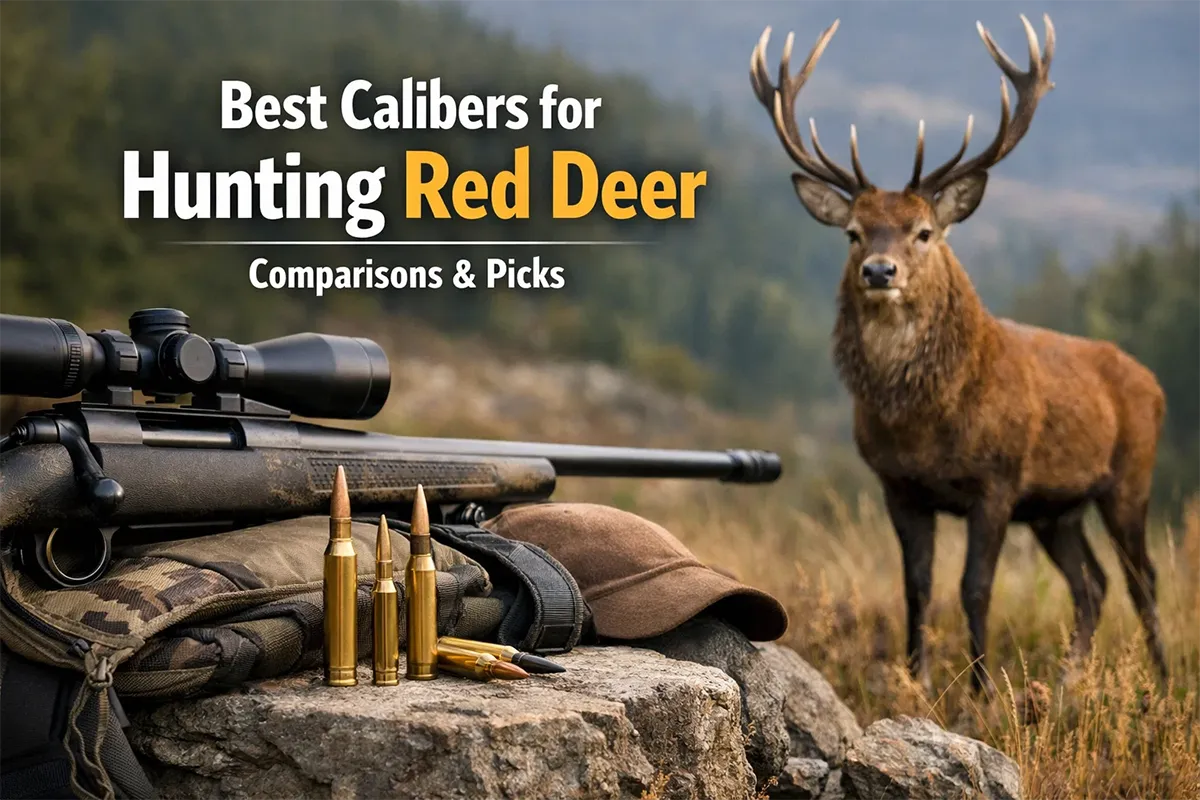
Five proven red deer hunting calibers, mapped to common terrain, distance, and recoil tolerance.
Picking red deer hunting calibers is about matching your typical terrain and distance to a bullet that penetrates and expands reliably. Red deer are big-bodied deer, so prioritize controlled-expansion bullets, steady field-position accuracy, and ethical shot angles (broadside or slight quartering-away). Handle firearms safely, confirm your backstop, and check local regulations—minimum caliber/energy rules, lead or non-toxic requirements, magazine limits, and seasons vary by area. Here are five proven options and when to choose each.
Caliber Comparisons
| Feature | 6.5 Creedmoor | .270 Win | .308 Win | .30-06 Springfield | 7mm Rem Mag |
|---|---|---|---|---|---|
| Recoil How much kick you can expect when firing. |
Light–moderate | Moderate | Moderate | Moderate–stout | Stout |
| Effective Range The distance at which the caliber remains accurate and lethal. |
Commonly 0–400 yd with good bullets | Commonly 0–450 yd in open country | Commonly 0–350/400 yd (depends on load) | Commonly 0–400+ yd with flexible loads | Commonly 0–500 yd for practiced shooters |
| Bullet Weight Range The range of bullet weights typically available for the caliber. |
120–156 gr | 130–150 gr | 150–180 gr | 150–200 gr | 139–175 gr |
| Versatility How well the caliber or gauge performs for other game species besides your primary target. |
Excellent for deer/antelope; works on red deer with proper bullets | Great all-around deer caliber; flat enough for hillsides | Very versatile for deer/boar; easy to tune for your rifle | One of the most versatile “do-everything” big-game options | Strong for open country and larger game where legal |
| Ammo Availability How easy it is to find ammunition for the caliber. |
High (popular modern cartridge) | High (classic staple) | Very high (global staple) | Very high (global staple) | High (common magnum) |
6.5 Creedmoor (caliber)
6.5 Creedmoor is a smart choice when you want red-deer-capable performance with recoil that encourages good shooting. It’s at its best for stalking and mixed terrain where shots are commonly inside ~300–400 yards, and you value staying on target and calling your shot. With 120–156 grain hunting bullets, penetration is excellent when you choose controlled-expansion designs.
How to choose: for bigger stags or tougher angles, lean toward 130–156 grain bonded or monolithic bullets rather than softer cup-and-core options. Chronograph if you can—short barrels may reduce velocity—and confirm your rifle’s twist rate supports the heavier loads you plan to hunt. Finally, verify your area’s minimum caliber/energy rules before committing.
PROS
- Lower recoil helps many hunters shoot more accurately
- Great modern bullet selection for controlled expansion
- Often outstanding practical accuracy
CONS
- Some jurisdictions’ minimum-energy rules can be a constraint
- Bullet choice matters more than with larger .30-caliber options
- Wind calls still matter at longer distances
Interesting Fact: Built for efficient short-action rifles while using long, high-BC 6.5mm bullets.
Consider this Caliber If…
You want a modern, easy-to-shoot setup for stalking, and you’ll pick a tough big-game bullet and keep shots within your proven distance.
.270 Win (caliber)
The .270 Win is a classic for open country where red deer can step out across a glen or clear-cut. Its flatter trajectory with common 130–150 grain loads makes holdovers simpler across typical 150–350 yard shots, and it carries velocity well for reliable expansion.
How to choose: 130 grain controlled-expansion bullets work well for many red deer situations; move to 140–150 grain bonded or monolithic bullets if your stags run heavy or you expect steep quartering shots. Avoid fragile bullets not intended for big game. Zero sensibly (a 200-yard zero is common) and confirm real drops and wind holds at the range.
PROS
- Flatter trajectory can simplify open-country shooting
- Moderate recoil with strong downrange performance
- Widespread rifle and ammo support
CONS
- Narrower bullet diameter makes construction important
- Less bullet-weight flexibility than .308/.30-06
- Light rifles can be loud and sharp in recoil
Interesting Fact: The .270 Win’s reputation was boosted by decades of mountain-hunting success stories.
Consider this Caliber If…
You hunt windy hills, open forest edges, or fields where shots may stretch, and you want a flat-shooting standard cartridge without magnum recoil.
.308 Win (caliber)
The .308 Win is the practical, everywhere-available red deer choice. It’s ideal for woodland, mixed farms, and driven-hunt setups where shots are often 50–250 yards and you want straightforward, repeatable terminal performance. With 150–180 grain bullets, it offers excellent penetration potential and broad load availability.
How to choose: 150–165 grain is a common balance of recoil, trajectory, and performance; go 165–180 grain in bonded or monolithic designs if you prioritize penetration on quartering angles. Past ~300 yards, drop and wind become more demanding—verify your dope and be honest about your field-position accuracy.
PROS
- Rifles and ammo are widely available almost everywhere
- Excellent bullet options in 150–180 gr for red deer
- Great performance at common stalking distances
CONS
- More drop at distance than .270 or 7mm Rem Mag
- Can feel “snappy” in lightweight rifles
- Not an “easy mode” long-range cartridge without practice
Interesting Fact: The .308 Win’s popularity means you’ll find loads for nearly any hunting style.
Consider this Caliber If…
You want maximum practicality: easy ammo sourcing, simple load choices, and strong performance in timber or mixed terrain.
.30-06 Springfield (caliber)
.30-06 Springfield is the versatility king for red deer hunters who want one rifle for many conditions. It handles everything from 150 grain deer loads to heavier 180–200 grain controlled-expansion bullets that can add penetration margin on bigger stags.
How to choose: 165–180 grain bonded or monolithic bullets are a strong default for red deer. If recoil is an issue, focus on rifle fit and practice—then confirm point of impact with your hunting load. While .30-06 is common, always double-check local minimum caliber/energy rules and any lead/non-toxic restrictions.
PROS
- Wide bullet-weight range for tailoring performance
- Strong penetration potential with heavier bullets
- Very common rifles and ammo worldwide
CONS
- More recoil than 6.5 Creedmoor for many shooters
- Trajectory advantage over .308 is modest in many loads
- Heavier rifles and ammo can add carry weight
Interesting Fact: After more than a century, .30-06 is still a reference point for all-around big-game performance.
Consider this Caliber If…
You want a proven “one rifle” caliber for mixed terrain and you like the option to run heavier bullets when conditions call for it.
7mm Rem Mag (caliber)
7mm Rem Mag is the pick when wind and distance are common in your red deer country. It offers a flatter trajectory and typically less wind drift than many standard cartridges, which can help in open valleys and exposed ridgelines.
How to choose: for red deer, 150–162 grain controlled-expansion bullets are a common balance of trajectory and penetration; choose bonded, partition-style, or monolithic designs for consistent performance. Recoil and muzzle blast can be significant—especially in light rifles—so only choose this if you can shoot it well and you’re committed to practice with verified drops and wind holds.
PROS
- Flatter trajectory and better wind handling for open country
- Strong downrange energy with big-game bullet options
- Excellent choice for practiced shooters with a rangefinder
CONS
- Stouter recoil and blast can reduce practical accuracy
- Ammo cost and availability can vary by region
- Magnum speed doesn’t replace careful shot selection
Interesting Fact: It helped popularize the modern “flat-shooting magnum” concept for mountain hunting.
Consider this Caliber If…
You regularly hunt open, windy terrain and you can consistently shoot magnum recoil well from real field positions.
Our picks at a glance (and how to decide)
For many hunters, 6.5 Creedmoor or .308 Win is the easiest path to accurate, repeatable hits with widely available ammo. If you hunt open, windy hills and want simpler holds, .270 Win or 7mm Rem Mag can help—so long as you practice and verify your drops and wind calls. .30-06 Springfield remains the flexible “one rifle” choice thanks to its wide bullet-weight range.
Whatever you pick, use a tough, appropriate bullet, zero with the exact load you’ll hunt, and set a maximum distance you can consistently keep in the vital zone from field positions. That’s the ethical standard—along with following local rules and taking only shots you can place with confidence.