
Best Calibers for Hunting Pronghorn: Comparisons & Picks
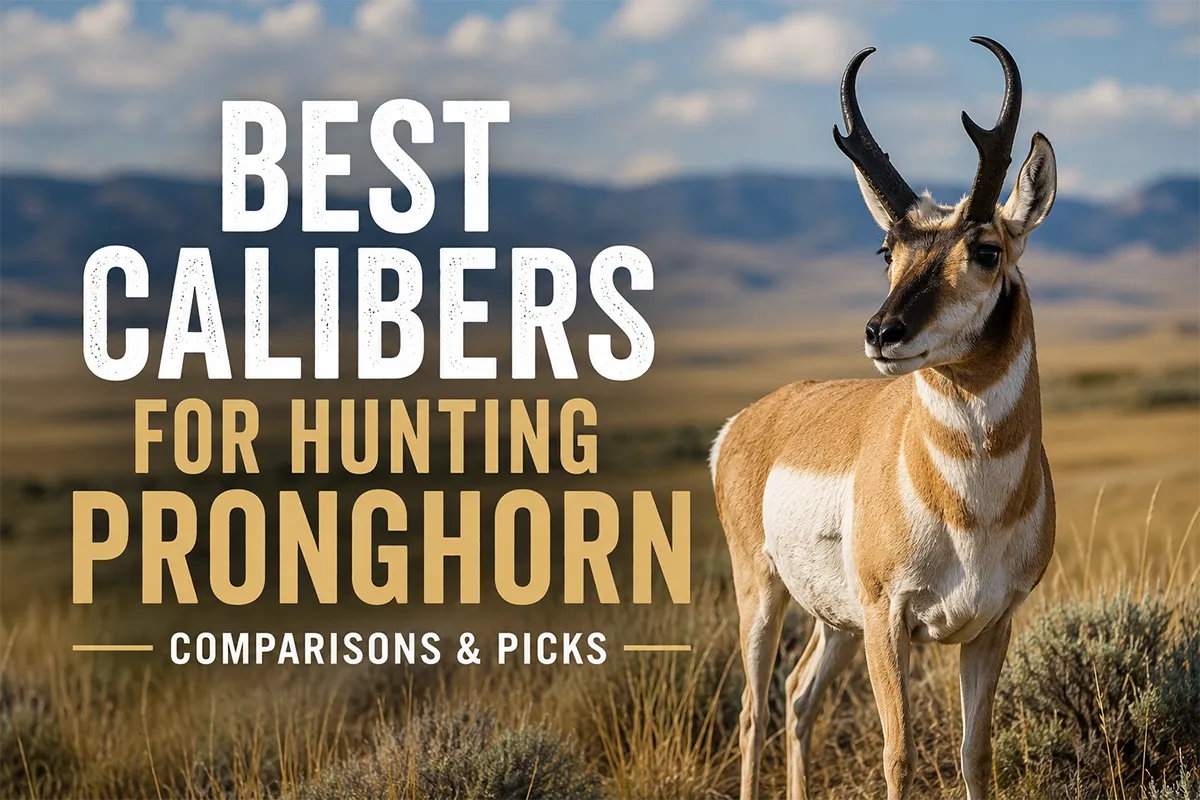
Flat-shooting, manageable options for open-country accuracy
The best pronghorn hunting calibers balance flat trajectory, wind performance, manageable recoil, and dependable terminal performance. Open country can produce longer shots, but distance should not drive the choice by itself. Rifle fit, practice, bullet construction, and wind judgment matter as much as velocity. These five options cover mild-recoiling rifles, efficient all-around cartridges, and faster choices for experienced hunters.
Where/When: Pronghorn commonly occupy open plains, sagebrush basins, rolling prairie, and high-desert country of the western United States where forage, water, and visibility come together. Hunters often locate them by glassing feeding flats, fence crossings, travel routes, low saddles, and areas near water or bedding cover. Seasons often run from late summer into fall, with early hunts sometimes overlapping rut activity and later hunts bringing cooler conditions and changing feeding patterns. Morning and evening movement is commonly strongest, while wind, heat, pressure, and weather can alter travel. Timing, legal methods, and season structure vary by region, so confirm current regulations.
Pronghorn Hunting Calibers: Comparison
| Feature | .243 Winchester | 6.5 Creedmoor | .25-06 Remington | 7mm-08 Remington | .270 Winchester |
|---|---|---|---|---|---|
|
Recoil How much kick you can expect when firing. |
Low | Low to moderate | Moderate | Moderate | Moderate to firm |
|
Effective Range The distance at which the caliber remains accurate and lethal. |
Best inside about 300 yards for most hunters | Commonly practical to 400 yards with training | Well suited to open-country shots around 400 yards | Commonly practical to 350 yards with training | Well suited to open-country shots around 400 yards |
|
Bullet Weight Range The range of bullet weights typically available for the caliber. |
80–105 grains for big-game use | 120–143 grains | 100–120 grains | 120–150 grains | 130–150 grains |
|
Versatility How well the caliber or gauge performs for other game species besides your primary target. |
Good for varmints and deer-size game where legal | Excellent for deer and many Western hunts | Strong choice for deer-size game and predators | Excellent all-around deer and elk option with proper bullets | Excellent for deer, pronghorn, and many elk hunts |
|
Ammo Availability How easy it is to find ammunition for the caliber. |
Common | Very common | Common but fewer loads | Common | Very common |
.243 Winchester
The .243 Winchester solves the recoil problem for new hunters, smaller-framed shooters, and anyone who wants to practice without developing a flinch. Its light kick supports steadier field positions and easier follow-through. For pronghorn, choose a controlled-expansion big-game bullet instead of a thin-jacketed varmint load. Hunting bullets around 90 to 105 grains offer useful trajectory and penetration. Keep distance reasonable, verify drop at the range, and wait for a broadside or slightly quartering-away presentation.
PROS
- Low recoil supports accurate practice and confident field shooting.
- Flat enough for many common pronghorn distances.
- Rifles and hunting ammunition are widely available.
CONS
- Light bullets lose wind stability sooner than heavier options.
- Bullet selection matters because varmint loads are not appropriate.
- Some jurisdictions may set minimum caliber or energy requirements.
Interesting Fact: The .243 Winchester uses the .308 Winchester case necked down for a smaller-diameter bullet, helping explain its efficient performance and mild recoil.
Consider this Caliber If…
Choose the .243 Winchester if recoil tolerance is your main concern, your rifle fits well, and your likely shots are within distances you have repeatedly practiced. It is especially sensible for youth hunters and careful adults who prioritize precision over power.
6.5 Creedmoor
The 6.5 Creedmoor solves the need for an easy-shooting cartridge that handles distance and wind efficiently. Its common streamlined hunting bullets can make trajectory and wind calls more forgiving, though they never replace skill. Loads from 120 to 143 grains are common; controlled-expansion designs suit pronghorn best. Choose ammunition your rifle groups consistently, verify actual drop, and practice seated, kneeling, and from supported field positions before extending range.
PROS
- Manageable recoil encourages frequent, productive practice.
- Efficient bullets perform well in typical prairie winds.
- Broad rifle and ammunition selection supports different budgets.
CONS
- Its reputation can tempt hunters to shoot beyond their proven ability.
- Short barrels may give up some advertised velocity.
- Premium hunting loads can cost more than basic cup-and-core ammunition.
Interesting Fact: The 6.5 Creedmoor was designed around efficient long-range bullets and a short-action rifle format, which helped it become popular with both target shooters and hunters.
Consider this Caliber If…
Choose the 6.5 Creedmoor if you want mild-to-moderate recoil, good wind performance, and a cartridge that can also cover deer and other medium game. It is a strong fit for hunters willing to verify data rather than rely on a box label.
.25-06 Remington
The .25-06 Remington solves a classic open-country problem: sending a fast, flat-shooting bullet across a basin without magnum-level recoil. It pairs well with 100- to 120-grain controlled-expansion bullets. Speed can simplify holdover at ordinary pronghorn ranges, but a rangefinder and sound wind calls remain essential. The cartridge usually benefits from a standard-length action and adequate barrel length. Confirm that the chosen bullet is not overly fragile at close range.
PROS
- Flat trajectory suits open grassland and sage country.
- Moderate recoil remains comfortable for many adult hunters.
- Excellent match for deer-size game and predator hunting.
CONS
- Factory load selection is narrower than for newer popular cartridges.
- Longer barrels can be less convenient in vehicles or tight blinds.
- High impact velocity demands careful bullet construction choices.
Interesting Fact: The .25-06 Remington is based on the .30-06 Springfield case necked down to accept .257-inch bullets, creating a long-standing favorite for Western open-country hunting.
Consider this Caliber If…
Choose the .25-06 Remington if you value a flat trajectory, can tolerate moderate recoil, and do not mind a full-length rifle. It is particularly appealing to hunters who expect cross-basin shots but still want a cartridge dedicated to medium game.
7mm-08 Remington
The 7mm-08 Remington solves the versatility question for hunters wanting one moderate-recoil rifle for pronghorn, deer, and larger game with proper bullets. It gives up some speed to faster options, yet efficient 7mm bullets retain energy and handle wind well. For pronghorn, 120- to 140-grain hunting bullets offer a practical mix of trajectory and expansion. It fits short-action rifles and portable setups. Build a verified drop chart rather than assuming it shoots flat.
PROS
- Balanced recoil, bullet weight, and field performance.
- Short-action rifles can be compact and easy to carry.
- Versatile enough for several big-game species.
CONS
- Trajectory is slightly more arched than faster .25- and .27-caliber choices.
- Local ammunition selection may be smaller than .270 or 6.5 Creedmoor.
- Heavier bullets can create more recoil in ultralight rifles.
Interesting Fact: The 7mm-08 Remington is derived from the .308 Winchester case and combines efficient 7mm bullets with a short-action platform.
Consider this Caliber If…
Choose the 7mm-08 Remington if you want a balanced, multipurpose hunting rifle rather than a specialized speed cartridge. It is well suited to hunters who value compact handling, moderate recoil, and strong performance across several species.
.270 Winchester
The .270 Winchester solves the need for a proven open-country cartridge with useful reach and broad versatility. Common 130-grain loads shoot flat, while heavier controlled-expansion bullets expand its role for larger game. Recoil is more noticeable than with the .243 Winchester or 6.5 Creedmoor, especially in light rifles, so fit and technique matter. It suits hunters who can manage the kick and want one rifle for several seasons without moving to a magnum.
PROS
- Flat trajectory and strong terminal performance on medium game.
- Very broad rifle and factory ammunition availability.
- Useful for pronghorn, deer, and many elk hunts with suitable bullets.
CONS
- More recoil than lighter options may reduce practical accuracy.
- Long-action rifles are often slightly longer and heavier.
- Fast impact speeds can damage meat with fragile bullet designs.
Interesting Fact: The .270 Winchester has been associated with open-country hunting for generations because it combines useful velocity, practical bullet weights, and widespread availability.
Consider this Caliber If…
Choose the .270 Winchester if you want a widely supported all-around rifle and can shoot it accurately from field positions. It is a practical option for hunters who may pursue pronghorn one season and deer or elk in another.
How to Choose the Best Pronghorn Caliber
Start with the cartridge you shoot accurately, then match it to your terrain and proven distance. The .243 Winchester favors recoil-sensitive hunters; the 6.5 Creedmoor blends mild recoil with wind efficiency. The .25-06 Remington and .270 Winchester add speed, while the 7mm-08 Remington is a balanced multipurpose option. Use a well-constructed hunting bullet, confirm zero and drop with the exact load you will carry, and practice from field supports. Handle firearms safely, identify the target and what lies beyond it, and keep shots within your demonstrated ability. Ethical shot placement matters more than cartridge power. Regulations vary and may cover minimum caliber or energy, ammunition type, magazine limits, and seasons. Check current local laws and follow non-toxic ammunition requirements where applicable.