
Best Calibers for Hunting Nilgai: Comparisons & Picks
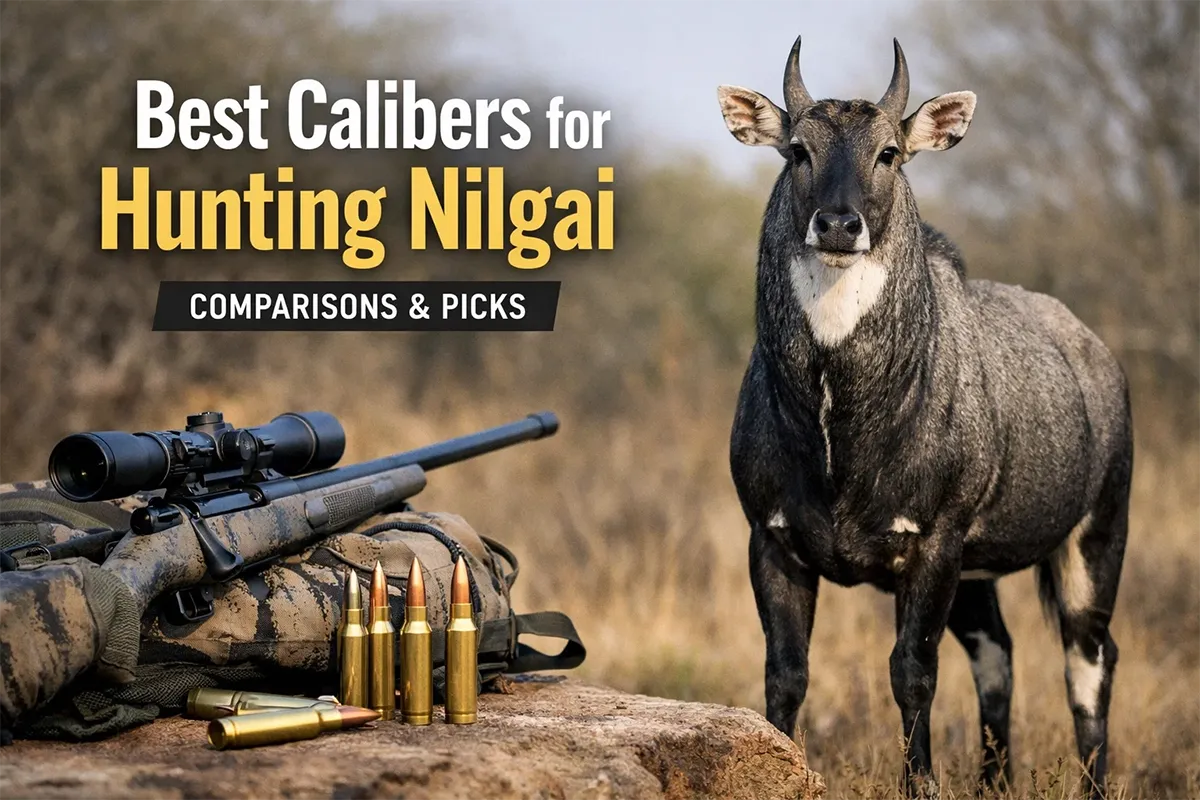
Hard-hitting, practical options for tough South Texas-style game.
Nilgai are big, dense animals, and they don’t always react like a whitetail when hit. So your “nilgai hunting calibers” decision should prioritize penetration, controlled expansion, and a setup you can shoot accurately from field rests. Most shots fall roughly 50–300 yards, often with brush, wind, or a moving animal adding pressure.
No cartridge replaces fundamentals: follow safe gun handling, confirm a solid backstop, and take ethical heart–lung shots. Regulations vary (legal methods, seasons, magazine limits, lead/non-lead rules, minimum calibers), so verify local requirements before you hunt. Use sturdy big-game bullets (bonded, partition-style, or monolithic copper) and avoid fragile, rapid-expansion loads on nilgai shoulders.
Caliber Comparisons
| Feature | .308 Winchester | .30-06 Springfield | .270 Winchester | 7mm Remington Magnum | 12 Gauge (Slug) |
|---|---|---|---|---|---|
| Recoil How much kick you can expect when firing. |
Moderate | Moderate–stout | Mild–moderate | Stout | Stout (varies by slug/shotgun) |
| Effective Range The distance at which the caliber remains accurate and lethal. |
0–350 yd typical | 0–400 yd typical | 0–400 yd typical | 0–500 yd typical | 0–150 yd typical |
| Bullet Weight Range The range of bullet weights typically available for the caliber. |
150–180 gr common | 150–200+ gr common | 130–150 gr common | 140–175 gr common | 300–600 gr (slugs) |
| Versatility How well the caliber or gauge performs for other game species besides your primary target. |
High (deer, hogs) | Very high (most NA big game) | High (deer-sized game) | High (open-country big game) | Medium (close-range big game) |
| Ammo Availability How easy it is to find ammunition for the caliber. |
Excellent | Excellent | Excellent | Good | Excellent |
.308 Winchester
The .308 Winchester is a practical nilgai caliber when you want manageable recoil and dependable penetration. With 150–180 grain controlled-expansion bullets, it commonly drives through ribs and can hold together on shoulder hits. It’s also easy to find and easy to practice with—two things that matter more than “paper energy.”
PROS
- Moderate recoil that supports accurate shot placement
- Wide ammo and bullet selection, including tough hunting bullets
- Efficient performance from compact rifles and shorter barrels
CONS
- Less margin than magnums on very steep angles or long-range shots
- Some loads favor lighter bullets; pick a deep-penetrating design for nilgai
- Wind drift is manageable but not the best of the group
Interesting Fact: The .308 Winchester is the commercial version of the 7.62×51mm NATO, which is why it’s offered almost everywhere.
Consider this Caliber If…
Choose .308 if most shots are inside ~300 yards and you want repeatable accuracy from sticks or a bipod. Start with a 165–180 grain bonded or monolithic bullet, confirm your zero, and keep shots centered in the heart–lung zone.
.30-06 Springfield
The .30-06 Springfield adds bullet-weight flexibility and a little extra penetration margin without jumping to full magnum recoil. Loaded with 165–200+ grain controlled-expansion bullets, it’s well-suited to quartering angles and “break-the-shoulder” insurance when needed.
PROS
- Broad bullet-weight range for tuning penetration and recoil
- Excellent availability and big-game load options
- Strong downrange energy for tough animals at practical distances
CONS
- More recoil than .308 in similar rifles
- Not as flat as some modern magnums at longer range
- Older rifles may have shorter magazines that limit very long/heavy bullets
Interesting Fact: Introduced in 1906, the .30-06 has taken virtually every North American big-game species with the right bullet.
Consider this Caliber If…
Pick .30-06 if you want heavier bullet options for nilgai and you’re comfortable with moderate recoil. A 180-grain bonded/partition-style bullet is a common, proven baseline.
.270 Winchester
The .270 Winchester solves the “hit precisely at distance” problem with a flatter trajectory and mild-to-moderate recoil. For nilgai, bullet construction is the whole game: use a tough 140–150 grain hunting bullet designed for deep penetration.
PROS
- Flatter trajectory with manageable recoil
- Excellent accuracy potential and easy field shooting
- Common ammo choices and lots of quality hunting bullets
CONS
- Less forgiving on hard shoulder impacts with light, soft bullets
- Heavier, tougher bullets can be pricier or less common on shelves
- Not ideal if you expect very steep quartering shots
Interesting Fact: The .270 Winchester became famous for open-country hunting partly because it combines speed with relatively light recoil.
Consider this Caliber If…
Choose .270 for open senderos and 200–350 yard shots where a flatter trajectory helps. Avoid raking angles, and prioritize controlled-expansion bullets over soft, fast-opening designs.
7mm Remington Magnum
The 7mm Remington Magnum is for open-country nilgai hunts where wind and distance are real factors. With 150–175 grain controlled-expansion bullets, it keeps velocity well and can offer extra margin past 300 yards—if you can shoot it accurately.
PROS
- Strong downrange performance with good wind resistance
- Wide selection of high-BC hunting bullets for open country
- Extra margin for longer shots compared to standard cartridges
CONS
- Stout recoil and muzzle blast can hurt real-world accuracy
- Shorter barrel rifles can be loud and give up some velocity
- Ammo is common, but premium hunting loads can cost more
Interesting Fact: The 7mm Rem Mag gained popularity because it offers magnum performance without the very heavy bullets and recoil of some .30 magnums.
Consider this Caliber If…
Pick 7mm Mag if you may shoot 300–500 yards and you’ll practice enough to manage recoil. Verify drop/wind holds from your actual hunting rest, not just the bench.
12 Gauge (Slug)
A 12 gauge slug setup is the close-range hammer for thick brush and short lanes. Match slug type to your barrel (sabot for rifled barrels; many smoothbores prefer rifled slugs), and keep expectations realistic on range and drop.
PROS
- Big frontal diameter and heavy payload for close-range penetration
- Excellent option for brush country and short shooting lanes
- Ammo is widely available and easy to source
CONS
- Limited effective range and fast drop compared to rifle calibers
- Recoil can be heavy, especially in lighter shotguns
- Accuracy depends strongly on matching slug type to your barrel
Interesting Fact: Many modern sabot slugs are designed to stabilize in rifled shotgun barrels and can group surprisingly well with the right load.
Consider this Caliber If…
Use 12 gauge slugs if your shots are typically inside ~150 yards and come fast. Zero at a realistic distance (50–75 yards), test multiple slug loads, and stay within the range you can place a slug precisely.
Final Picks for Nilgai Hunting
For an all-around, easy-to-source nilgai pick, start with .308 Winchester and a tough 165–180 grain bullet. If you want heavier bullet options and extra penetration margin, .30-06 Springfield is a proven step up. For flatter shooting in open country, .270 Winchester works well with strong bullet construction and disciplined shot angles. If long shots and wind are on the menu, 7mm Remington Magnum adds reach—provided recoil doesn’t cost you precision. And for tight brush and short lanes, a 12 gauge slug gun can be extremely effective inside its realistic range.
Whatever you choose, confirm your zero, practice from field positions, and prioritize ethical heart–lung shots. Always follow safe handling practices and local regulations.