
Best Calibers for Hunting Grant’s Gazelle: Comparisons & Picks
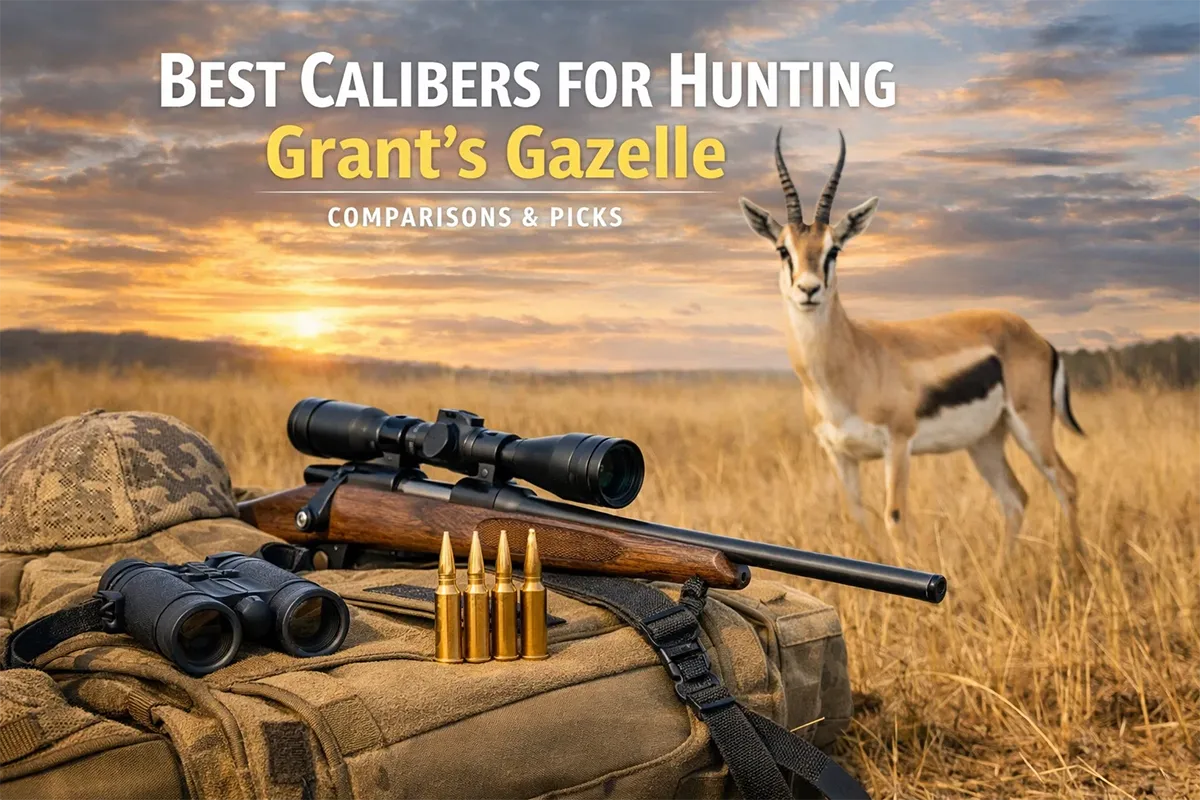
Practical rifle-caliber picks for open-country shots, steady shooting sticks, and ethical plains-game kills.
Grant’s gazelle hunts typically happen in open, windy country where shots can stretch and where a calm, well-placed first round matters more than raw power. Because the animal is relatively thin-skinned and not especially heavy, you don’t need a “big game cannon”—but you do want a caliber that you can shoot accurately from field positions (often off shooting sticks), that carries enough energy and bullet performance at your expected distance, and that won’t punish you with recoil during practice.
This guide focuses on common rifle calibers that are widely proven on medium African plains game. When choosing, think through: your realistic max distance (many hunters cap themselves around 300–400 yards), how much wind you expect, how steady you are from sticks, and whether your safari will include slightly larger antelope as an “opportunity” animal. Above all, prioritize safe gun handling, confirm zero after travel, and choose a premium controlled-expansion bullet that matches your impact speeds.
Regulations and outfitter rules vary by country and concession—some places specify minimum calibers or energy, and airlines may limit ammo quantities—so verify local requirements before you pack. And remember: ethical shot placement (heart/lung) and passing on poor angles will do more for clean recoveries than chasing the hottest load.
Caliber Comparisons
| Feature | .243 Winchester | 6.5 Creedmoor | .270 Winchester | 7mm-08 Remington | .308 Winchester |
|---|---|---|---|---|---|
| Recoil How much kick you can expect when firing. |
Low | Low–Moderate | Moderate | Low–Moderate | Moderate |
| Effective Range The distance at which the caliber remains accurate and lethal. |
0–350 yd typical | 0–400 yd typical | 0–450 yd typical | 0–400 yd typical | 0–400 yd typical |
| Bullet Weight Range The range of bullet weights typically available for the caliber. |
80–105 gr | 120–143 gr | 130–150 gr | 120–150 gr | 150–180 gr |
| Versatility How well the caliber or gauge performs for other game species besides your primary target. |
Varmints–medium deer | Deer–elk (with bullets) | Deer–elk | Deer–elk (moderate) | Deer–elk & more |
| Ammo Availability How easy it is to find ammunition for the caliber. |
Very common | Common | Very common | Common | Very common |
.243 Winchester
A classic light-recoiling plains-game caliber that can be very effective on Grant’s gazelle when paired with a tough 95–105 grain controlled-expansion bullet and disciplined shot placement. It shines for hunters who want flat-ish trajectory out to typical open-country distances without getting beat up by recoil during practice.
PROS
- Low recoil for fast follow-up shots and better field accuracy.
- Excellent bullet selection in 90–105 gr for thin-skinned game.
- Often very accurate in common sporter rifles.
CONS
- Less margin for error than larger 6.5–.30 calibers on quartering angles.
- Wind drift can be more noticeable with lighter bullets.
- Requires bullet construction that holds together at close-range impact speeds.
Interesting Fact: The .243 Win shares the same parent case as the .308 Win, necked down to take 6mm bullets—one reason ammo is widely available.
Consider this Caliber If…
…you’re recoil-sensitive, shoot well with lighter rifles, and plan to pass on steep quartering shots to keep angles clean.
6.5 Creedmoor
A modern favorite for open plains because it blends mild recoil with high-BC bullets that resist wind well. For Grant’s gazelle, a 120–143 grain bonded or monolithic bullet gives reliable penetration while keeping trajectories forgiving at 250–400 yards—especially when you’re shooting off sticks in variable wind.
PROS
- High ballistic coefficients help cut wind drift on the savanna.
- Moderate recoil that most hunters shoot accurately from field positions.
- Strong selection of 120–143 gr hunting bullets and loads.
CONS
- Not as flat as fast .270/.25-06 loads at the far edge of distance.
- Factory load performance varies—pick proven controlled-expansion options.
- Short barrels can give up velocity, which can reduce expansion at long range.
Interesting Fact: The Creedmoor was designed for match shooting, but its efficient case and long, sleek bullets translated unusually well to real-world hunting.
Consider this Caliber If…
…you want a “do-most-things” plains caliber that’s forgiving in wind and you value consistent accuracy over raw speed.
.270 Winchester
If you like classic, fast, and flat, the .270 Win is hard to ignore for gazelle-sized game. With 130–150 grain bullets, it carries velocity well and flattens the trajectory enough that small range-estimation errors are less punishing. It also adds a bit more “reach” and terminal energy than the light calibers without jumping to heavy recoil.
PROS
- Flat trajectory and strong downrange velocity for open-country shots.
- Plenty of hunting bullet choices in 130–150 gr.
- Good step up in margin for error on slightly imperfect angles.
CONS
- Recoil is still manageable, but more noticeable than .243/6.5.
- High impact speeds up close demand controlled-expansion bullets to avoid excessive meat damage.
- Some rifles with long barrels are less handy in vehicles or blinds.
Interesting Fact: Jack O’Connor famously popularized the .270 Win for mountain and plains game, cementing its reputation for flat-shooting practicality.
Consider this Caliber If…
…you expect longer sight-lines and want a traditional, widely supported “flat shooter” for medium plains game.
7mm-08 Remington
The 7mm-08 is a sweet spot caliber for hunters who want deeper penetration and heavier-for-caliber bullets while keeping recoil reasonable. On Grant’s gazelle it’s flexible: use 120–140 grain bullets for flatter shooting, or step to 150 grain controlled-expansion loads if your outfitter expects slightly bigger plains species in the mix.
PROS
- Balanced recoil-to-performance ratio; easy to shoot well from sticks.
- 7mm bullets offer good sectional density for penetration.
- Works well in short-action rifles that carry and handle nicely.
CONS
- Ammo can be less common in remote shops than .270/.308 (plan ahead).
- Trajectory is good but not as flat as high-velocity .270 loads.
- Light, fast 7mm bullets can be wind-sensitive compared with heavier 6.5/.30 options.
Interesting Fact: Like the .243 and 6.5 CM, the 7mm-08 is based on the .308 family of cases, which helps explain its efficiency in shorter barrels.
Consider this Caliber If…
…you want one rifle that’s gentle enough for practice but still hits with authority for a mix of medium plains game.
.308 Winchester
The .308 Win is the practical workhorse: easy to find, easy to load for, and effective on a wide range of game with the right bullet. For Grant’s gazelle, many hunters favor 150–165 grain controlled-expansion bullets for dependable penetration and a little extra margin on quartering shots—while keeping recoil and rifle weight in a very manageable zone.
PROS
- Excellent ammo availability and broad hunting load selection.
- Good penetration and terminal performance with 150–165 gr bullets.
- Often shoots accurately in compact, rugged rifles.
CONS
- More recoil than .243/6.5/7mm-08, especially in lighter rifles.
- Drops a bit more at long range than faster .270-class loads.
- Heavier bullets can increase meat damage if impact is high and placement is off.
Interesting Fact: Although the .308 started as a military-inspired cartridge, it became one of the most common hunting rounds worldwide because of its efficiency and availability.
Consider this Caliber If…
…you prioritize reliability and ammo logistics, and you’d rather have a proven “generalist” than chase maximum velocity.
Bottom Line: Pick the Caliber You’ll Shoot Best
For Grant’s gazelle, the “best” choice is usually the one that lets you hold steady, read the wind, and place a controlled-expansion bullet through the vitals every time. If you’re recoil-sensitive or you want maximum comfort in practice, .243 Winchester and 6.5 Creedmoor are excellent—just be disciplined about angles and bullet choice. If you want a flatter traditional plains setup, the .270 Winchester remains a top pick. The 7mm-08 Remington is a balanced all-rounder for mixed-bag plains hunts, and the .308 Winchester is the dependable workhorse when logistics and versatility matter.
Whatever you pick, confirm your rifle’s zero with the exact ammo you’ll hunt with, practice from sticks at realistic distances, and talk with your professional hunter about shot angles and follow-up. Safe handling, respecting local laws, and taking only high-percentage shots are what turn good ballistics into an ethical, successful hunt.