
Best Calibers for Hunting Gemsbok: Comparisons & Picks
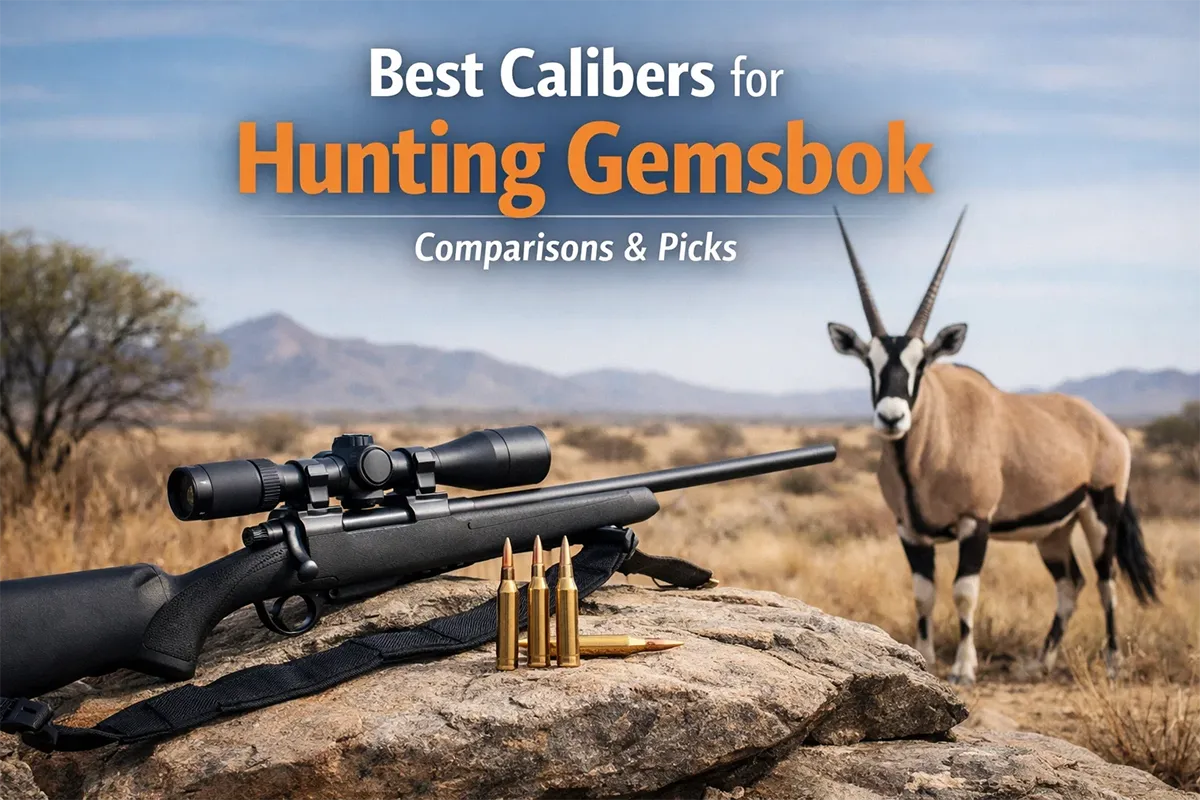
Tough animal, open country—pick a caliber you can shoot well with a bullet built for penetration.
Gemsbok (oryx) are famous for their toughness: dense muscle, heavy shoulder structure, and a will to keep moving even after a hit that would stop lighter-bodied game. That means “enough gun” matters—but shot placement matters more. The best gemsbok hunting calibers are the ones you can shoot accurately from real field positions, with bullets designed to hold together and penetrate (bonded, partition-style, or monolithic copper are common choices).
In most gemsbok country you’ll see open terrain—pans, grassland, and brushy edges—where shots often land in the 150–300 yard zone, with occasional longer opportunities if you and your outfitter are set up for it. Your goal is a clean, ethical kill: a bullet that reaches the vitals even if you have to take a slightly quartering angle, and a rifle setup you can run calmly under pressure.
Below you’ll find a practical comparison of five proven calibers for hunting gemsbok, plus guidance on when each one shines. Whatever you pick, confirm local regulations (minimum caliber/energy rules vary by country and concession), follow safe firearm handling, and prioritize ethical shot placement—especially on an animal as durable as an oryx.
Caliber Comparisons
| Feature | .308 Win | .30-06 | 7mm Rem Mag | .300 Win Mag | .375 H&H |
|---|---|---|---|---|---|
| Recoil How much kick you can expect when firing. |
Moderate | Moderate | Moderate-High | High | Very High |
| Effective Range The distance at which the caliber remains accurate and lethal. |
0–300+ yds (shooter/bullet dependent) | 0–350 yds (shooter/bullet dependent) | 0–400 yds (shooter/bullet dependent) | 0–450 yds (shooter/bullet dependent) | 0–300 yds (best inside this window) |
| Bullet Weight Range The range of bullet weights typically available for the caliber. |
150–180 gr (165–180 common) | 150–200+ gr (180–200 common) | 139–175 gr (160–175 common) | 150–220 gr (180–200 common) | 235–300 gr (270–300 common) |
| Versatility How well the caliber or gauge performs for other game species besides your primary target. |
High | Very High | High | High | Africa-focused |
| Ammo Availability How easy it is to find ammunition for the caliber. |
Very High | Very High | High | High | Moderate |
.308 Winchester
If you want a widely available, no-drama gemsbok caliber that still hits hard with modern bullets, .308 Winchester is a classic. With tough 165–180 grain bonded or monolithic bullets, it commonly delivers deep penetration through the shoulder and into the vitals—exactly what you want on a thick-skinned, hard-walking oryx.
PROS
- Common rifle and ammo availability in many areas (easy to practice with).
- Excellent penetration with 165–180 gr bonded/mono bullets at typical gemsbok ranges.
- Manageable recoil for most hunters, which usually means better shot placement.
CONS
- Less forgiving than magnums when shots stretch past ~300 yards in wind.
- Some factory loads emphasize deer bullets—choose controlled-expansion designs.
- Shorter “point-blank” trajectory than 7mm/.300 magnums with similar optics zero.
Interesting Fact: In many rifles, .308 can be very accurate with a wide variety of powders and bullets, which is why it’s popular for both hunting and target shooting.
Consider this Caliber If…
You’ll be hunting open country but expect most shots inside 250–300 yards, you value ammo availability, and you want a caliber that encourages calm, repeatable shooting.
.30-06 Springfield
For gemsbok, .30-06 Springfield is the “do almost anything” choice—especially if you want heavier bullets without jumping to a magnum. With 180–200 grain controlled-expansion bullets, .30-06 gives you a little more flexibility for quartering shots and larger-bodied animals, while still keeping recoil reasonable in a properly fitted rifle.
PROS
- Handles heavier bullets (180–200 gr) well for penetration on tough plains game.
- Broad ammo selection—from premium bonded to monolithic to traditional soft points.
- Proven field record across continents; easy to find load data and rifle options.
CONS
- Recoil can feel snappy in lightweight rifles compared to .308.
- Trajectory is good but not “laser flat” unless you pick faster, lighter loads.
- Some older rifles have long throats—confirm accuracy with your chosen load.
Interesting Fact: The .30-06 has been in continuous service for more than a century, and its case capacity still makes it one of the most flexible .30-caliber hunting rounds.
Consider this Caliber If…
You want one rifle for gemsbok and other medium-to-large game, you like the idea of 180–200 gr bullets, and you prefer standard-length actions over magnums.
7mm Remington Magnum
When gemsbok hunting can turn into a long-ish shot across a pan or grassland, 7mm Remington Magnum is a strong balance of flat trajectory, wind performance, and adequate bullet weight. With premium 160–175 grain bonded or monolithic bullets, it commonly offers excellent penetration and a bit more reach than standard cartridges.
PROS
- Flatter trajectory and better wind handling than many non-magnums at longer ranges.
- Premium 160–175 gr bullets can penetrate very well for the caliber.
- Often shoots accurately with a wide variety of factory loads.
CONS
- Recoil and muzzle blast increase noticeably compared to .308/.30-06.
- Fast velocities can stress softer bullets—stick with controlled-expansion designs.
- Barrels can heat and erode faster than standard rounds if you do high-volume practice.
Interesting Fact: Despite its age, 7mm Rem Mag remains a top seller because it pairs high ballistic coefficients with hunting-appropriate bullet weights.
Consider this Caliber If…
Your hunt is likely in open terrain, you’re comfortable practicing to 300–400 yards, and you want a flatter-shooting option without stepping up to .300 magnum recoil.
.300 Winchester Magnum
.300 Winchester Magnum is the “extra margin” pick for gemsbok—useful when shots are long, winds are up, or you want more authority through heavy bone. With 180–200 grain bonded or monolithic bullets, it’s commonly excellent for breaking the near shoulder and still reaching the far-side vitals, which can help anchor an animal that’s built to go miles.
PROS
- Strong downrange energy and penetration with 180–200 gr controlled-expansion bullets.
- Flatter trajectory and better wind performance than .30-06 with similar bullets.
- Widely supported by rifle makers and premium ammo lines.
CONS
- Recoil and blast are substantial; a brake/suppressor and good stock fit help a lot.
- More expensive to practice with than standard calibers for many hunters.
- Overconfidence risk—still requires disciplined shot selection and range limits.
Interesting Fact: The .300 Win Mag’s long case and belt were designed for reliable feeding, and it became a favorite for long-range hunting decades before “long-range” was trendy.
Consider this Caliber If…
You want a flatter-shooting .30 caliber with extra penetration margin, you can manage magnum recoil, and you’ll prioritize premium bullets and plenty of practice time.
.375 H&H Magnum
.375 H&H Magnum is often considered the do-it-all African safari caliber, and it’s a confidence booster on big-bodied, tough animals like gemsbok—especially if shots might be closer and you want decisive penetration. With 270–300 grain softs (or monolithic equivalents), it commonly punches straight through muscle and bone while still expanding reliably.
PROS
- Outstanding penetration and straight-line performance on tough, heavy animals.
- Often legal across a wide range of African hunting scenarios (always confirm locally).
- Flexible bullet selection: 235–300 gr softs and solids for different needs.
CONS
- Recoil is heavy; frequent practice can be challenging without a well-set-up rifle.
- Trajectory is more arced than the magnums—range estimation matters sooner.
- Ammo and rifles can be pricier and less common than .30-caliber options.
Interesting Fact: The .375 H&H dates to 1912 and is still widely respected because it feeds smoothly in bolt actions and offers a rare mix of power and shootability for its class.
Consider this Caliber If…
You’re planning an Africa-focused rifle setup, you expect some closer shots in thicker cover, or you simply want maximum penetration confidence and can handle the recoil.
Final Picks for Gemsbok
For most hunters, the safest path to an ethical gemsbok is a cartridge you can place precisely, loaded with a bullet designed for controlled expansion and deep penetration. If you want the most practical, widely supported options, .308 Winchester and .30-06 Springfield are hard to beat—choose premium 165–180 grain (for .308) or 180–200 grain (for .30-06) bonded, partition-style, or monolithic bullets, and practice from the same kind of rest you’ll use in the field.
If your hunt is likely to involve wind and longer shots in open terrain, 7mm Remington Magnum and .300 Winchester Magnum can provide a flatter trajectory and stronger downrange performance, but only if you manage recoil well enough to keep your shot placement tight.
If you’re building an Africa-first setup and want maximum penetration confidence, .375 H&H Magnum is a classic—set a realistic range limit and practice from sticks to match how you’ll shoot.
Regulations and concession rules vary (including minimum calibers and bullet requirements), so confirm details before you travel. Handle firearms safely, prioritize ethical shot placement, and don’t take angles or distances you haven’t practiced.