
Best Calibers for Hunting Feral Pigeon: Comparisons & Picks
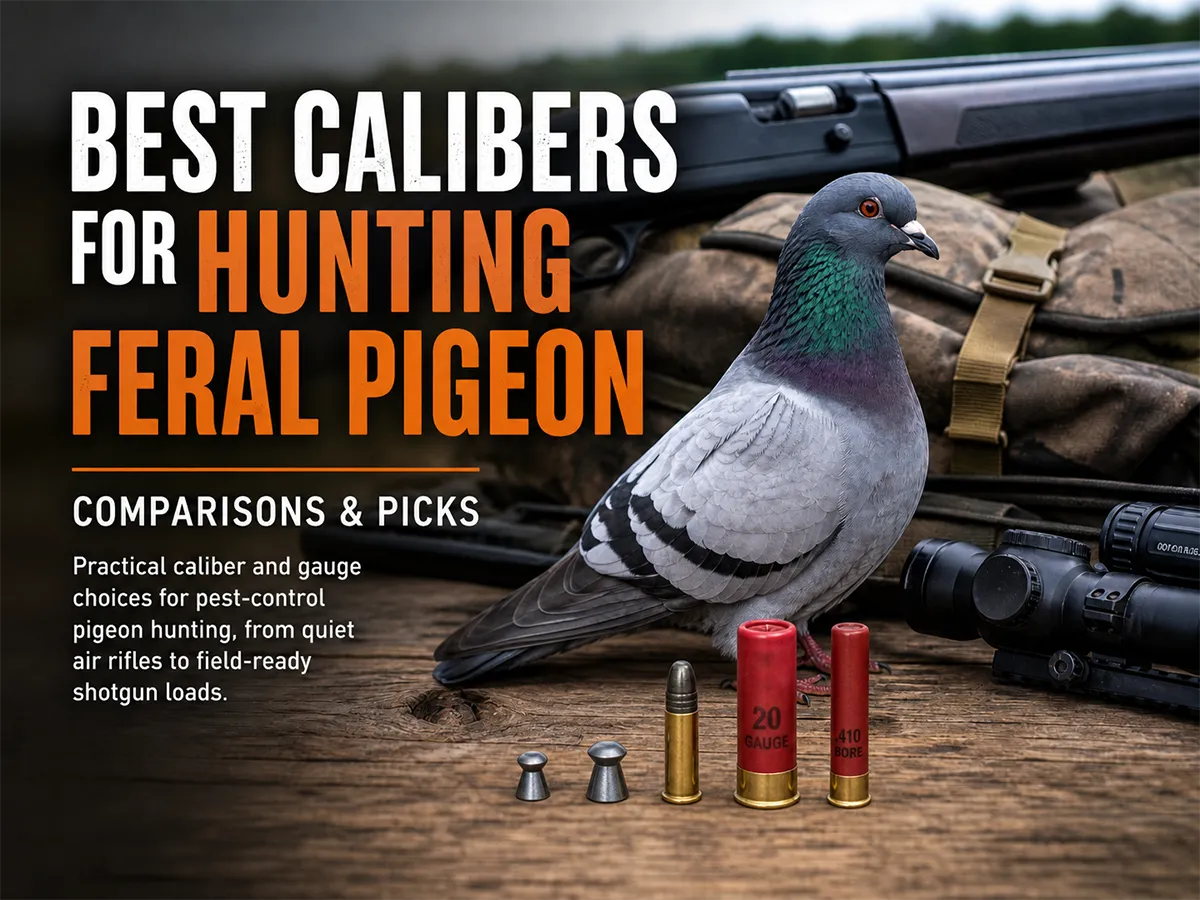
Practical caliber and gauge choices for pest-control pigeon hunting, from quiet air rifles to field-ready shotgun loads.
Choosing the best feral pigeon hunting calibers depends heavily on where the birds are, how they are presenting, and what local law allows. Feral pigeons are commonly hunted or controlled around farms, feedlots, grain storage areas, dairies, bridges, barns, and open agricultural fields, but many of those locations also create safety concerns. A quiet air rifle may be the right tool for stationary birds near buildings when legal, while a 20 gauge or .410 bore may make more sense for flying birds over open ground. The goal is not maximum power; it is safe handling, clean shot placement, suitable range, and a load that matches the setting.
Where/When: Feral pigeons are widely found across North America and many other regions, especially around towns, agricultural operations, rail yards, grain elevators, barns, bridges, and rocky or man-made roosting structures. Hunters commonly pattern them by watching feeding areas, water sources, loafing ledges, roost entrances, flight lines, and repeated travel corridors between grain, cover, and nighttime roosts. Hunting or pest-control timing varies by region and regulations, but pigeons often move most predictably in the morning as they leave roosts and again late in the day as they return. Weather, food availability, farm activity, and local pressure can change patterns quickly, so always confirm seasons, property permission, firearm restrictions, non-toxic shot rules, and local ordinances before hunting.
Caliber Comparisons
| Feature | .177 Caliber Air Rifle | .22 Caliber Air Rifle | .22 LR | 20 Gauge | .410 Bore |
|---|---|---|---|---|---|
| Recoil How much kick you can expect when firing. | Very low | Very low | Low | Moderate | Light |
| Effective Range The distance at which the caliber remains accurate and lethal. | Typically 15–35 yards | Typically 20–45 yards | Typically 25–75 yards with a safe backstop | Typically 20–40 yards on flying birds | Typically 15–30 yards |
| Bullet Weight Range The range of bullet weights typically available for the caliber. | Commonly 7–10 grain pellets | Commonly 14–18 grain pellets | Commonly 36–40 grain bullets | Commonly 7/8–1 ounce shot loads | Commonly 1/2–11/16 ounce shot loads |
| Versatility How well the caliber or gauge performs for other game species besides your primary target. | Good for small pests and target work | Good for small game and pest control | Broad small-game utility where legal | Useful for upland birds, small game, and pests | Useful for close-range small game and light bird hunting |
| Ammo Availability How easy it is to find ammunition for the caliber. | Common | Common | Very common | Common | Moderate |
.177 Caliber Air Rifle
A .177 caliber air rifle solves the main problem many feral pigeon hunters face: needing a quiet, precise tool for stationary birds without excessive power. It is usually best for close-range work on perched pigeons where a safe backstop exists and local rules allow airguns. The flatter trajectory of many .177 pellet rifles can help newer shooters make clean head or upper-vital shots at modest distances, but pellet selection and rifle accuracy matter more than raw velocity.
PROS
- Very low recoil makes accurate shot placement easier
- Often quieter than firearms when used legally and responsibly
- Pellets are commonly available and affordable
CONS
- Limited power requires disciplined range control
- Not appropriate for flying birds
- Wind can affect light pellets noticeably
Interesting Fact: Many accurate .177 pellet rifles are designed for target shooting, which is one reason they can work well for precise pest-control shots at close range.
Consider this Caliber If…
Choose .177 caliber if you are hunting stationary feral pigeons around farms, barns, or other controlled areas where noise, over-penetration, and precise placement are major concerns. Look for a rifle that groups reliably with quality domed pellets, has a dependable safety, and is legal for your location. Avoid marginal shots, never shoot toward roofs or hard surfaces without understanding ricochet risk, and confirm whether airguns are permitted for pest birds in your area.
.22 Caliber Air Rifle
A .22 caliber air rifle gives pigeon hunters a heavier pellet and stronger close-range impact than .177, which can be useful when shots are slightly longer or birds are larger-bodied. It is still a low-recoil, relatively quiet option, but the curved trajectory means you must know your holdover and actual point of impact. For ethical results, treat it as a precision tool rather than a long-range solution.
PROS
- Heavier pellets can improve terminal performance on pigeons
- Still offers very low recoil and manageable noise
- Useful for other close-range small-game situations where legal
CONS
- More arched trajectory than many .177 setups
- Requires careful pellet testing for accuracy
- May be too much for some tight spaces without a proper backstop
Interesting Fact: The .22 airgun pellet is a popular pest-control choice because it balances manageable shooting with noticeably more pellet weight than .177.
Consider this Caliber If…
Choose .22 caliber air rifle equipment if you want more pellet weight for perched pigeons and you can practice enough to understand the trajectory. It often fits rural pest-control work where shots are deliberate, distances are measured, and the shooter can use a stable rest. Pick quality domed or hunting pellets that group tightly in your rifle, and remember that humane shot placement is still the deciding factor.
.22 LR
The .22 LR cartridge can be effective for feral pigeon hunting only in very specific rural situations: stationary birds, a known safe backstop, and enough space to manage ricochet and travel distance. It solves the need for a familiar, accurate small-game rifle with widely available ammunition, but it is not a casual barnyard option. Never use .22 LR at flying birds, on skylined birds, or anywhere a missed shot cannot be safely captured.
PROS
- Accurate and familiar for many small-game hunters
- Ammunition is commonly available in many load types
- Useful beyond pigeons for other legal small-game hunting
CONS
- Requires an excellent backstop and strict safety discipline
- Not suitable for shooting birds in flight
- Can be restricted or unsafe near structures and populated areas
Interesting Fact: Although .22 LR is a classic small-game cartridge, its ability to travel far after a miss makes backstop selection more important than cartridge power.
Consider this Caliber If…
Consider .22 LR only if you are hunting in a rural area with permission, a safe earthen backstop, and clear legal approval. It can work well for roost-edge or ground-feeding pigeons where shots are controlled and deliberate. Choose accurate ammunition your rifle groups well, avoid hard surfaces that can cause ricochets, and prioritize safe angles over every other factor.
20 Gauge
The 20 gauge is one of the most practical gauges for feral pigeons when birds are flying over open agricultural ground, around legal shooting fields, or along safe flight lines. It solves the problem air rifles cannot: moving targets. With appropriate shot size and choke, it offers enough pattern density for clean hits without the recoil and payload of many 12 gauge loads.
PROS
- Good balance of pattern performance and manageable recoil
- Works well for flying pigeons at typical shotgun distances
- Versatile for upland birds and small game where legal
CONS
- Louder and less discreet than air rifles
- Requires safe shot zones and awareness of nearby property
- Load choice may be affected by non-toxic shot regulations
Interesting Fact: A 20 gauge with the right choke can pattern efficiently enough for pigeons while remaining easier to carry and shoot than many heavier field guns.
Consider this Caliber If…
Pick 20 gauge if you are targeting flying feral pigeons in safe, open settings such as crop edges, farm fields, or legal pest-control shoots. Choose loads with enough pellet count for consistent patterns, and pattern your shotgun before hunting. In many areas, shot size, non-toxic shot requirements, magazine limits, and seasons vary, so check local laws before buying shells or heading out.
.410 Bore
The .410 bore is a light, low-recoil shotgun option for close-range feral pigeon hunting, especially when birds flush predictably and shots are kept inside practical limits. It solves the recoil problem for smaller-framed or recoil-sensitive hunters, but it also demands better shooting and closer birds because payloads are limited. It is best treated as a specialty close-range choice, not a substitute for pattern density.
PROS
- Very light recoil for new or recoil-sensitive hunters
- Handy in tight field setups where legal and safe
- Can be effective on close, predictable pigeon shots
CONS
- Small shot payload leaves less room for aiming error
- Best kept to close ranges
- Shells may be less available or more expensive than common gauges
Interesting Fact: The .410 bore is named by bore diameter rather than shotgun gauge, which is why it should not be called a .410 gauge.
Consider this Caliber If…
Choose .410 bore if you want a lightweight shotgun for close pigeon opportunities and you are disciplined enough to pass longer or crossing shots. It can be useful around small fields, roost exits, and short flushes where legal, but pattern testing is critical. Select shells that produce even patterns in your shotgun, and remember that ethical shot placement and range limits matter more than the convenience of a light gun.
Final Pick for Feral Pigeon Hunting
For most controlled, stationary feral pigeon hunting, a quality .22 caliber air rifle is often the most useful choice because it combines low recoil, manageable noise, and enough pellet weight for clean close-range results. For flying pigeons in open country, 20 gauge is usually the more practical tool because it gives better pattern coverage without excessive recoil. The .177 caliber air rifle is a strong choice for precise short-range work, .22 LR should be reserved for rural settings with excellent backstops, and .410 bore is best for close shotgun shots by disciplined shooters. Whatever you choose, handle every gun safely, confirm your target and what is beyond it, use ethical shot placement, and check local regulations for seasons, legal methods, non-toxic shot rules, magazine limits, and pest-control requirements.