
Best Calibers for Hunting Cougar: Comparisons & Picks
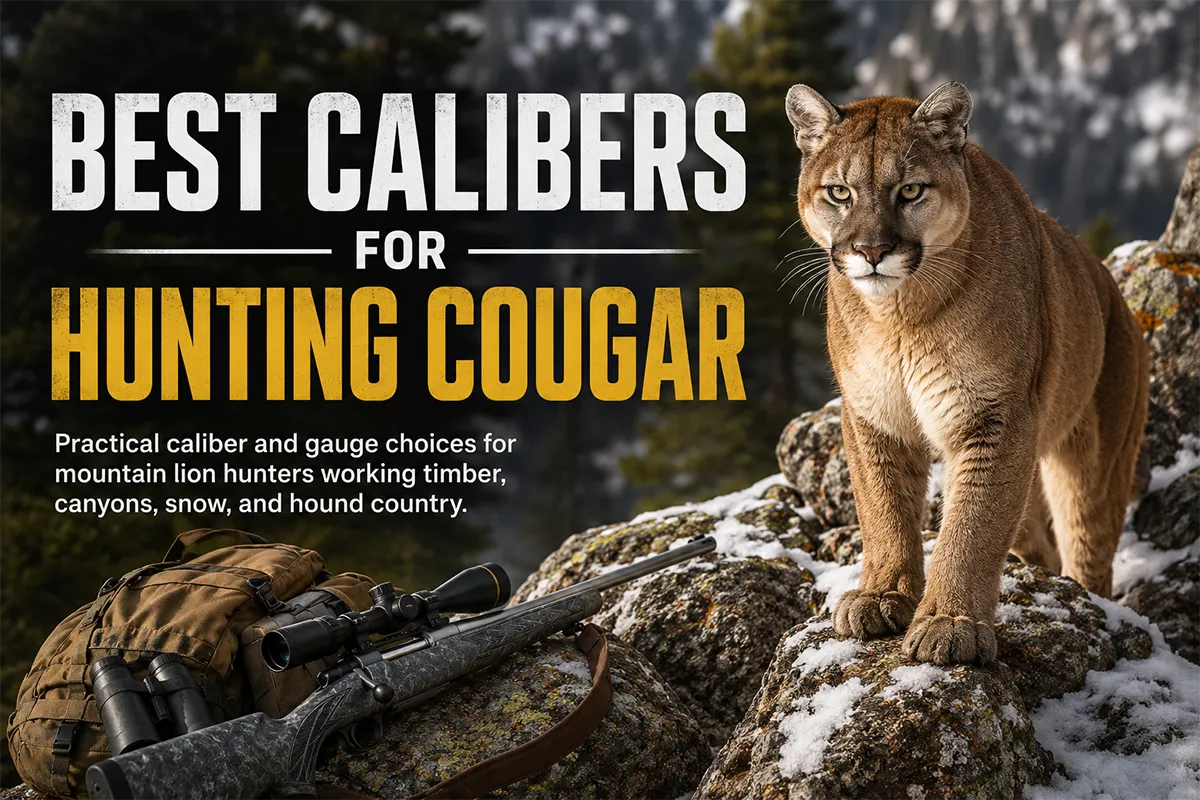
Practical caliber and gauge choices for mountain lion hunters working timber, canyons, snow, and hound country.
Choosing the best cougar hunting calibers is less about raw power and more about control, accuracy, terrain, and the way you hunt. Cougars are not large compared with elk or bear, but they are tough predators that deserve careful shot placement and enough bullet performance to reach the vitals cleanly. A good cougar setup should be easy to carry, fast to shoulder, legal in your area, and accurate enough for the distances you actually expect. Hound hunters often need a light, handy rifle for close shots in steep cover, while callers and spot-and-stalk hunters may want a flatter-shooting option for open cuts, canyon rims, or snowy basins.
Where/When: Cougars, often called mountain lions, are commonly found across much of the western United States, parts of the Midwest, western Canada, Mexico, and other rugged regions where deer-sized prey, cover, and escape terrain overlap. Hunters often focus on timber edges, canyon breaks, rimrock, brushy draws, snow-covered travel routes, saddles, game trails, kill sites, and areas where deer or elk concentrate near food, water, bedding cover, and travel corridors. Seasons and legal methods vary widely by region, but cougar hunting often centers on cooler months when tracks are easier to cut, hounds can work scent more effectively, and predators may be patterned around prey movement. In many areas, early mornings, evenings, fresh snow, and changing weather can improve sign visibility and movement, though exact timing depends on local regulations, quotas, access, and conditions.
Cougar Hunting Calibers and Gauges Compared
| Feature | .243 Win | .22-250 Rem | .223 Rem | .30-30 Win | 12 gauge |
|---|---|---|---|---|---|
| Recoil How much kick you can expect when firing. | Light to moderate | Light | Very light | Moderate | Moderate to heavy depending on load |
| Effective Range The distance at which the caliber remains accurate and lethal. | Commonly 250+ yards with the right bullet | Commonly 250+ yards with precise placement | Best inside moderate ranges and where legal | Best inside 150–200 yards | Close range; load and choke dependent |
| Bullet Weight Range The range of bullet weights typically available for the caliber. | 80–100 grains common for hunting | 50–64 grains common | 55–77 grains common | 150–170 grains common | Buckshot or slug loads depending on law and setup |
| Versatility How well the caliber or gauge performs for other game species besides your primary target. | Excellent for deer and predators | Excellent predator and varmint round | Useful for predators and training | Strong timber deer and black bear option | Useful for close cover, birds, and some big-game seasons |
| Ammo Availability How easy it is to find ammunition for the caliber. | Often good | Generally good, more specialized | Very common | Very common in hunting areas | Very common, but hunting loads vary |
.243 Win
The .243 Win is one of the most balanced cougar hunting calibers for hunters who want light recoil, flat trajectory, and enough bullet weight for clean penetration. It solves the common problem of carrying more gun than needed while still offering more authority than small predator rounds. It matters most for hunters who may shoot across a canyon, down a snowy logging cut, or from a calling setup where a cougar does not stop at bow-range distances. For best results, choose controlled-expansion hunting bullets in the heavier end of the common range, confirm your rifle’s zero, and avoid fragile varmint bullets that may not give the penetration you want.
PROS
- Flat enough for open-country shots without punishing recoil.
- Good bullet selection for predators and deer-sized game.
- Easy for many hunters to shoot accurately from field positions.
CONS
- Bullet construction matters more than sheer diameter.
- May damage hides more than smaller rounds with certain bullets.
- Not legal everywhere, so minimum caliber rules must be checked.
Interesting Fact: The .243 Win began as a dual-purpose varmint and deer cartridge, which is exactly why it fits many cougar scenarios so well.
Consider this Caliber If…
Choose the .243 Win if you want a forgiving, accurate rifle for calling, snow tracking, or mixed predator and deer hunting. It is especially useful when recoil tolerance is a concern or when a smaller-framed hunter needs a rifle that still performs beyond close timber distances. Match it with a quality hunting bullet, practice from kneeling and sitting positions, and keep shots within the range where you can place the bullet through the vitals with confidence.
.22-250 Rem
The .22-250 Rem is a fast, flat-shooting predator caliber that can make sense for experienced cougar hunters who value precision and low recoil. It solves the problem of judging holdover on longer calling stands because its trajectory is typically very forgiving inside normal predator-hunting distances. It matters when you are watching open ridges, sage edges, snowy burns, or canyon benches where a cougar may pause briefly and offer a careful shot. Because this is a smaller-diameter caliber, bullet selection and shot placement are critical. Choose sturdy soft-point, bonded, or controlled-expansion bullets where available, and avoid treating it like a big-game hammer.
PROS
- Very flat trajectory for a predator rifle.
- Light recoil helps hunters stay steady and see impacts.
- Excellent for hunters who also pursue coyotes and varmints.
CONS
- Requires disciplined shot selection on cougar-sized predators.
- Some varmint bullets are too fragile for ideal penetration.
- May not meet minimum caliber rules in certain jurisdictions.
Interesting Fact: The .22-250 Rem is known for high velocity, which can simplify aiming at moderate distances but makes bullet construction especially important.
Consider this Caliber If…
Consider the .22-250 Rem if your cougar hunting overlaps with predator calling and you are comfortable waiting for a broadside or slightly quartering shot. It is not the best choice for rushed angles, heavy bone, or thick brush, but it can be highly effective in careful hands. Hunters who prioritize hide quality should test loads, because fast bullets can be either surprisingly tidy or very destructive depending on construction and impact distance.
.223 Rem
The .223 Rem is common, affordable to practice with, and extremely easy to shoot well, which makes it appealing for some cougar hunters. It solves the problem of flinching and poor follow-through because recoil is minimal, and many lightweight bolt-action and semi-automatic rifles are available. It matters most for close to moderate shots where legal, especially for hunters who already know their rifle and can place shots precisely. The key is not to choose cheap practice ammunition for the hunt. Use a suitable hunting bullet, confirm that your rifle stabilizes the bullet weight, and check whether your state or province allows .22-caliber centerfires for cougar.
PROS
- Very low recoil supports accurate field shooting.
- Ammunition and rifle options are widely available.
- Light rifles are easy to carry during long days in steep country.
CONS
- Legality varies and may be restricted by minimum caliber rules.
- Performance depends heavily on proper hunting bullets.
- Less forgiving than larger calibers on poor angles or marginal hits.
Interesting Fact: The .223 Rem’s popularity makes it one of the easiest centerfire rounds to practice with regularly, and practice often matters more than paper ballistics.
Consider this Caliber If…
Consider the .223 Rem if you hunt in a jurisdiction where it is legal, you can choose a strong hunting bullet, and your expected shots are controlled rather than rushed. It is a practical option for experienced marksmen, recoil-sensitive hunters, and those who already own a reliable .223 rifle. Avoid stretching range simply because the rifle is accurate on targets; ethical cougar hunting requires enough bullet performance and precise placement in real field conditions.
.30-30 Win
The .30-30 Win is a classic timber caliber that fits many hound and close-cover cougar hunts. It solves the problem of carrying a long, heavy rifle through brush, snow, and steep draws because lever-action .30-30 rifles are typically compact and quick to handle. It matters when shots are close, angles are fast, and visibility is limited by timber or terrain. The .30-30 does not shoot as flat as modern high-velocity rounds, but it hits with dependable authority at normal woods distances. Choose proven soft-point hunting loads, know your trajectory, and avoid taking shots beyond your confirmed zero and skill level.
PROS
- Excellent handling in timber, brush, and hound country.
- More forgiving bullet diameter than small predator calibers.
- Common ammunition and proven hunting performance.
CONS
- More arched trajectory than flatter-shooting options.
- Lever-action sight systems may limit precision unless upgraded.
- Not ideal for long canyon or open-basin shots.
Interesting Fact: The .30-30 Win has taken countless deer in North American timber, and that same close-range dependability translates well to cougar hunting.
Consider this Caliber If…
Choose the .30-30 Win if your hunt is mostly in close cover or if you want one rifle for cougar, deer, and similar timber hunting. It is a strong choice for hunters who value speed, simplicity, and easy carry over maximum range. A low-power scope, aperture sight, or red-dot sight can make it even more practical, but safe handling is crucial because close-range predator hunts can unfold quickly around dogs, partners, and uneven terrain.
12 gauge
The 12 gauge is the close-range gauge option for cougar hunters who work thick cover, hounds, or short shooting lanes. It solves the problem of fast handling at very close distance, especially where a rifle may be awkward in brush or where local rules allow shotgun use. It matters when the hunt is measured in yards rather than hundreds of yards. Load choice is the whole story: buckshot, slugs, choke selection, pattern density, and legal restrictions all affect whether a 12 gauge is appropriate. Pattern your shotgun on paper, confirm point of impact, and never assume a hunting load performs well just because it is powerful.
PROS
- Very effective at close range with suitable legal hunting loads.
- Fast to point in brush, timber, and tight terrain.
- Extremely versatile for hunters who already own a shotgun.
CONS
- Range is limited compared with rifle calibers.
- Recoil can be stout with heavy slug or buckshot loads.
- Patterning and local regulations are mandatory before hunting.
Interesting Fact: Two 12 gauge loads can perform very differently from the same shotgun, which is why pattern testing is not optional for ethical hunting.
Consider this Caliber If…
Consider the 12 gauge if your cougar hunting is close-range, timber-focused, and legal for the method you use. It is not a precision canyon rifle replacement, but it can be practical in tight conditions when matched with the right load and choke. Hunters should pay special attention to safe zones of fire around hounds and other hunters, because shotgun patterns and quick shots demand discipline. Confirm whether non-toxic shot, buckshot restrictions, slug rules, magazine limits, or special predator regulations apply where you hunt.
Final Pick: Match the Tool to the Hunt
For most hunters comparing cougar hunting calibers, the .243 Win is the best all-around pick because it balances reach, recoil, accuracy, and bullet performance. The .30-30 Win is excellent for timber and hound hunters who expect close shots, while the .22-250 Rem and .223 Rem can work well for careful marksmen using proper bullets where those calibers are legal. The 12 gauge belongs in the conversation for close-cover hunts, but it requires pattern testing and strict range discipline. Whatever you choose, practice from real field positions, know your backstop, handle every firearm safely, and make ethical shot placement the priority. Cougar regulations vary widely, including season dates, quotas, legal methods, minimum calibers, non-toxic ammunition rules, and magazine limits, so always check current local laws before buying ammunition or heading into the field.