
Best Calibers for Hunting Brown/Grizzly Bears: Comparisons & Picks
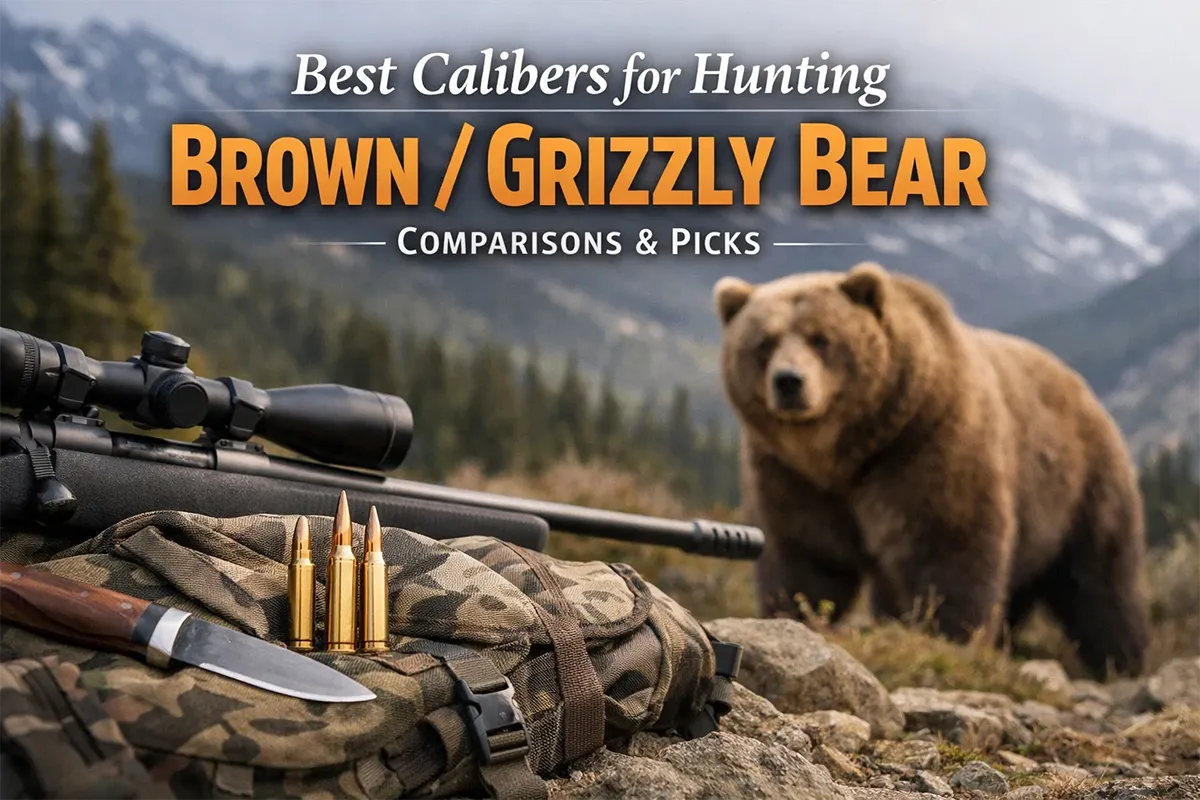
Big bears demand deep penetration, controlled recoil, and a setup you can shoot well—fast.
Choosing the right brown/grizzly bear hunting caliber (or gauge) is less about internet “stopping power” debates and more about solving real field problems: heavy bone and dense muscle, angles that aren’t always perfect, wind and weather that can punish marginal loads, and the need to place a bullet precisely when your heart rate spikes. The best options balance penetration, bullet construction, shootability, and practical accuracy at the distances you’re likely to shoot—whether that’s a close alder-choked encounter or a longer cross-valley shot. Below are five proven picks that cover most bear-hunting scenarios, plus guidance to match caliber/gauge to terrain, distance, recoil tolerance, and the realities of your hunt.
Where/When: Brown/grizzly bears are found across Alaska and parts of western Canada and the northern Rockies in the U.S., and they typically live in big, broken country—coastal tidal flats and salmon streams, alpine basins, river bottoms, berry slopes, and thick willow/alder drainages where visibility can be limited. Hunters commonly locate sign along food sources (salmon runs, berry patches, sedge/grass flats), travel corridors (creek bottoms, ridgelines, game trails), and near bedding cover on cool north-facing slopes or brushy benches. Seasons and daily movement vary by region and regulations, but in many areas spring hunting often centers on bears feeding on new green-up and carrion with good evening movement, while fall hunting commonly lines up with berries and salmon where available; weather shifts (wind, rain, sudden warm-ups/cold snaps) can change activity and where bears hold. Always confirm timing and legal methods for your specific unit and season.
Caliber Comparisons
| Feature | .300 Winchester Magnum | .338 Winchester Magnum | .375 H&H Magnum | .45-70 Government | 12 gauge (slugs) |
|---|---|---|---|---|---|
| Recoil How much kick you can expect when firing. |
Medium-High (manageable with good fit/brake) | High (noticeable jump; practice matters) | High to Very High (pushy; benefits from weight) | Medium to High (load-dependent; lever guns vary) | High (slug recoil is stout, especially light guns) |
| Effective Range The distance at which the caliber remains accurate and lethal. |
0–400+ yards (shooter/load dependent) | 0–350+ yards (excellent energy retention) | 0–300+ yards (built for authority at any angle) | 0–200 yards (best in timber/brush) | 0–125 yards (some setups to ~150) |
| Bullet Weight Range The range of bullet weights typically available for the caliber. |
180–220 gr (bear-suitable options common) | 200–250 gr (heavy-for-caliber sweet spot) | 250–300 gr (deep-penetrating standards) | 300–405+ gr (hard-hitting, big meplat options) | 1 oz–1 1/4 oz slugs (plus specialty designs) |
| Versatility How well the caliber or gauge performs for other game species besides your primary target. |
Very versatile (deer/elk/moose-capable) | Versatile for big game (elk/moose, large bears) | Big-game focused (moose, large bears; not “light”) | Excellent woods cartridge (deer to big bears) | Highly versatile platform (birds to big game with slugs) |
| Ammo Availability How easy it is to find ammunition for the caliber. |
High (common in many stores) | Medium-High (popular, but not everywhere) | Medium (often available, sometimes pricey) | High (common; wide load variety) | High (slugs widely sold; quality varies) |
.300 Winchester Magnum
A practical “do-it-all” magnum that becomes a serious brown/grizzly option when paired with tough 200–220 grain controlled-expansion or bonded bullets and a rifle you can shoot accurately.
PROS
- Flatter trajectory for open-country shots without needing extreme holdovers.
- Excellent bullet selection, including premium bonded and monolithic bear-worthy loads.
- Common chambering with strong ammo availability compared to larger magnums.
- Often fits standard long-action rifles without excessive weight or length.
CONS
- Shot placement and bullet choice matter more than with bigger bores—avoid “light/fast” bullet trends.
- Recoil and muzzle blast can cause flinching if you don’t practice realistically.
- Less forgiving on steep quartering angles than .338/.375 when impact velocity is lower at distance.
- Short, light rifles can be unpleasant to shoot and harder to run fast.
Interesting Fact: Many experienced guides value .300 Win Mag for its reach and precision—when loaded with stout bullets—because a well-placed first shot often prevents the hardest part of bear hunting: a close follow-up in thick cover.
Consider this Caliber If…
You expect mixed terrain (open slopes, beaches, river bars) and want one rifle that can also serve for elk or moose. Prioritize premium 200–220 grain bullets designed for penetration, confirm reliable feeding from the magazine, and practice quick second shots from field positions. As always, follow safe handling, confirm legal caliber minimums for your area, and plan for ethical shot angles (broadside or slight quartering whenever possible).
.338 Winchester Magnum
A classic brown/grizzly bear hunting caliber that blends reach with heavier bullets and a wider wound channel—often considered a “sweet spot” between .300 magnums and the traditional big bores.
PROS
- Strong penetration potential with 225–250 grain bonded or monolithic bullets.
- Excellent authority on quartering shots and through heavy shoulder structure (with proper bullets).
- Still shoots relatively flat for longer shots compared to true big-bore cartridges.
- Broad support from rifle makers and premium ammo lines.
CONS
- Recoil is significant and can reduce practical accuracy without consistent practice.
- Ammo can be more expensive and sometimes less common than .300 magnum staples.
- Lightweight mountain rifles can be punishing and slow follow-up shots.
- Not necessary for every hunt—can be “more than you need” on shorter, controlled-distance setups.
Interesting Fact: The .338 Win Mag’s enduring reputation comes from a simple formula: heavy-for-caliber bullets at useful speeds, producing consistent straight-line penetration on large, tough animals.
Consider this Caliber If…
You’re planning for big bears where shot angles might not be perfect, and you want a margin of penetration without jumping all the way to .375 recoil and rifle weight. Choose a rifle with enough mass to tame recoil, run a quality sling for hands-free hiking, and test your chosen load for accuracy and point-of-impact shifts in wet/cold conditions. Regulations vary, so verify caliber legality and always prioritize safe, ethical shot placement.
.375 H&H Magnum
A proven heavy hitter with deep-penetrating bullets and a big frontal area—ideal when you want maximum confidence on close-to-midrange bears, thick cover, and steep quartering angles.
PROS
- Excellent penetration and terminal performance with 270–300 grain premium bullets.
- More forgiving on tough angles and through heavy bone when bullet construction is appropriate.
- Comfortable “push” recoil in properly weighted rifles compared to some sharper magnums.
- Long-standing track record on dangerous game worldwide, including large bears.
CONS
- Rifles and ammo are typically heavier and more expensive than .300/.338 setups.
- Trajectory is not as flat as smaller magnums—range estimation matters more at distance.
- Not as ubiquitous on store shelves in remote areas unless you plan ahead.
- Overkill for some hunts, especially if you expect only longer, open-country shooting.
Interesting Fact: The .375 H&H has remained a benchmark for “serious” hunting cartridges for over a century largely because it balances heavy bullets, reliable feeding in controlled-round rifles, and consistent penetration.
Consider this Caliber If…
You’re hunting places where encounters can be close and fast—salmon streams, alders, willows, and brushy river bottoms—and you want a cartridge that hits hard even if the shot is slightly quartering. Focus on premium bullets built for deep penetration, confirm you can cycle the rifle smoothly without breaking cheek weld, and practice fast, controlled pairs. Always handle firearms safely, and take ethical shots that you can place precisely under pressure.
.45-70 Government
A hammer at close range, especially in handy lever actions—excellent for thick cover, bait setups where legal, or coastal brush hunts where shots are often inside 150–200 yards.
PROS
- Delivers heavy bullets that can penetrate deeply at practical woods distances.
- Fast handling in compact rifles—helpful when visibility is tight and bears appear suddenly.
- Effective performance with modern hard-cast, bonded, or monolithic bear-focused loads.
- Often easier to carry all day than long, heavy magnum bolt guns.
CONS
- Arched trajectory makes distance judgment critical beyond ~150–200 yards.
- Some lever guns have limitations with optics mounting and cheek weld unless set up well.
- Recoil can be sharp with high-performance loads in lighter rifles.
- Load selection is wide—some “soft” loads are intended for deer, not large bears.
Interesting Fact: The .45-70 dates to the black powder era, but modern strong actions and modern bullets have turned it into a highly capable short-range big-game option—when you pick the right load for your rifle.
Consider this Caliber If…
You’re hunting dense cover where shots are likely close and fast, and you value a quick-pointing rifle you can cycle instinctively. Choose bear-appropriate loads that emphasize penetration, confirm your rifle’s twist rate and magazine length support your chosen bullet, and sight in for the distances you’ll actually shoot. As always, check local regulations (some areas have minimum caliber/energy rules), keep muzzle discipline in brush, and pass shots you can’t place cleanly.
12 gauge (slugs)
A close-range powerhouse that can make sense for tight-cover hunts and simple, rugged setups—especially if your effective shooting distances stay short and you choose quality slugs built to penetrate.
PROS
- Outstanding close-range impact with appropriate slugs and solid shot placement.
- Shotguns are widely available, and slug ammo is generally easy to source.
- Simple manual of arms for many hunters already comfortable with 12 gauge platforms.
- With the right sights/optic, can be very effective inside typical brush-country distances.
CONS
- Limited effective range compared to rifle calibers—trajectory drops quickly.
- Slug recoil can be heavy, especially in lighter defensive-style shotguns.
- Accuracy varies dramatically by barrel type and slug choice—testing is mandatory.
- Less flexible for longer shots across open beaches, river bars, or alpine bowls.
Interesting Fact: Many shotguns show strong “preferences” for specific slug designs—two brands with the same listed velocity can print very different groups, so patterning/accuracy testing is just as important as it is with buckshot.
Consider this Caliber If…
Your hunt is in thick cover where shots are close, and you want a durable, straightforward setup—often with rugged sights or a low-power optic. Choose slugs designed for penetration, confirm point of impact at multiple distances (50, 75, 100 yards), and practice follow-up shots while maintaining control and safe muzzle direction. Regulations vary widely (including method-of-take rules), so confirm legality for slugs and hunting seasons in your unit.
Final Picks: Match Your Cartridge to the Hunt
For most hunters, the “best” brown/grizzly bear hunting caliber is the one that lets you put a deep-penetrating bullet exactly where it needs to go—under stress—while still giving you enough margin for heavy bone and imperfect angles. If you want reach and versatility, a well-loaded .300 Winchester Magnum can be a smart choice, especially for open terrain where you may need a longer shot and careful wind calls. If you want a more bear-focused balance of trajectory and frontal area, the .338 Winchester Magnum is a classic step up that many hunters find reassuring on quartering shots. If your hunt includes tight cover, close encounters, or simply a desire for maximum confidence in penetration, the .375 H&H Magnum remains a gold standard—particularly in rifles you can cycle smoothly and shoot well. For dense brush and realistic sub-200-yard shooting, .45-70 Government lever guns (with bear-appropriate loads) can be incredibly effective and fast-handling, but you must respect the trajectory and choose loads that are built for penetration. And if you’re committed to short-range hunting or a simple platform, 12 gauge slugs can work well inside their limits—provided you test for accuracy and pick quality slugs that your barrel shoots consistently.
Whatever you choose, keep safety and ethics front and center: know your backstop, keep your muzzle under control in brush, and practice from field positions—not just a bench. Confirm local regulations for minimum calibers, allowed methods, seasons, and any special requirements. Then commit to a premium bullet/slug designed for deep penetration, confirm zero in real conditions, and prioritize broadside or slight quartering angles you can place confidently. Big bears are tough, but good decisions—before and during the shot—stack the odds in your favor.