
Best Calibers for Hunting American Crow: Comparisons & Picks
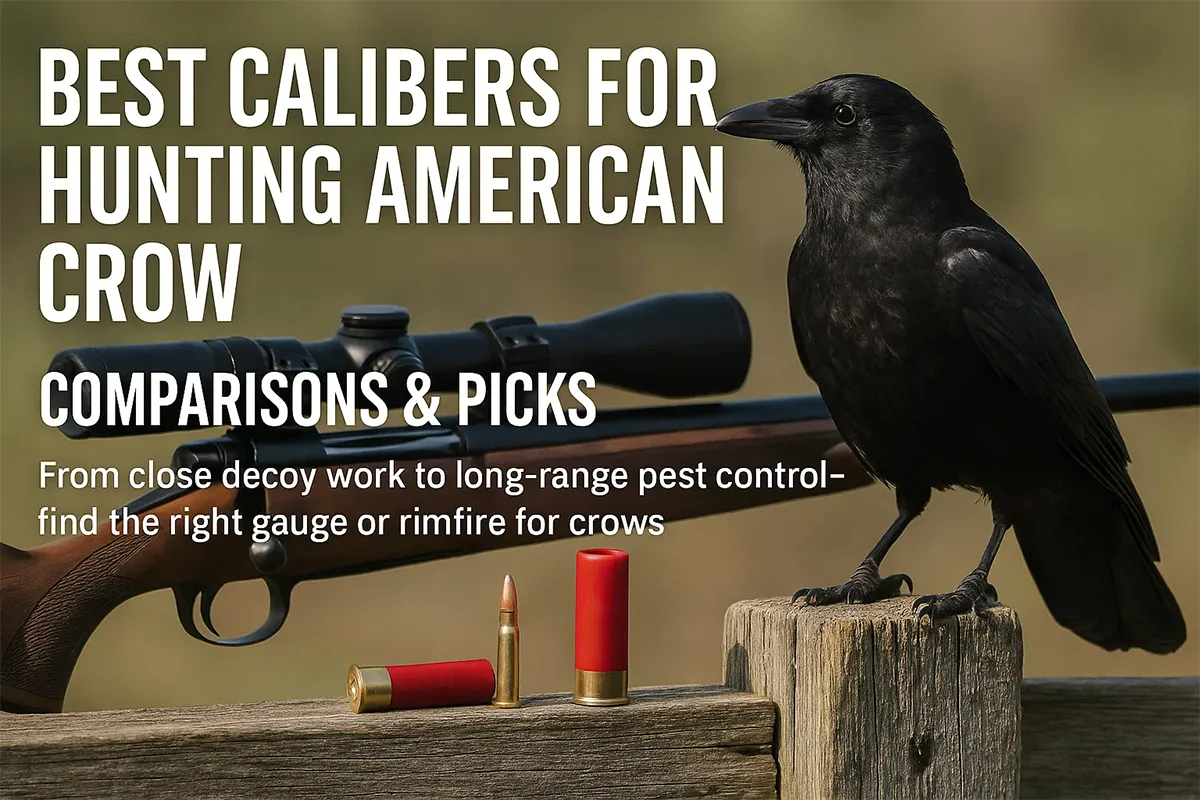
From close decoy work to long-range pest control—find the right gauge or rimfire for crows.
Crows are sharp-eyed, tough birds with surprisingly resilient vitals. Most hunters lean on shotguns (12/20/28 gauge) for calling and decoying inside 30–40 yards, while rimfires like .17 HMR or .22 WMR shine for stand-off farm and pasture sets where safe backstops exist. Below, we compare practical gauges and calibers for hunting American crow and outline who each option fits. Always confirm local seasons, legal methods, and non-toxic shot rules before heading out.
Caliber Comparisons
| Feature | 12 Gauge (Crow Loads) | 20 Gauge | 28 Gauge | .17 HMR | .22 WMR |
|---|---|---|---|---|---|
| Recoil How much kick you can expect when firing. |
Moderate (light to stout depending on payload) | Low–Moderate | Low | Very Low | Low |
| Effective Range The distance at which the caliber remains accurate and lethal. |
20–45 yards (choked & patterned) | 20–40 yards | 20–35 yards | Up to ~150 yards with good wind calls | Up to ~125 yards, practical ~100 |
| Bullet Weight Range The range of bullet weights typically available for the caliber. |
1–1¼ oz shot (#6–#8; non-toxic where required) | ⅞–1 oz shot (#6–#8) | ¾–⅞ oz shot (#6–#8) | 15–20 gr V-Max/HP | 30–50 gr JHP/SP |
| Versatility How well the caliber performs for other game species besides fallow deer. |
High (upland, waterfowl with non-toxic, small game) | High (upland, small game) | Moderate (upland, skeet/clays) | Moderate (varmints, small pests) | Moderate (varmints, small predators) |
| Ammo Availability How easy it is to find ammunition for the caliber. |
Common | Common | Moderate | Common–Moderate | Common–Moderate |
12 Gauge (Crow Loads)
The 12 gauge is the do-everything choice for crow sets over decoys and for pass-shooting on windy fence lines. With the right choke and pattern-tested load (#6–#8 lead or approved non-toxic where required), it offers dense patterns and forgiving range out to about 45 yards.
Pros
- Dense, forgiving patterns for tough birds
- Wide ammo selection and payload flexibility
- Works for upland and clay practice off-season
Cons
- Heavier guns; more recoil than sub-gauges
- Overkill for close timber shots if not choked right
- Lead may be restricted—non-toxic can change patterns
Interesting Fact: Many “pheasant” or “game” loads in #6 or #7½ pattern excellently for crows after a quick choke test—often Improved Modified or Light Full.
Consider this Caliber If…
You want one shotgun to do almost everything, expect shots from 20–45 yards, and don’t mind a bit more weight and recoil.
20 Gauge
Lighter to carry and easier on the shoulder, the 20 gauge still throws effective crow patterns with ⅞–1 oz loads. Ideal for callers who like to move between hedgerows and small woodlots.
Pros
- Lighter guns with friendlier recoil
- Ample effective range for decoyed birds
- Great crossover for upland birds and small game
Cons
- Slightly thinner pattern at the fringe vs 12 gauge
- Fewer true “heavy” crow loads
- Non-toxic options can be pricier
Interesting Fact: Many modern 20s pattern so well with mid-range chokes that they rival older 12s—always pattern your setup on paper at 30–40 yards.
Consider this Caliber If…
You prioritize a nimble, light shotgun for walking sets and expect most shots between 20–40 yards.
28 Gauge
A gentleman’s gauge that’s deadly within its lane. The 28 trades payload for light weight and minimal recoil. With ¾–⅞ oz shot and the right choke, it’s a quiet killer on close, cooperative birds.
Pros
- Feathery guns and very soft recoil
- Surprisingly even patterns with quality loads
- Fun to shoot—more hits in training equals better field results
Cons
- Shortest effective range of the three gauges
- Ammo can be seasonal or pricey
- Not ideal for consistent pass-shooting
Interesting Fact: Many 28-gauge target loads in #7½ double as excellent crow loads in tight cover—pattern first and keep shots conservative.
Consider this Caliber If…
You expect close work over callers/decoys, want minimal recoil, and value a lively, easy-carrying gun.
.17 HMR
For farm edges and open pastures where rifles are lawful and safe, .17 HMR offers flat trajectory and surgical accuracy on perched or ground birds out to ~150 yards, with minimal pelt mess and very low recoil.
Pros
- Extremely flat shooting with tiny wind drift inside 100 yards
- Pinpoint accuracy for head/neck shots
- Quiet report compared to centerfires; cheap practice
Cons
- Light bullets are wind-sensitive past 120–150 yards
- Rifle methods may be restricted for migratory birds—check regs
- Requires impeccable backstops and shot discipline
Interesting Fact: V-Max-style polymer tips expand rapidly, minimizing ricochet risk relative to solid projectiles—still, never shoot without a safe backstop.
Consider this Caliber If…
You hunt static sets on private land with known backstops, value precision, and your jurisdiction allows rifle take of crows.
.22 WMR
The .22 Magnum carries a heavier punch than .17 HMR while staying affordable and easy to shoot. It’s a solid pick for 60–120 yard shots where a bit more bullet weight helps on quartering angles.
Pros
- Heavier 30–50 gr bullets for better penetration
- Still low recoil and relatively quiet
- Useful crossover for varmints and small predators
Cons
- More drop than .17 HMR beyond ~120 yards
- Ammo variability—test lots for accuracy
- Rifle legality varies; confirm local rules
Interesting Fact: Many .22 WMR loads are designed around small-predator terminal performance, which translates well to tough corvids with careful shot placement.
Consider this Caliber If…
You prefer a little more authority than .17 HMR without stepping into centerfire recoil or cost, and you keep shots inside ~125 yards.
Bottom Line & Ethics
For most crow hunters, a 12 or 20 gauge with #6–#8 shot and a pattern-tested choke covers 90% of scenarios. The 28 gauge is a joy for close, cooperative birds. If (and only if) your regulations allow rifle methods and you have safe backstops, .17 HMR and .22 WMR extend your reach with precision. Whichever you choose, pattern or zero your setup, keep ranges honest, and follow all local seasons, non-toxic requirements, and landowner rules—ethical shots and respectful retrieval keep crow hunting welcome.