
Best Calibers for Hunting Groundhog: Comparisons & Picks
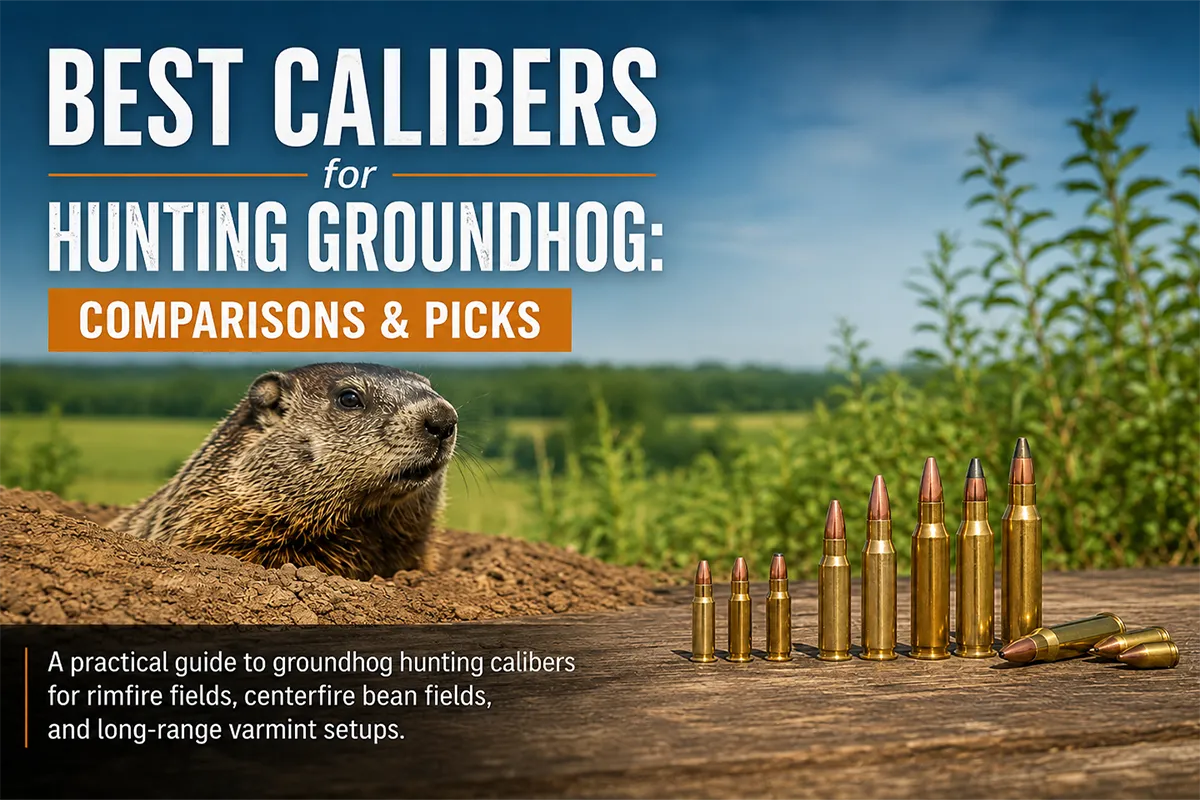
A practical guide to groundhog hunting calibers for rimfire fields, centerfire bean fields, and long-range varmint setups.
Choosing the best groundhog hunting calibers comes down to distance, terrain, rifle weight, recoil tolerance, and local rules. Groundhogs are small, tough-bodied varmints, and the goal is a precise, ethical shot with a cartridge that matches the field. A rimfire can be excellent around barns, small farms, and short pasture edges where legal and safe. A fast centerfire is usually better for big hay fields, crop fields, and windy ridges where shots commonly stretch beyond rimfire distance. Always confirm seasons, legal methods, magazine limits, suppressor rules, and landowner requirements before hunting.
Where/When: Groundhogs, often called woodchucks, are commonly found across much of the eastern, Midwestern, and parts of the central United States in open agricultural country, hay fields, pasture edges, brushy fencerows, creek bottoms, orchards, and field borders near burrow systems. Hunters often pattern them by glassing fresh digging, mowed field edges, clover, soybeans, alfalfa, garden areas, rock piles, and travel routes between dens and feeding spots. In many areas, groundhog activity is best from spring through late summer, with movement often improving during mild mornings and late afternoons, while very hot midday periods can be slower. Weather, crop height, mowing schedules, pressure, and regional regulations all affect timing, so check local laws before planning a hunt.
Groundhog Hunting Calibers Compared
| Feature | .17 HMR | .22 WMR | .223 Remington | .22-250 Remington | .243 Winchester |
|---|---|---|---|---|---|
| Recoil How much kick you can expect when firing. | Very light; easy to spot hits through the scope. | Very light; slightly more push than .22 LR but still mild. | Light; comfortable for high-volume varmint shooting. | Light to moderate; still manageable from a supported position. | Moderate; noticeable compared with smaller varmint cartridges. |
| Effective Range The distance at which the caliber remains accurate and lethal. | Best inside about 100-150 yards in calm conditions. | Best inside about 100-125 yards, depending on load and wind. | Often practical to 250-300 yards with good bullets and optics. | Often practical to 350-400 yards in capable hands. | Often practical past 300 yards when paired with varmint bullets. |
| Bullet Weight Range The range of bullet weights typically available for the caliber. | Commonly 17-20 grains. | Commonly 30-50 grains. | Commonly 40-77 grains, with 50-55 grain varmint loads popular. | Commonly 35-64 grains, with 50-55 grain loads widely used. | Commonly 55-100 grains, with lighter varmint bullets favored. |
| Versatility How well the caliber or gauge performs for other game species besides your primary target. | Excellent small-varmint rimfire; limited for larger game. | Useful for small game and close varmints where legal. | Very versatile for varmints, predators, and target use. | Specialized but excellent for open-country varmints and predators. | Highly versatile for varmints, predators, and some deer hunting where legal. |
| Ammo Availability How easy it is to find ammunition for the caliber. | Common, but load selection is narrower than centerfires. | Common rimfire option with several hunting loads. | Very common with broad varmint-load availability. | Common among varmint hunters, though not as universal as .223. | Very common with broad hunting and varmint options. |
.17 HMR
The .17 HMR solves the short-range precision problem for hunters who want a flat-shooting rimfire with almost no recoil. It is a strong fit for small fields, farm lanes, pasture corners, and places where a centerfire may be more gun than the situation requires. It works best when the hunter can keep shots reasonable, wait for a steady rest, and avoid pushing the cartridge in gusty wind. Choose polymer-tipped 17-grain or heavier 20-grain loads from a rifle that groups well at 100 yards, and pair it with a scope that allows precise holdover.
PROS
- Very low recoil makes it easy to practice and see impacts.
- Flat enough for close groundhog hunting without much holdover.
- Quieter and often less disruptive than centerfire varmint rounds.
CONS
- Wind drift becomes a real issue as distance increases.
- Limited energy compared with centerfire groundhog calibers.
- Not ideal for large crop fields or unknown long shots.
Interesting Fact: The .17 HMR became popular with varmint hunters because it offered a noticeably flatter rimfire trajectory than traditional .22 LR loads.
Consider this Caliber If…
Choose .17 HMR if most of your groundhog hunting happens inside 150 yards, you want minimal recoil, and you value precision more than raw power. It is especially useful for new shooters, high-volume practice, and carefully managed farm shots where the backstop is safe and the distance is known. Ethical shot placement matters: keep angles clean and avoid stretching the cartridge beyond its practical range.
.22 WMR
The .22 WMR, also called .22 Magnum, is a practical groundhog caliber for hunters who like rimfire simplicity but want a heavier bullet than .17 HMR. It solves the close-cover and mixed-farm problem well: short pastures, garden edges, brushy fencerows, and shots where bullet weight matters more than extreme flatness. It does not match the long-range reach of centerfire options, but with a good 30- to 50-grain hunting load, it can be dependable at modest distances. Choose accurate ammunition first, because rimfire rifles can be picky.
PROS
- Heavier rimfire bullets can perform well on close groundhogs.
- Low recoil and simple rifles make it easy to shoot accurately.
- Useful for hunters who also pursue small game where legal.
CONS
- Trajectory is more arched than faster varmint centerfires.
- Not the best choice for windy fields or long shots.
- Premium rimfire loads can vary in accuracy by rifle.
Interesting Fact: The .22 WMR has remained popular because it bridges the gap between traditional rimfire small-game rounds and lighter centerfire varmint cartridges.
Consider this Caliber If…
Choose .22 WMR if you hunt small farms, orchards, or short field edges where shots are commonly close and controlled. It is a good option for hunters who want mild report, mild recoil, and enough bullet weight for clean hits inside its limits. Confirm that rimfire cartridges are legal for your groundhog season and always use a safe backstop, especially around barns, roads, livestock, and neighboring properties.
.223 Remington
The .223 Remington is one of the most useful groundhog hunting calibers because it balances recoil, cost, accuracy, and reach. It solves the “one rifle for most fields” problem for hunters who may see groundhogs at 75 yards one day and 275 yards the next. With quality 50- to 55-grain varmint bullets, it shoots flat enough for many practical field setups while still being easy to manage during long glassing-and-shooting sessions. Choose a rifle twist rate that matches your preferred bullet weight, and use expanding varmint bullets rather than full metal jacket ammunition for hunting.
PROS
- Excellent mix of low recoil, accuracy, and field range.
- Ammunition and rifle options are commonly available.
- Works well from bolt-action rifles and many sporting semi-auto platforms where legal.
CONS
- Wind still matters at longer distances with lighter bullets.
- Some areas restrict certain rifle types, magazines, or hunting methods.
- Requires careful bullet selection for ethical varmint performance.
Interesting Fact: The .223 Remington is popular with varmint hunters partly because it offers centerfire precision without the recoil and barrel heat of larger cartridges.
Consider this Caliber If…
Choose .223 Remington if you want one practical rifle for most groundhog hunting situations. It fits hunters who glass fields from a bipod, shooting sticks, a portable bench, or a truck-side rest where legal. It is also a smart pick for budget-conscious shooters who want to practice often. Check local regulations on rifle configuration, magazine capacity, and legal ammunition, and place shots carefully rather than relying on cartridge speed alone.
.22-250 Remington
The .22-250 Remington is a classic open-country varmint caliber for hunters who need more speed and flatter trajectory than .223 Remington. It solves the long-hayfield problem, especially when groundhogs appear across a wide bean field, on distant mound edges, or along far fencerows. The cartridge is fast, accurate, and highly effective with 50- to 55-grain varmint bullets, but it is louder, burns more powder, and can heat barrels faster during high-volume shooting. Choose it when distance and wind are frequent concerns, not when every shot is close.
PROS
- Very flat trajectory helps on longer field shots.
- Excellent terminal performance with dedicated varmint bullets.
- Good choice for windy farmland compared with lighter rimfires.
CONS
- Louder than smaller options and may be excessive for tight farms.
- More barrel heat during extended shooting sessions.
- Ammunition is usually less common than .223 Remington.
Interesting Fact: The .22-250 Remington built its reputation among varmint hunters by pushing small bullets very fast for a flat-shooting field rifle.
Consider this Caliber If…
Choose .22-250 Remington if you hunt large farms, rolling hay ground, or open fields where groundhogs commonly appear beyond 250 yards. It rewards a stable rest, a quality scope, and a hunter who knows wind calls and drop data. It is less ideal for small properties or sensitive areas because of noise and range. Use safe shooting lanes and confirm what lies beyond the target.
.243 Winchester
The .243 Winchester is a powerful, versatile caliber for groundhog hunters who also want a rifle that can serve for predators and deer-sized game where legal. It solves the “one hunting rifle” problem for someone who does not want a dedicated varmint-only setup. With lighter varmint bullets, it can be extremely effective on groundhogs at long range, but recoil, noise, and ammunition cost are higher than .223 Remington or rimfire options. Choose it when you value versatility and already own a .243, not because groundhogs require that much cartridge.
PROS
- Strong long-range capability with appropriate varmint loads.
- Highly versatile for predators and deer hunting where legal.
- Handles wind better than many smaller, lighter-bullet options.
CONS
- More recoil, blast, and cost than smaller groundhog calibers.
- Can be more rifle than needed for short-range varmint work.
- High-volume shooting can heat barrels quickly.
Interesting Fact: The .243 Winchester gained popularity because it can fire light varmint bullets and heavier big-game bullets from the same general rifle platform.
Consider this Caliber If…
Choose .243 Winchester if you already own one accurate rifle and want it to cover groundhogs, coyotes, and some big-game seasons where legal. It is a strong fit for hunters who shoot from a bench, bipod, or solid field rest and who understand their backstop. For groundhogs, use lighter expanding varmint bullets, confirm zero, and avoid unsafe low-angle shots across hard or rocky ground.
Choosing the Best Groundhog Caliber for Your Fields
The best caliber for hunting groundhog is the one that fits your actual shots. For small properties and known close distances, .17 HMR and .22 WMR are pleasant, precise rimfire choices when legal. For most hunters who want a dependable all-around varmint rifle, .223 Remington is often the most practical balance of recoil, accuracy, availability, and cost. For wide-open farms and longer shots, .22-250 Remington adds speed and reach. For hunters who want one rifle that can also cover other seasons, .243 Winchester offers more power and versatility. No caliber replaces judgment: use a solid rest, verify your target and backstop, choose proper hunting bullets, follow safe firearm handling rules, and make only ethical shots you can place accurately. Regulations vary widely by state, county, land type, and season, so check current local laws before hunting.