
Fall Turkey Hunting Gauges: A Thanksgiving Season Guide
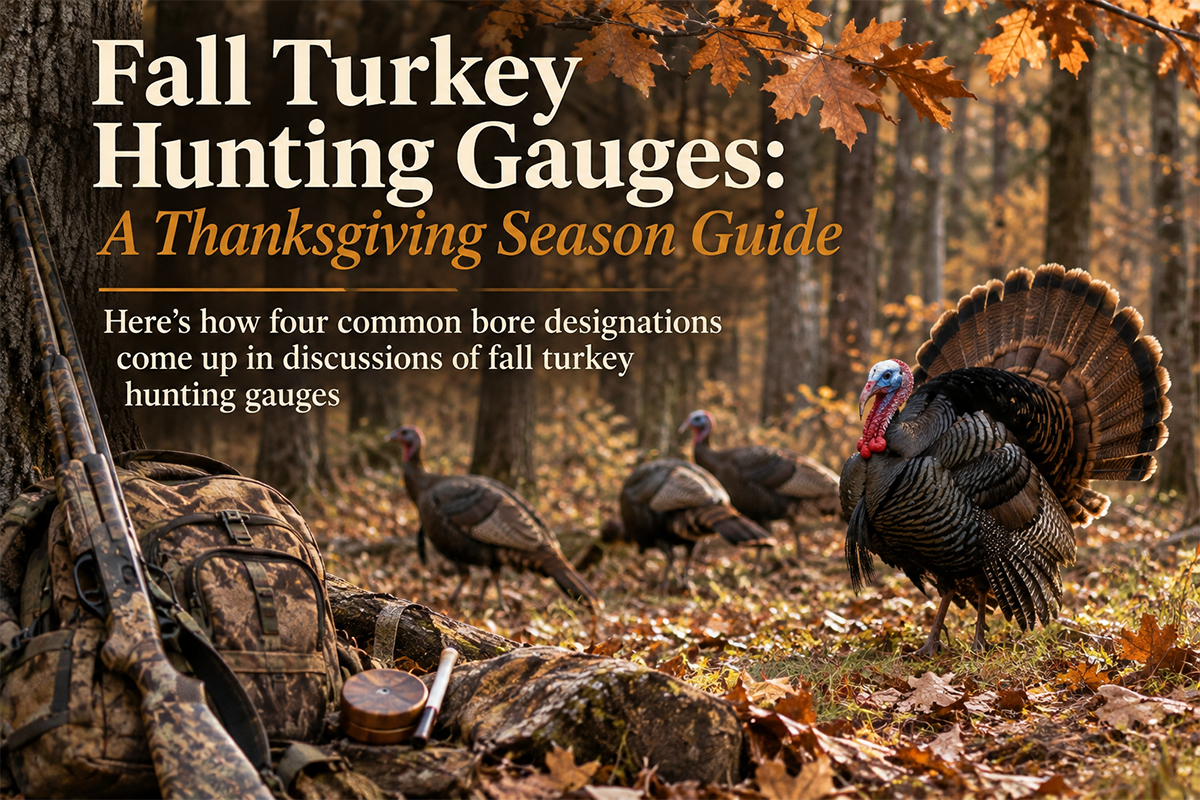
Pennsylvania’s Thanksgiving turkey season gives hunters in eight wildlife management units three more days afield, from Nov. 25 through Nov. 27, 2026. Here’s how four common bore designations come up in discussions of fall turkey hunting gauges, what the markings tell you about an individual shotgun, and which Pennsylvania rules matter before you head out. Pennsylvania Game Commission season dates and bag limits
Where/When: Eastern wild turkeys live year-round in Pennsylvania’s woods and mountains. In late fall, they often travel in flocks and feed on acorns, beechnuts, and seeds. Birds typically roost in trees overnight and forage on the ground during the day. Snow can change which foods are accessible. Pennsylvania sets fall dates by wildlife management unit. Check the current regulations wherever you hunt. Pennsylvania Game Commission wild turkey profile
Fall turkey hunting gauges at a glance
The traditional gauge system is based on how many lead balls of the bore’s diameter add up to one pound. The lower the gauge number, the larger the nominal bore. The .410 bore uses a nominal diameter in inches. Sporting Arms and Ammunition Manufacturers’ Institute gauge definition
| Designation | Relative bore size | What the designation describes |
|---|---|---|
| 12 gauge | Largest of these four | Traditional shotgun gauge |
| 20 gauge | Smaller than 12 gauge | Traditional shotgun gauge |
| 28 gauge | Smaller than 20 gauge | Traditional shotgun gauge |
| .410 bore | Smallest of these four | Nominal bore diameter in inches |
12 Gauge: A Familiar Designation Across Many Shotgun Styles
The 12-gauge designation appears on sporting shotguns ranging from lightweight field models to heavier target models. The gauge tells you about the bore. The model specifications give you the details that matter when comparing physical size and handling.
PROS
- Familiar designation across field and sporting models.
- Many action styles and stock dimensions to compare.
- Current models generally have accessible manuals.
CONS
- Heavier configurations can be cumbersome to carry.
- Dimensions vary considerably by model.
- The gauge alone leaves chamber length unspecified.
Interesting Fact: The gauge number originally referred to 12 bore-diameter lead balls weighing one pound in total.
Consider This Gauge If…
You already own a 12 gauge and are reviewing it before the holiday. Look up the exact model and check that your lockable case fits its full length.
20 Gauge: A Smaller Bore With Full-Size and Compact Models
The 20 gauge sits between 12 and 28 gauge by bore diameter. Full-size and compact configurations can share the same gauge, even when their weight, stock length, and controls feel quite different.
PROS
- Full-size and compact models make fit easier to compare.
- Some models have lighter frames than their 12-gauge counterparts.
- Common gauge markings are easy to recognize.
CONS
- Weight differences depend on the individual model.
- Compact stocks may feel cramped for some adults.
- Older or worn markings may need professional identification.
Interesting Fact: A higher gauge number represents a smaller bore because more of the smaller lead balls fit into the same one-pound total.
Consider This Gauge If…
You’re comparing a familiar 20 gauge with a compact version of the same model. Check the actual dimensions, and have eye and ear protection handy for any range visit.
28 Gauge: A Traditional Small-Bore Designation
The 28 gauge uses the same naming convention as both larger gauges in the table. Some dedicated 28-gauge designs are built on small frames. Others share their basic design with a larger-gauge model.
PROS
- Dedicated small-frame models are available.
- Uses the familiar whole-number gauge system.
- Available in field and sporting configurations.
CONS
- Fewer configurations to compare in many product lines.
- Shared-frame models may weigh more than expected.
- Older and newer models can carry different chamber markings.
Interesting Fact: Of the four designations here, 28 is the highest traditional gauge number.
Consider This Gauge If…
You already own a 28 gauge and are reviewing a late-fall packing list. Put a flashlight or headlamp in an accessible pocket for the walk back to the vehicle.
.410 bore: An Inch-Based Designation
The decimal in .410 bore gives the nominal bore diameter in inches. Chamber length is a separate measurement. That distinction matters when you see two inch-based numbers on a barrel or in a manufacturer’s manual.
PROS
- The designation directly expresses nominal bore diameter.
- Compact models are available.
- Many models use easily recognizable bore markings.
CONS
- The naming convention can confuse first-time readers.
- Stock dimensions vary among compact models.
- Two inch-based markings can be easy to mix up.
Interesting Fact: The nominal .410-inch diameter is about 10.4 millimeters.
Consider This Gauge If…
You’re checking the markings on a family .410 bore before a trip. If they’re unclear, ask a gunsmith. For the fall woods, check that your fluorescent orange fits over your outer layers.
Keep gauge and chamber markings separate
Holiday hunting trips sometimes bring several people’s gear into the same truck or camp. Keep ammunition in its labeled packaging and stored separately from firearms. Loose shells and worn labels make identification harder, and color alone is an unreliable guide. Keep firearms unloaded when they’re out of use. If the markings on a firearm or ammunition are uncertain, set it aside and consult the manufacturer or a qualified gunsmith. SAAMI firearm safety rules
Pennsylvania’s 2026 Thanksgiving turkey season
The Thanksgiving split runs Wednesday, Nov. 25, through Friday, Nov. 27, 2026, in WMUs 2A, 2B, 2C, 2D, 2E, 2F, 3B, and 3C. Earlier fall dates differed among these units. The Thanksgiving dates are the same across all eight. If you’re visiting family or hunting a different property for the holiday, confirm its exact location on the Game Commission map. A nearby town or county name can be too broad to tell you which unit a particular parcel falls in. Pennsylvania Hunting & Trapping Digest and interactive map
The Game Commission allows shotguns with fine shot and archery equipment during the fall season. Single-projectile firearms are prohibited. Pennsylvania’s fall season is open to male or female turkeys, with a limit of one fall bird per license year. The Thanksgiving split is part of that same fall season, so a hunter who already took a fall turkey has filled the season limit. Review the current digest for complete equipment, licensing, and shooting-hour rules. Pennsylvania Game Commission fall season announcement
The split is a good example of how Pennsylvania manages fall turkey hunting locally. The Game Commission uses population trends within each unit to set its season length. Summer sightings give biologists information on how many young birds survived per hen observed, which feeds into the agency’s population model. Several units with earlier openings have already finished their 2026 fall seasons, and WMUs 5C and 5D are closed to fall turkey hunting this year. Game Commission season outlook and survey results
Keep your fall tag accessible. Pennsylvania requires hunters to tag the turkey before moving it and report the harvest within 10 days. The report asks for the wildlife management unit, county, township, sex, and age of the bird. Keeping the location information with your license can save you from having to reconstruct it later, especially if your holiday plans take you to an unfamiliar property. Pennsylvania tagging and harvest reporting instructions
Safety in the late-November woods
A turkey call, a flicker of color, or a patch of moving leaves can come from another person. Positively identify the bird and know what lies beyond it. Pass whenever the view is obstructed or you are unsure what you’re seeing. Keep the muzzle pointed in a safe direction and your finger off the trigger. Tell someone where you plan to go and when you expect to return, particularly when you’re visiting unfamiliar ground with spotty cell service. Pennsylvania Game Commission hunting safety guidance
The Game Commission strongly recommends fluorescent orange for fall turkey hunters, particularly while moving. That makes an orange vest or hat a worthwhile item to have within reach on a short holiday hunt. Check the orange rules that apply to your activity and location, including the separate rules for people on state game lands. Pennsylvania fluorescent orange guidance
After harvest, wear gloves when handling or dressing the bird and wash your hands and tools afterward. The Game Commission advises leaving birds that appear sick or that you find dead alone. Keep the tools used to dress a wild bird separate from kitchen equipment, and clean them before using them again. Those steps are worth planning for when you’ll be traveling between the woods and a holiday gathering. Game Commission guidance on handling harvested birds
Before you head out
Confirm your wildlife management unit, its season dates, and your fall tag before heading out. Check the manufacturer’s markings and manual for the details of any individual shotgun. For future Thanksgiving seasons, consult the Game Commission’s current schedule. Current Pennsylvania hunting seasons and bag limits