
Best Gauges for Hunting Black Francolin: Comparisons & Picks
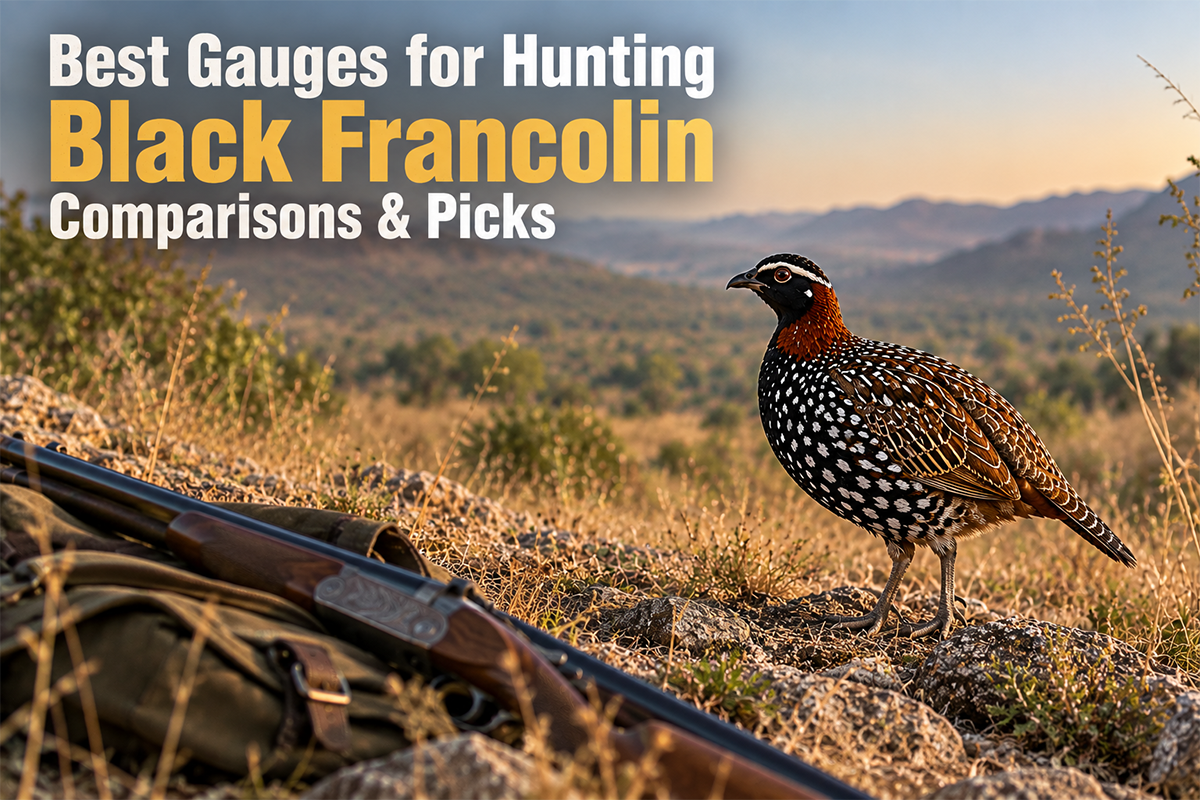
Compare 20 gauge, 28 gauge, 12 gauge, and .410 bore options for Black Francolin hunting in Hawaiʻi.
For hunters comparing Black Francolin hunting gauges, the practical choice comes down to carry weight, recoil, pattern density, and how quickly birds flush from grass or brush. In Hawaiʻi, where Black Francolin are introduced game birds, a light shotgun that mounts quickly is often more useful than extra payload. The 20 gauge is the balanced starting point, 28 gauge favors light weight and mild recoil, 12 gauge offers broad ammunition choice, and .410 bore demands careful range discipline. Pattern the exact gun, choke, and load before hunting and keep shots within the distance where the pattern remains reliably dense.
Where/When: In North America, the most established hunting context for Black Francolin is Hawaiʻi. Hawaiʻi DLNR lists the species as a huntable game bird on Hawaiʻi Island, Maui, Molokaʻi, Oʻahu, and Kauaʻi, while its current species table does not list it for Lānaʻi. The agency notes that Black Francolin were introduced to Hawaiʻi and commonly use thick vegetation, brushy areas, and tall grasslands, often near water. Hunters may hear calling birds around first light and often find better movement during cooler morning periods, but daily activity can shift with wind, rain, hunting pressure, and local cover. Hawaiʻi game-bird seasons generally fall in the late-year period, often November through January, but legal days, units, permits, bag limits, and access conditions vary by island and can change. Check the current DLNR season announcement and unit rules before every trip.
Black Francolin Hunting Gauge Comparisons
| Feature | 20 Gauge | 28 Gauge | 12 Gauge | .410 Bore |
|---|---|---|---|---|
| Recoil Relative kick with typical upland-style field loads. |
Mild to moderate | Mild | Moderate, depending on load and gun weight | Very mild in many field loads |
| Practical Patterned Range Typical working distance after confirming the exact gun, choke, and load on paper. |
About 20–35 yards | About 20–35 yards | About 20–40 yards | About 15–25 yards for many hunters |
| Typical Shot Charge Common light-field payloads; exact offerings vary by shell length and manufacturer. |
About 7/8–1 oz | About 3/4–1 oz | About 1–1 1/8 oz | About 1/2–11/16 oz |
| Versatility How readily the option crosses over to other upland birds and small game. |
Excellent all-around upland choice | Excellent for light upland use | Very broad hunting versatility | Best for close, carefully patterned small-game work |
| Ammo Availability General availability can vary by island, store, and season. |
Generally strong | More limited | Usually the broadest | Common, but suitable field loads may be narrower |
20 Gauge
The 20 gauge is the strongest all-around option for Black Francolin because it combines useful pattern density, manageable recoil, and light shotgun choices. That matters in grass, brush edges, ranch country, and slopes where the gun may be carried far more than fired. Light field loads with small upland shot such as No. 7 1/2 or No. 8 are sensible starting points when legal. Try improved cylinder or modified choke, then pattern at 20, 25, 30, and 35 yards. Select the choke that produces an even pattern without large gaps. Any action type can work; prioritize fit, a clean mount, and a safety you can operate naturally.
PROS
- Good balance of pellet count, recoil, and carrying weight
- Wide selection of upland-style shotguns and field loads
- Forgiving enough for fast flushes without requiring a heavy gun
CONS
- More recoil than 28 gauge or many .410 bore loads
- Very light guns can feel lively or whippy to some shooters
- Island-specific ammunition selection may still be limited
Interesting Fact: The 20 gauge has long been a standard upland-bird option because it can deliver useful patterns from noticeably lighter shotguns than many traditional 12-gauge field guns.
Consider this Gauge If…
You want one practical upland shotgun with moderate recoil, good portability, and enough pattern density to handle typical Black Francolin flushes.
28 Gauge
The 28 gauge suits hunters who want a trim upland gun with mild recoil and fast handling. A well-patterned 28 gauge can be very effective at normal flushing-bird distances without a heavy payload. Typical 3/4-ounce loads are pleasant to shoot and can produce useful patterns, but ammunition may be harder to find locally than 12- or 20-gauge shells. Secure enough of one load for both patterning and hunting. Because many 28-gauge guns are very light, proper fit matters; quick handling helps on sudden flushes but can encourage a rushed swing. Start with improved cylinder or modified and let the pattern board decide.
PROS
- Mild recoil encourages smooth, confident shooting
- Light shotguns are comfortable for long walks
- Efficient upland patterns with appropriate loads and chokes
CONS
- Ammunition can cost more and be harder to source
- Fewer shotgun choices than 12 or 20 gauge
- Light guns can be less forgiving of poor mounting technique
Interesting Fact: Despite its smaller payload, the 28 gauge has a strong upland following because good loads can produce remarkably even patterns with relatively low recoil.
Consider this Gauge If…
You shoot 28 gauge well, want a light walking gun, and can secure enough of the same field load for pattern testing and the hunt.
12 Gauge
The 12 gauge makes sense for hunters who want one shotgun for Black Francolin plus larger upland birds or other game. Its advantage is choice: many shotgun models, shell types, payloads, and choke options are available. Light 1-ounce field loads can limit recoil while still producing dense patterns. A lighter 12-gauge gun can work well in steep country, though full-size models may feel heavy after hours on foot. Extra gun weight can steady the swing, but it does not justify longer shots. Start with improved cylinder or modified and let pattern quality, target presentation, and shooter consistency set the limit.
PROS
- Broadest selection of shotguns, shells, and choke options
- Dense patterns with light field loads
- Highly versatile for hunters pursuing multiple game species
CONS
- Can add unnecessary gun weight for a small upland bird
- Recoil increases quickly with heavier field loads
- Dense close-range patterns demand disciplined shooting
Interesting Fact: A 12 gauge does not require a heavy hunting load; light payloads can make it much more pleasant for small-bird hunting while preserving the platform’s broad versatility.
Consider this Gauge If…
You already own a well-fitted 12 gauge, want broad ammunition choice, or need one shotgun that can cover several hunting roles.
.410 Bore
The .410 bore offers very mild recoil and light guns, but its small shot charge leaves less margin for pattern gaps or range errors. It is best for experienced shooters who will pass on longer or poor presentations. A .410 bore can work on close-flushing Black Francolin, but careful pattern testing is essential. Compare 2 1/2-inch and 3-inch loads only if the shotgun is chambered for both, and never use a shell longer than the chamber marking. Test loads at 15, 20, and 25 yards with open to moderate chokes, then set a personal maximum distance from actual paper patterns. Low recoil does not make the .410 bore the easiest field option.
PROS
- Very mild recoil with many field loads
- Light, compact shotguns are easy to carry
- Useful for close-range hunting when carefully patterned
CONS
- Small shot charge leaves less room for aiming error
- Ethical range is often shorter than with larger gauges
- Requires disciplined shot selection and precise pattern testing
Interesting Fact: Unlike 12, 20, and 28 gauge, .410 bore is named for its approximate bore diameter rather than by the traditional shotgun gauge system.
Consider this Bore If…
You are an experienced shotgunner who expects close shots, values low recoil, and will pass on birds beyond your proven pattern distance.
Choosing a Shotgun for Black Francolin Hunting
For most hunters, 20 gauge offers the easiest blend of low carrying weight, manageable recoil, pattern density, and ammunition choice. The 28 gauge favors a light upland gun, 12 gauge favors versatility and shell availability, and .410 bore suits practiced shooters who keep shots close. Whatever the shotgun, use legal ammunition, confirm chamber length and choke compatibility, and pattern the exact hunting load before opening day. Hawaiʻi DLNR states that game birds may be hunted with shotguns or bow and arrow and prohibits BB or larger shot except during the spring turkey hunt; public-area hunters are also subject to blaze-orange requirements except in designated archery-only areas. Keep the muzzle in a safe direction, positively identify the bird and what is beyond it, and avoid low shots around partners, dogs, roads, buildings, livestock, or other hunters. Stay inside your proven pattern range and verify current island, unit, season, bag limit, hunting-day, license, stamp, check-in, landowner-permission, and any non-toxic-shot requirements before hunting.