
Best Gauges for Hunting Mountain Quail: Comparisons & Picks
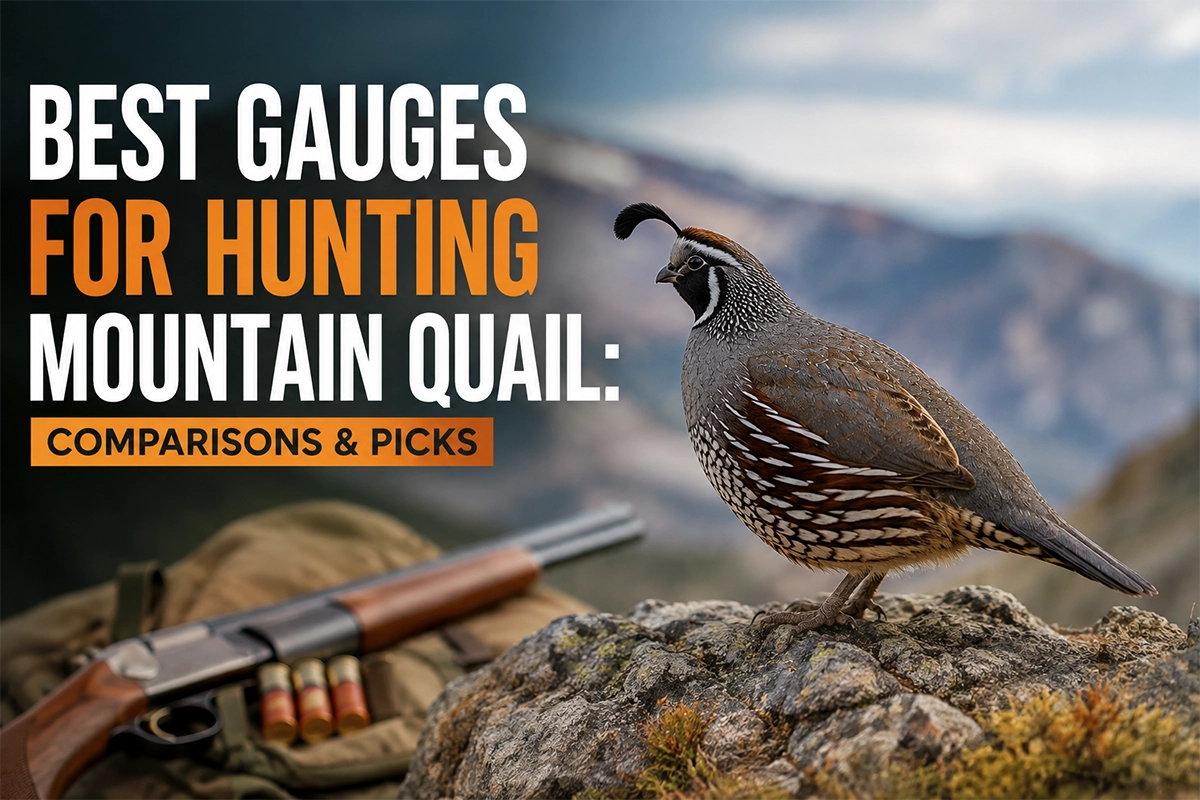
Compare 12 gauge, 20 gauge, 28 gauge, and .410 bore for fast, close-range mountain quail hunting.
Choosing the best mountain quail hunting gauges comes down to balancing shotgun weight, recoil, pattern density, handling, ammunition selection, and the terrain you expect to cover. Mountain quail often live in steep, brushy country where hunters may hike for hours before a covey suddenly flushes through a narrow opening. A shotgun that mounts quickly and carries comfortably can be more useful than one built around maximum payload. The four practical choices below—12 gauge, 20 gauge, 28 gauge, and .410 bore—cover a range from forgiving pattern density to extremely light recoil and carrying weight. Pattern your shotgun before hunting, confirm that your ammunition is compatible with your firearm and choke, practice safe muzzle control, positively identify birds before firing, and limit shots to distances where you can consistently place an effective pattern.
Where/When: Mountain quail are commonly associated with mountainous regions of the western United States, especially brushy slopes, forest edges, chaparral, riparian corridors, creek bottoms, and other steep terrain with dependable food and cover. Hunters often find sign near water, feeding areas, brushy travel routes, loafing cover, and transitions between dense vegetation and more open ground. Early mornings and late afternoons can be productive as birds move between feeding and secure cover, while midday activity may shift toward shaded or protected areas. Early-season coveys are often influenced by water and family-group patterns, while colder weather, snow, and changing food sources can alter movement later in the season. Exact timing varies by region, elevation, weather, and regulations, so always check current seasons, bag limits, zone boundaries, ammunition requirements, and other local rules before hunting.
Gauge Comparisons
| Feature | 12 Gauge | 20 Gauge | 28 Gauge | .410 Bore |
|---|---|---|---|---|
|
Recoil How much kick you can expect when firing. |
Moderate to heavy depending on gun weight and load | Mild to moderate | Mild | Very mild with many field loads |
|
Effective Range The distance at which the gauge or bore can maintain a useful hunting pattern with a suitable load and choke. |
Often about 20–40 yards | Often about 20–35 yards | Often about 20–35 yards with good patterning | Best kept relatively close, often inside about 25–30 yards |
|
Typical Shot Payload Common upland payloads vary by shell length, firearm, and load. |
Often 1 to 1 1/4 oz | Often 7/8 to 1 oz | Often 3/4 to 1 oz | Often 1/2 to 11/16 oz |
|
Versatility How well the gauge or bore works for other game species. |
Excellent for many upland and waterfowl applications | Excellent all-around upland choice | Very good for upland birds | More specialized for close-range small-game use |
|
Ammo Availability How easy it is to find ammunition for the gauge or bore. |
Typically excellent | Typically excellent | Generally good but less broad than 12 or 20 gauge | Generally available, though hunting-load selection may be narrower |
12 Gauge
The 12 gauge is the most forgiving option in this comparison when pattern density and versatility are priorities. Its larger payload capacity gives hunters more pellets to work with, which can help when a mountain quail flushes farther than expected or crosses a brief opening before vanishing into thick cover. That does not mean heavy field loads are necessary. For quail, moderate upland loads are usually more comfortable to shoot and easier to control. The main disadvantage is carrying weight. A substantial 12-gauge shotgun can become tiring on steep climbs, while an ultralight model may produce sharper recoil. Hunters should look for a gun that balances well, mounts naturally, and is comfortable enough to carry for several hours.
PROS
- Dense patterns offer useful forgiveness on fast crossing birds.
- Wide ammunition selection makes load testing relatively easy.
- Highly versatile for hunters who pursue several bird species.
CONS
- Can produce more recoil than smaller gauges.
- Many 12-gauge shotguns are heavier in steep country.
- Heavy hunting loads are usually unnecessary for mountain quail.
Interesting Fact: The 12 gauge offers one of the broadest ranges of shotgun loads, allowing hunters to use relatively light upland shells for quail while keeping the same shotgun useful for larger birds and other hunting situations.
Consider this Gauge If…
Choose a 12 gauge if you already shoot one well, want broad ammunition availability, or prefer extra pattern density when birds flush at unpredictable distances. A shorter, well-balanced upland gun can be easier to maneuver in brush than a long, heavy field setup. Start pattern testing with open or moderately open chokes at the distances you actually expect to shoot. Rather than relying only on choke labels, count pellet distribution and confirm that your chosen load gives enough coverage without producing an excessively tight pattern at close range.
20 Gauge
For many hunters, the 20 gauge is the best all-around mountain quail choice. It offers enough payload for practical upland ranges while allowing shotguns to remain relatively light and quick handling. That combination matters when hunting steep slopes, brushy draws, and uneven ground where every extra pound becomes noticeable by the end of the day. Recoil is usually easier to manage than with comparable 12-gauge setups, especially with moderate upland loads. The 20 gauge also provides more pattern margin than the smaller 28 gauge or .410 bore, making it a sensible middle ground for both experienced wingshooters and hunters still developing confidence on fast flushing birds.
PROS
- Excellent balance of weight, recoil, and pattern density.
- Well suited to long walks and steep mountain terrain.
- Common ammunition with many practical upland loads.
CONS
- Provides fewer pellets than comparable 12-gauge loads.
- Very light shotguns can still feel sharp with heavier shells.
- Longer shots still require careful patterning and range judgment.
Interesting Fact: The 20 gauge has remained a favorite among upland hunters because it can deliver useful hunting payloads from shotguns that are often noticeably lighter and handier than comparable 12-gauge models.
Consider this Gauge If…
Choose the 20 gauge if you want one practical shotgun for mountain quail and other upland birds without carrying unnecessary weight. It is particularly attractive for hunters who cover several miles of rough ground or who prefer moderate recoil. Gun fit should be a major part of the decision. A shotgun that comes naturally to the shoulder and points where you look will usually serve you better on a sudden flush than a heavier gun chosen only for payload capacity. Pattern several loads with your actual choke before deciding what to hunt with.
28 Gauge
The 28 gauge is a strong choice for hunters who place a premium on light weight and responsive handling. Properly scaled 28-gauge shotguns can feel lively in the hands, making them well suited to birds that flush abruptly from dense cover. Recoil is generally mild, and common upland payloads can produce effective patterns for mountain quail when matched carefully to the gun and choke. The tradeoff is a smaller pellet count than 12 or 20 gauge. That leaves less room for poor centering or overestimating range. Ammunition selection may also be narrower, so it pays to find a load that patterns well and purchase enough of the same type for practice and hunting.
PROS
- Light, responsive shotguns are excellent for steep upland walking.
- Mild recoil can promote smooth shooting and follow-through.
- Well suited to close and moderate mountain quail shots.
CONS
- Smaller payload provides less forgiveness than 12 or 20 gauge.
- Ammunition choices may be more limited.
- Hunters need disciplined range estimation as distance increases.
Interesting Fact: The 28 gauge has a strong following among dedicated upland hunters because its modest payload can still perform efficiently while allowing manufacturers to build exceptionally trim, quick-handling shotguns.
Consider this Gauge If…
Consider a 28 gauge if you routinely climb steep terrain, value a lively shotgun, and are comfortable keeping shots within the ranges your patterns support. It is especially appealing to hunters who prioritize gun handling and low recoil over maximum pellet count. Check chamber length, choke compatibility, and legal ammunition requirements before purchasing shells. Because smaller payloads provide less room for error, careful pattern testing is particularly important. Two loads with similar specifications can behave differently through the same barrel and choke.
.410 Bore
The .410 bore is the most specialized option here, and it is correctly described as a bore rather than a gauge. Its advantages are low recoil and the availability of very light, compact shotguns. Those traits can be appealing in steep mountain terrain, but the smaller shot charge creates a less forgiving pattern. A .410 bore can work for mountain quail when birds are close and the shooter is disciplined, but it demands more precise shooting than the larger gauges. It should not automatically be considered a beginner option simply because recoil is mild. Fewer pellets mean less margin for aiming, timing, and range-estimation errors.
PROS
- Very low recoil with many field loads.
- Compact, lightweight shotguns are easy to carry.
- Can be effective for disciplined close-range shooting.
CONS
- Small payload creates less forgiving patterns.
- Practical hunting range is more limited.
- Requires careful pattern testing and conservative shot selection.
Interesting Fact: Unlike 12, 20, and 28 gauge, .410 is a bore designation based approximately on barrel diameter in inches. Calling it “.410 gauge” is technically incorrect.
Consider this Bore If…
Choose .410 bore if very low recoil and minimal carrying weight are important and you are willing to keep shots close. It can be rewarding for experienced wingshooters who understand its limitations and pass marginal opportunities. Pattern the exact hunting load at several distances so you know where pellet coverage begins to fall apart. Confirm that the shell length is appropriate for your shotgun, verify choke compatibility, and use only ammunition that complies with local regulations. Ethical shot selection matters more with .410 bore because its smaller payload gives you less room for error.
Choosing the Best Gauge for Mountain Quail
For most hunters, the 20 gauge offers the strongest overall balance for mountain quail because it combines manageable recoil, practical pattern density, light carrying weight, and common ammunition. The 12 gauge is an excellent choice for hunters who want maximum versatility and a more forgiving pattern, provided they are comfortable with its potential weight and recoil. The 28 gauge is particularly attractive for experienced upland hunters who value a light, quick-handling shotgun in steep terrain. The .410 bore is best treated as a close-range specialist rather than a general-purpose recommendation. Regardless of your choice, pattern your shotgun with the exact load you plan to hunt, verify chamber and choke compatibility, practice safe firearm handling, positively identify birds before shooting, and prioritize ethical shots within your demonstrated ability. Hunting regulations vary by jurisdiction and may include non-toxic shot requirements, magazine limits, season dates, bag limits, shooting-hour restrictions, and other rules, so check current local laws before heading into the field.