
Best Gauges for Hunting Black-billed Magpie: Comparisons & Picks
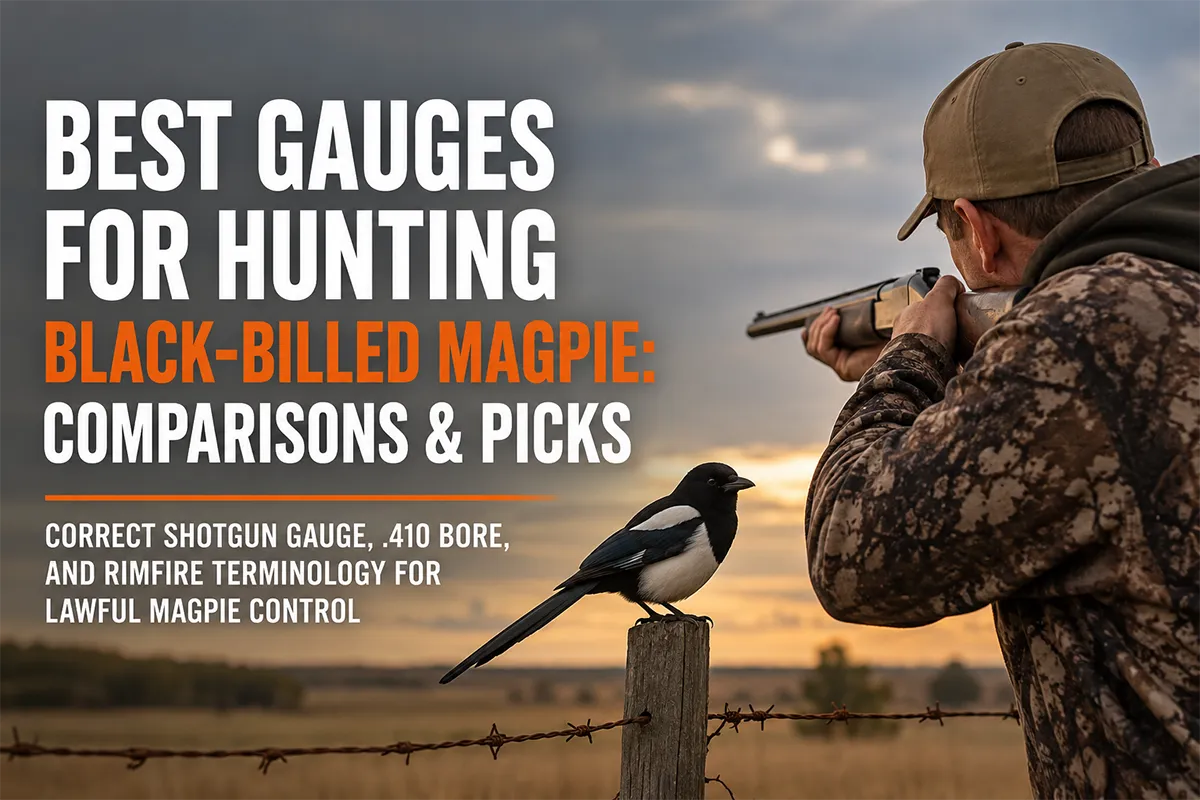
Correct shotgun gauge, .410 bore, and rimfire terminology for lawful magpie control.
For black-billed magpie hunting gauges, the best choice is usually a light shotgun setup that patterns well at close range without being excessive. The correct terminology matters: 12 gauge, 20 gauge, and 28 gauge are shotgun gauges; .410 bore is not a gauge; and .22 LR is a rifle caliber. This guide keeps that distinction clear while comparing practical options for lawful, ethical black-billed magpie control. Because regulations can vary by federal, state, tribal, and local authority, confirm that take is legal before acting, and check rules for seasons, permits, non-toxic shot, magazine limits, and lawful methods.
Where/When: Black-billed magpies are commonly associated with the western half of North America, especially open rangeland, agricultural edges, shelterbelts, riparian corridors, ranch country, and broken brush near livestock, carrion, grain, water, or nesting cover. Hunters or landowners looking for legal control opportunities often pattern birds around feedlots, calving areas, travel lanes between roosting and feeding cover, fence lines, creek bottoms, and visible perches. Timing varies by region and regulation, but magpies are often most active during morning and evening movement, while weather, food availability, nesting season behavior, and local pressure can change daily patterns. Always check current regulations before any hunt or control activity.
Gauge Comparisons
| Feature | 12 gauge | 20 gauge | 28 gauge | .410 bore | .22 LR |
|---|---|---|---|---|---|
| Recoil How much kick you can expect when firing. |
Low to moderate with light field loads | Low and easy for most shooters | Very low | Minimal | Minimal |
| Effective Range The distance where the option remains practical for clean, ethical use. |
Typically 20–35 yards with small shot | Typically 20–30 yards with small shot | Typically 15–30 yards with small shot | Typically 15–25 yards with small shot | Only for deliberate shots with a safe backstop |
| Load or Bullet Weight Range The typical shot payload or bullet weight range available. |
Shot payloads often 7/8–1 1/8 oz | Shot payloads often 3/4–1 oz | Shot payloads often 3/4 oz | Shot payloads often 1/2–11/16 oz | Bullets often 36–40 grains |
| Versatility How well the option performs for other lawful hunting uses. |
Excellent for many upland and small-game uses | Excellent light shotgun option | Good for close upland and small-game use | Specialized for close shooting | Useful for small game only where legal and safe |
| Ammo Availability How easy it is to find suitable ammunition. |
Very common | Very common | Moderate | Common but load-sensitive | Very common |
12 gauge
The 12 gauge is the most forgiving shotgun gauge in this comparison. It solves the pattern-density problem that comes with a small, quick, wary bird. A light 12 gauge field or target load with small shot can give a useful pattern at close range without needing heavy recoil or oversized pellets. This gauge matters most when birds flush suddenly from corrals, shelterbelts, brushy draws, or open ranch edges and the shooter needs a short, clean window. Choose an open or improved-cylinder choke for close work, then pattern the gun at 20, 30, and 35 yards. If non-toxic shot is required in your area or on the land you hunt, pick a legal load and test it before field use.
PROS
- Strongest pattern density among the shotgun gauges listed here
- Very broad ammunition selection
- Good choice for fast, close, moving shots
CONS
- Can be more gun than needed for a small bird
- Heavier shotguns may be less convenient to carry
- Close-range patterns can be too dense if choke choice is poor
Interesting Fact: A 12 gauge is a shotgun gauge, not a caliber, so it should never be written as “12 gauge caliber.”
Consider this Gauge If…
Consider this gauge if you already own a 12 gauge, want the widest shell availability, or need a forgiving pattern for legal magpie control around open agricultural ground. It is also the best pick when wind, distance judgment, or fast bird movement makes smaller shotgun options less forgiving. Use safe muzzle control around buildings, roads, livestock, and people, and take only shots that offer a clean pattern and ethical result.
20 gauge
The 20 gauge is often the best all-around shotgun gauge for black-billed magpie because it balances pattern, recoil, gun weight, and practicality. It solves the common problem of using too much shotgun while still giving enough pellet count for clean close-range shooting. Compared with 12 gauge, a 20 gauge is usually easier to carry and quicker to mount, especially during property checks, fence-line walks, or short setups near travel corridors. Compared with .410 bore, it gives far more pattern forgiveness. For most shooters, small shot through an improved-cylinder or modified choke is a sensible starting point, but pattern testing should decide the final load and choke combination.
PROS
- Excellent balance of pattern density and low recoil
- Common shotguns and shells
- Practical for youth, smaller-framed, or recoil-sensitive shooters
CONS
- Less pellet count than 12 gauge
- Can run thin if shots are stretched too far
- Non-toxic load choices may be narrower than 12 gauge
Interesting Fact: A 20 gauge is still a shotgun gauge, even though many hunters casually group it into broader equipment discussions.
Consider this Gauge If…
Consider this gauge if you want the most practical compromise for lawful magpie control. It matters when you need a shotgun that carries easily, points quickly, and does not punish the shooter with unnecessary recoil. Choose a gun that fits well, confirm pattern coverage on paper, and stay inside distances where pellet density remains ethical. Also confirm any applicable magazine limits, legal methods, shot-material rules, and authorization requirements before use.
28 gauge
The 28 gauge is a light, pleasant shotgun gauge for disciplined close-range shooting. It solves the handling problem better than the power problem: many 28 gauge shotguns are quick, smooth, and easy to carry, but the smaller shot payload leaves less margin for poor range judgment. For black-billed magpie, that means the 28 gauge can work well when shots are close, the shooter is practiced, and the chosen load patterns evenly. It is not a good choice for stretching distance across open ground or trying to compensate for rushed shooting. If you use a 28 gauge, focus on clean opportunities and pass marginal birds.
PROS
- Very low recoil and smooth handling
- Light shotguns are easy to carry
- Useful for close birds with a proven pattern
CONS
- Less forgiving than 12 gauge or 20 gauge
- Ammunition can be less available
- Not ideal for longer or wind-affected shots
Interesting Fact: The 28 gauge is a true shotgun gauge and should not be described as a rifle or handgun caliber.
Consider this Gauge If…
Consider this gauge if you are a confident wingshooter who values a light firearm and can keep shots close. It is best around brush lines, small groves, creek bottoms, or ranch structures where legal shooting distances are short. Pick a load with enough small-shot pellet count, avoid overly tight chokes at very close range, and confirm that your pattern gives clean coverage before relying on it in the field.
.410 bore
The .410 bore is not a gauge. For black-billed magpie, .410 bore is a close-range shotgun option with minimal recoil and limited pattern forgiveness. It solves the problem of carrying a light, easy-handling firearm, but it does not solve the problem of thin patterns on small birds. Because the shot charge is small, every choice matters: shell length, shot size, choke, distance, and shooter skill. The .410 bore can be useful only when birds are close and the shooter can pass anything marginal. It is a poor choice if the goal is maximum forgiveness.
PROS
- Minimal recoil
- Light and convenient for close-range use
- Can work where birds are predictable and very close
CONS
- Small shot payload gives little margin for error
- Patterns may be thin beyond close range
- Not ideal for inexperienced shooters
Interesting Fact: The correct term is .410 bore, never .410 gauge.
Consider this Bore If…
Consider the .410 bore only if your shots are close, your pattern is proven, and you are willing to pass on birds that are moving away, quartering fast, or beyond reliable range. It matters most in controlled settings where a light shotgun is convenient and the legal shooting situation is predictable. If non-toxic shot is required, test several loads because the small payload can make pattern gaps more noticeable.
.22 LR
The .22 LR is the only rifle caliber in this guide. It should not be treated like a shotgun gauge and should not be used for flying birds. It solves a narrow problem: deliberate, lawful control work where a bird is stationary and a safe earth backstop is certain. Because a .22 LR bullet can travel far beyond the target, it is inappropriate for elevated birds on trees, wires, fence posts, roofs, ridgelines, or any setup without a secure backstop. For most magpie encounters, a shotgun gauge is safer and more practical than this caliber.
PROS
- Very low recoil
- Accurate for deliberate shots at small targets
- Inexpensive practice ammunition is commonly available
CONS
- Unsafe for airborne or elevated birds without a backstop
- Less forgiving than a shotgun gauge on moving birds
- May be restricted by legal method-of-take rules
Interesting Fact: .22 LR is a rimfire rifle caliber; it is not a gauge and should be described separately from shotgun options.
Consider this Caliber If…
Consider this caliber only for lawful, controlled, backstopped shots where a rifle is legal and safe. It matters most around open ground where the bullet path is downward into earth and no buildings, livestock, roads, or people are beyond the target. Confirm zero, use precise shot placement, and do not shoot if the backstop is uncertain. Ethical control means passing unsafe shots every time.
Best Overall Gauge for Black-billed Magpie
For most lawful black-billed magpie control, 20 gauge is the best overall shotgun gauge because it is light, common, manageable, and still patterned well enough for close birds. The 12 gauge is the most forgiving option when pattern density matters. The 28 gauge is a good low-recoil choice for disciplined shooters. The .410 bore is a close-range specialty option and should never be called a gauge. The .22 LR caliber belongs only in safe, deliberate, backstopped rifle situations where it is legal. Whatever you choose, pattern the shotgun or confirm the rifle zero, handle every firearm safely, take only ethical shots, and verify current regulations before any hunt or control activity.