
Best Calibers for Hunting Western Diamondback Rattlesnake: Comparisons & Picks
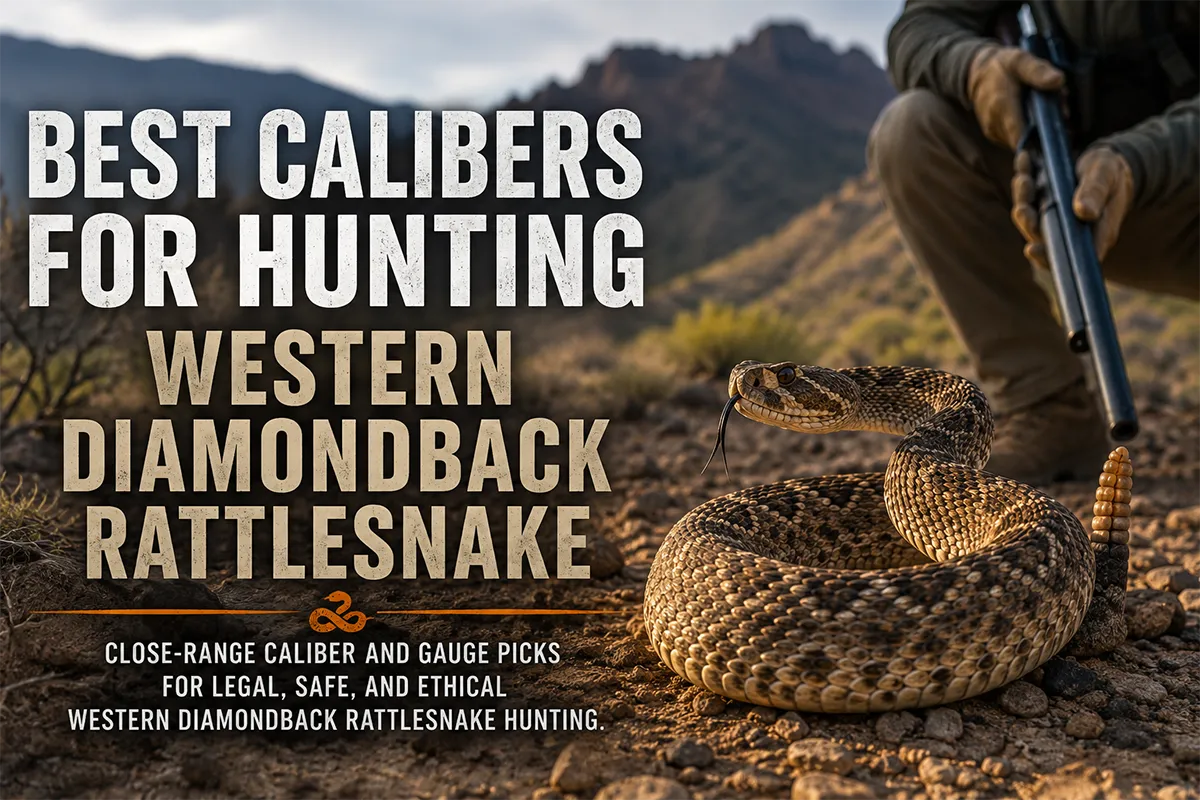
Close-range caliber and gauge picks for legal, safe, and ethical Western diamondback rattlesnake hunting.
Western diamondback rattlesnake hunting calibers are not about long-range power. The target is small, low to the ground, and often near rock, hardpan, roads, brush, or ranch structures, so ricochet risk and pellet travel matter more than energy. The Western diamondback, Crotalus atrox, inhabits arid and semiarid country in the Southwest and northern Mexico. Any firearm choice should start with local law, safe backstop, and restraint. Check current rules for licenses, seasons, take limits, minimum calibers, non-toxic shot, magazine limits, nongame permits, and local discharge ordinances before planning a hunt. :contentReference[oaicite:1]{index=1}
Where/When: Western diamondbacks commonly occur across Texas, New Mexico, Arizona, parts of southern California, and northern Mexico, especially in desert flats, mesquite grasslands, rocky washes, brushy draws, ranch roads, and cover edges near rodents. Hunters often find patterns around food, water, shade, denning cover, rock seams, two-tracks, fence lines, and canyon mouths. In many warm desert areas, activity typically increases from spring through fall, with mornings and evenings often best during hot weather and sunny periods sometimes mattering in cooler seasons. Weather, elevation, monsoon moisture, and regulations vary by region, so verify local timing and laws. :contentReference[oaicite:2]{index=2}
Western Diamondback Rattlesnake Hunting Calibers Comparison
| Feature | .22 LR Shotshell | .410 Bore | 20 Gauge | 12 Gauge | .38 Special/.357 Magnum Shotshell |
|---|---|---|---|---|---|
| Recoil How much kick you can expect when firing. |
Very light | Very light to light | Light to moderate | Moderate, depending on load | Light to moderate |
| Effective Range The distance at which the caliber remains accurate and lethal. |
Very short; pattern first | Short, controlled range | Short to modest range | Short to modest range | Very short; trail distance |
| Bullet Weight Range The range of bullet weights typically available for the caliber. |
Small shot capsules | Light shot payloads | Common upland payloads | Broad shot payload selection | Handgun shot capsules |
| Versatility How well the caliber or gauge performs for other game species besides your primary target. |
Small pests and practice | Small game and pest control | Upland birds, rabbits, and pests | Most versatile shotgun gauge | Specialty trail carry |
| Ammo Availability How easy it is to find ammunition for the caliber. |
Common caliber, specialty load | Moderate to common | Common | Very common | Specialty load; plan ahead |
.22 LR Shotshell
The .22 LR shotshell is a low-recoil caliber for close, controlled situations where a full shotgun is more than you need. It solves the problem of carrying a light firearm for legal ranch, camp, or pest-control use. It matters only when the snake is visible, the distance is very short, and the backstop is safe. Choose this option by patterning your exact load on paper first; tiny pellets spread quickly and lose energy fast. Standard .22 LR bullets are not the same tool and are usually a poor choice for this job.
PROS
- Extremely low recoil for close control
- Easy to carry around camp or ranch property
- Less destructive than larger shotgun loads
CONS
- Very limited range and pellet energy
- Must be patterned before field use
- Weak choice in wind, grass, or brush
Interesting Fact: Many .22 LR shotshells are built for pest control, which is why they should be treated as specialty loads rather than general hunting ammunition.
Consider this Caliber If…
You want minimal recoil, already carry a rimfire, and will pass any shot without a safe angle. This is for disciplined hunters who understand close-range pattern limits.
.410 Bore
The .410 bore is often the best balance for hunters who want a true shotgun pattern with very manageable recoil. It solves the problem of needing more pattern than a rimfire shotshell while keeping the gun light. It matters when the snake is legal to take, close, and positioned where pellets will not skip off rock or threaten people, livestock, vehicles, or buildings. Choose a .410 bore by confirming chamber length, testing small-game shot sizes, and selecting a load that patterns evenly at realistic distance.
PROS
- Low recoil and easy handling
- More forgiving pattern than most handgun shotshells
- Light firearms suit desert walking
CONS
- Patterns can be thin with poor loads
- Ammo may cost more than common gauges
- Still requires short shots and safe backstops
Interesting Fact: The .410 is correctly called a bore, not a gauge, which makes it the oddball shotgun option in this comparison.
Consider this Caliber If…
You want a light shotgun-style option and expect close, deliberate shots. It is a strong pick for low-recoil preferences and portability.
20 Gauge
The 20 gauge is a practical all-around gauge for hunters who also want a shotgun for birds, rabbits, and other small game. It solves the problem of thin patterns by offering more payload than .410 bore without the bulk and recoil of many 12 gauge setups. It matters in brushy desert edges, mesquite flats, and ranch-country walks where a snake may be partly screened by grass. Choose a 20 gauge with a manageable barrel, legal field loads, and a choke that patterns evenly at close range.
PROS
- Good pattern density without heavy recoil
- Versatile for upland and small-game seasons
- Common ammo and many compact guns
CONS
- More gun than some close situations need
- Pellets can travel farther than expected
- Choke, shot size, and non-toxic rules matter
Interesting Fact: Many hunters shoot a 20 gauge more accurately than a 12 gauge because the lighter recoil helps them stay composed.
Consider this Caliber If…
You want one shotgun for rattlesnake, upland, and small-game use. It fits hunters who value pattern density but do not want heavy recoil.
12 Gauge
The 12 gauge is the most versatile gauge here, but it is not automatically the best Western diamondback rattlesnake choice. It solves the problems of ammunition availability, pattern density, and multi-season usefulness. It matters for hunters who already carry a 12 gauge and can choose a mild, legal load. Choose lighter field or target-style loads when appropriate, avoid oversized shot, and pattern your gun at close range. The main caution is safety: 12 gauge payloads can be excessive around rocks, roads, hard desert surfaces, buildings, and livestock.
PROS
- Excellent ammunition availability
- Dense patterns with the right shell
- Useful for many other hunting roles
CONS
- Often heavier and louder than needed
- More recoil can reduce control
- Greater pellet travel demands caution
Interesting Fact: The 12 gauge remains popular because load selection is broad, but that variety makes choosing the mildest practical legal load important.
Consider this Caliber If…
You already hunt with a 12 gauge, tolerate its recoil, and want easy ammo sourcing. Use it only where the surroundings allow a safe shot.
.38 Special/.357 Magnum Shotshell
A .38 Special or .357 Magnum shotshell is a specialty handgun caliber choice for people who already carry a compatible revolver where legal. It solves the problem of having a compact trail or ranch option without a long gun. It matters only at very short distance, with clear identification, safe muzzle direction, and a clean angle. Choose factory shotshells that match your chambering, verify function, and pattern them before relying on them. Do not confuse shotshell performance with standard handgun bullets; pellet spread and energy are very different.
PROS
- Compact for legal trail or ranch carry
- Useful for shooters familiar with revolvers
- Less penetration than standard handgun bullets
CONS
- Very short effective range
- Close distance demands strict muzzle discipline
- Specialty ammo may be hard to find locally
Interesting Fact: Revolver shotshells fired through rifled barrels can pattern wider and less evenly than many hunters expect.
Consider this Caliber If…
You already carry a legal revolver and understand its limits. It is better as a compact backup than as a planned hunting setup.
Choosing the Best Western Diamondback Rattlesnake Caliber or Gauge
The best Western diamondback rattlesnake hunting calibers and gauges are legal, controllable, and suited to clean close-range dispatch. For many hunters, .410 bore or 20 gauge offers the best mix of pattern, recoil, and portability. A .22 LR shotshell can work at extremely short range, while 12 gauge is useful if loaded mildly and used in a safe setting. .38 Special or .357 Magnum shotshells are compact specialty choices. Before any hunt, confirm licenses, seasons, take limits, minimum calibers, non-toxic shot rules, magazine limits, public-land restrictions, and local firearm ordinances. Never shoot toward roads, rocks, water, buildings, livestock, or people. Ethical shot placement means passing unless you can make an immediate, humane dispatch. In many encounters, the responsible choice is to leave the snake alone or call a trained remover.