
Best Gauges for Hunting Osceola Wild Turkey: Comparisons & Picks
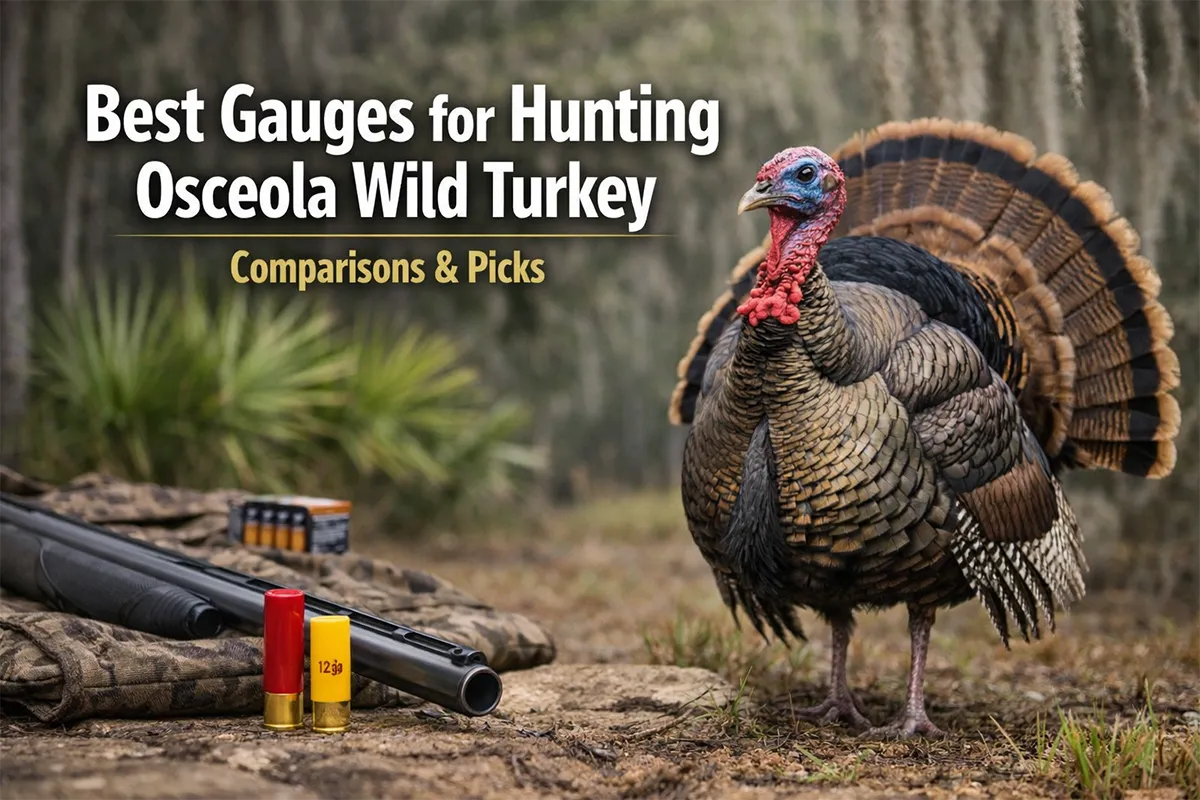
From tight Florida palmettos to open cattle-country edges, these turkey gauges help hunters balance pattern density, recoil, gun weight, and realistic calling distances.
Choosing the best Osceola wild turkey hunting gauges usually means choosing the right gauge and shell combination for the way you actually hunt. Osceolas live in thick cover, move fast when they decide to leave, and often force hunters to shoot through narrow windows rather than wide-open fields. That makes pattern quality, choke compatibility, recoil control, and confidence at typical turkey ranges more important than chasing maximum power on paper. In many setups, the best pick is not the hardest-kicking option. It is the gauge you can pattern well, carry comfortably, and shoot precisely when a gobbler hangs up at the edge of your lane.
Where/When: Osceola wild turkeys are found only in Florida, most commonly in peninsula regions with pine flatwoods, oak hammocks, palmetto cover, cattle pastures, cypress edges, and mixed agricultural ground. Hunters often find them around feeding areas, sandy roads, roost zones near water, strut openings, and travel corridors connecting bedding cover to open ground. In many areas, spring is the main season hunters focus on, especially around gobbling activity at daylight, mid-morning repositioning, and late-morning calling opportunities after hens drift off. Early-season birds may stay grouped and vocal, while later birds can become pressured and cautious. Movement often increases around cool mornings, after quiet weather changes, and in places with less hunting pressure, but exact timing varies by region and regulations.
Gauge Comparisons
| Feature | 12 gauge | 20 gauge | 28 gauge | .410 bore | 10 gauge |
|---|---|---|---|---|---|
| Recoil How much kick you can expect when firing. |
Moderate to heavy | Moderate | Light | Very light | Heavy |
| Effective Range The distance at which the load remains accurate and lethal. |
Commonly 30–50 yards | Commonly 25–45 yards | Commonly 20–40 yards | Commonly 15–35 yards | Commonly 35–55 yards |
| Payload Range The range of shot payloads typically available for the gauge. |
1 1/2–2 1/4 oz loads | 1–1 1/2 oz loads | 3/4–1 1/4 oz loads | 13/16 oz to 1 oz loads | 1 3/4–2 1/4 oz loads |
| Versatility How well the gauge performs for other game species besides your primary target. |
Excellent | Very good | Good | Limited | Fair |
| Ammo Availability How easy it is to find ammunition for the gauge. |
Excellent | Very good | Moderate | Moderate | Limited |
12 Gauge
The 12 gauge is still the most practical all-around choice for Osceola wild turkey hunting because it solves the biggest turkey problem: putting a dense, forgiving pattern into a small head-and-neck target at realistic field distances. It gives hunters the widest selection of turkey loads, chokes, and shotgun platforms, which matters when you need to tune a gun for thick Florida cover and short shooting lanes. A 12 gauge is especially useful for hunters who may need a little extra pattern margin when a gobbler stops at 40 yards instead of 25.
PROS
- Best mix of pellet count, range, and aftermarket support
- Easy to find turkey loads, choke tubes, and optic-ready shotguns
- Forgiving option for hunters who want reach and pattern density
CONS
- Recoil can be sharp with magnum turkey shells
- Guns are often heavier to carry on long Florida walk-and-call hunts
- Overbuilt for some hunters who rarely shoot beyond moderate distances
Interesting Fact: Many modern 12 gauge turkey loads use heavier-than-lead shot to keep dense patterns and strong energy without requiring the very largest payloads.
Consider this Gauge If…
Choose the 12 gauge if you want the safest all-around answer for Osceolas, especially if you hunt mixed habitat where shots could be anywhere from tight palmetto openings to longer edges around pasture or oak hammocks. It is a strong fit for hunters who pattern their guns carefully, do not mind moderate recoil, and want broad ammo options at multiple price levels.
20 Gauge
The 20 gauge is one of the smartest picks for Osceola hunters who want a lighter shotgun without giving up serious turkey performance. It solves the problem of carrying a heavy rig through warm weather, sand, and thick vegetation while still delivering effective turkey patterns with the right choke and load. For many hunters, 20 gauge is the sweet spot between shootability and lethality, particularly inside common calling distances.
PROS
- Lighter recoil and lighter guns than many 12 gauge setups
- Very capable turkey gauge with modern premium loads
- Excellent choice for mobile hunters covering ground
CONS
- Less forgiving than 12 gauge if patterning is poor
- Some budget loads do not carry dense patterns as far
- Still needs careful choke and shell matching for best results
Interesting Fact: Improved shot materials have made 20 gauge turkey guns far more capable than many hunters once assumed, especially at moderate range.
Consider this Gauge If…
Pick 20 gauge if you hunt actively, prefer manageable recoil, or want a compact shotgun that comes to shoulder quickly when a gobbler slips in close. It is often the best choice for smaller-framed hunters, youth hunters who have outgrown starter guns, or anyone who values mobility in dense Osceola habitat.
28 Gauge
The 28 gauge is a niche but very practical option for disciplined turkey hunters who keep their shots honest and value a trim, easy-carrying shotgun. It solves the problem of excess weight and recoil while still providing useful pattern performance with specialized loads. In tight Osceola cover, where birds are often called into closer windows, the 28 gauge can be surprisingly effective when paired with the right choke and realistic range limits.
PROS
- Light recoil and excellent handling in compact turkey guns
- Can perform well at close to moderate turkey distances
- Fun option for hunters who prioritize precision over brute payload
CONS
- Ammo choices are more limited than 12 gauge or 20 gauge
- Smaller payload leaves less room for range estimation mistakes
- Usually not the best budget-friendly path for first-time turkey hunters
Interesting Fact: The 28 gauge has grown in turkey popularity mostly because better shell technology lets a modest payload pattern above its traditional reputation.
Consider this Gauge If…
Choose 28 gauge if you already shoot it well, hunt from carefully selected setups, and are willing to limit shots to distances your patterning confirms. It makes sense for experienced hunters who value a lightweight gun and understand that careful shot placement matters more than raw payload size.
.410 Bore
The .410 bore is the most specialized option on this list. It solves one problem extremely well: minimizing recoil and making very light turkey guns possible. That can be valuable for recoil-sensitive hunters or those who want a compact rig for tight cover and short sits. Still, .410 bore is not forgiving. Its small payload means your choke, load, and maximum range must all be chosen with care, and your pattern must be verified on paper before hunting.
PROS
- Very mild recoil and easy-to-carry shotgun platforms
- Useful for hunters who need a highly manageable turkey gun
- Works well in close-range, carefully controlled situations
CONS
- Least forgiving option on the list
- Requires strict range discipline and excellent shot placement
- Not ideal for hunters who may rush shots or misjudge distance
Interesting Fact: Modern .410 bore turkey loads changed perceptions of the platform, but their success still depends heavily on careful pattern testing and conservative shot choices.
Consider this Gauge If…
Consider .410 bore only if you understand its limits, have patterned your exact setup thoroughly, and plan to pass marginal shots. It can be a valid turkey tool, but it is best for disciplined hunters who prioritize minimal recoil over maximum versatility or error margin.
10 Gauge
The 10 gauge is the heavy-duty option for hunters who want maximum payload and pattern potential, especially in more open setups where a gobbler may stall farther out. It solves the need for large shot charges and extended pattern performance, but it does so with more gun weight, more recoil, and less convenience. For most Osceola hunts, it is no longer necessary, yet it still appeals to hunters who already own one and want the biggest practical turkey setup.
PROS
- Excellent payload capacity and strong long-pattern potential
- Can be effective for hunters who want maximum pellet counts
- Still capable in open-country turkey setups
CONS
- Heavy guns are tiring in warm, mobile hunts
- Ammo is less common and often more expensive
- More recoil and bulk than most Osceola hunters need
Interesting Fact: Before premium smaller-gauge turkey loads became common, 10 gauge shotguns were a go-to choice for hunters wanting the largest practical patterns.
Consider this Gauge If…
Use 10 gauge if you already shoot one well, do not mind carrying extra weight, and hunt areas where a bird may hold up at the far edge of your effective pattern. It is a specialty choice rather than the default answer for most Osceola hunters today.
Final Thoughts on the Best Gauge for Osceola Wild Turkey
For most hunters, the best Osceola wild turkey hunting gauges come down to 12 gauge or 20 gauge because they offer the best balance of pellet count, realistic range, gun availability, and confidence under pressure. The 28 gauge and .410 bore can work well when matched to disciplined hunters and carefully patterned loads, while the 10 gauge remains a specialized tool for hunters who want maximum payload and do not mind the bulk. Whatever you choose, spend time patterning at multiple distances, confirm point of impact with your exact choke and shell, and keep your shots inside the range where your gun consistently produces clean head-and-neck hits. Safe handling, ethical shot placement, and local law compliance matter more than any chart. Turkey regulations can vary by state and management area, including legal shot types, season dates, magazine limits, and other equipment rules, so check local laws before heading into the field.