
Best Calibers for Hunting Thomson’s Gazelle: Comparisons & Picks
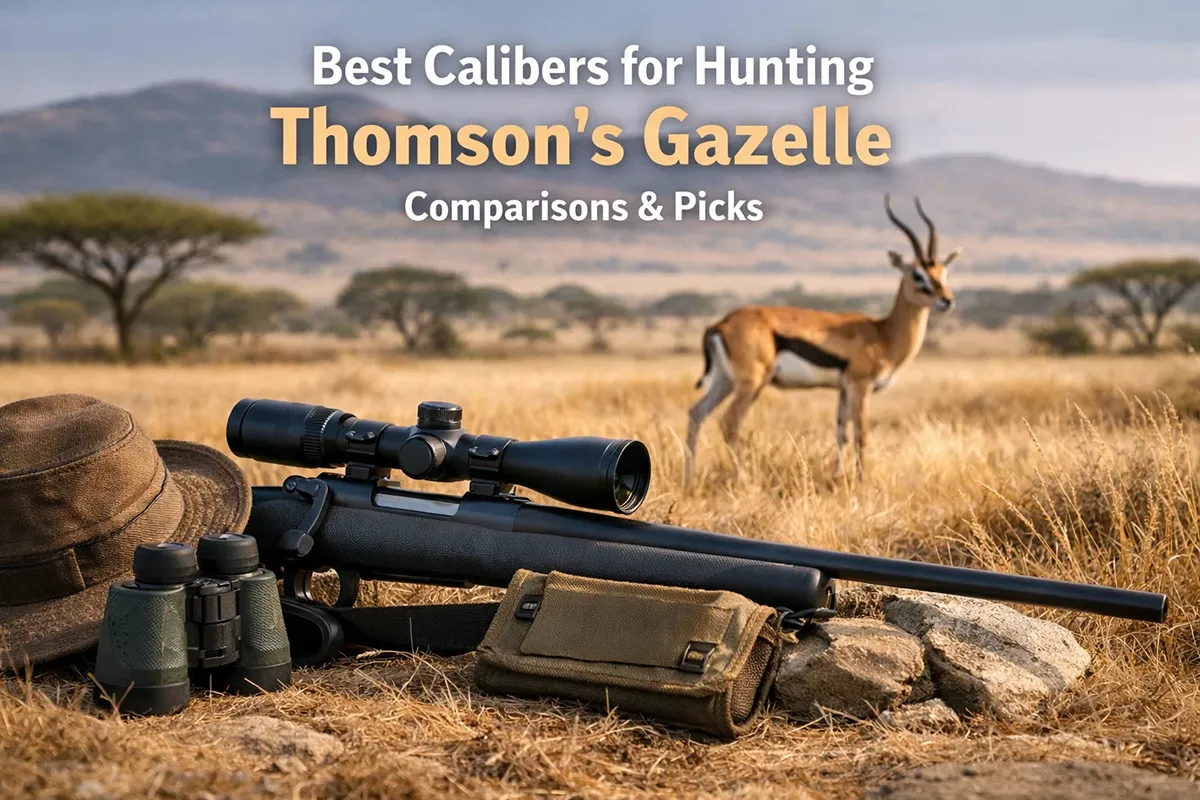
Flat-shooting, low-recoil picks for open-country shots and clean, ethical kills on Africa’s smallest antelope.
Choosing a cartridge for Thomson’s gazelle hunting is mostly about precision and bullet performance, not raw power. These small, light-bodied antelope are often hunted in open savanna where wind and small aiming points make shot placement the real challenge. A mild-to-moderate recoiling caliber you shoot confidently—paired with a controlled-expansion bullet—typically delivers the best mix of flat trajectory, manageable recoil, and reliable penetration.
Legal minimums and outfitter policies vary by country and concession, so confirm current rules (including any magazine limits or bullet restrictions) with your PH before you travel. Whatever you choose, prioritize safe handling, practice from shooting sticks, and commit to ethical heart-lung shots for quick, humane recoveries.
Caliber Comparisons
| Feature | .243 Win | 6mm Creedmoor | .257 Roberts | 6.5 Creedmoor | .270 Win |
|---|---|---|---|---|---|
| Recoil How much kick you can expect when firing. |
Low | Low | Low | Low–Moderate | Moderate |
| Effective Range The distance at which the caliber remains accurate and lethal. |
~300 yd typical | ~350–450 yd typical | ~300 yd typical | ~400+ yd typical | ~400+ yd typical |
| Bullet Weight Range The range of bullet weights typically available for the caliber. |
80–105 gr | 90–108 gr | 100–120 gr | 120–143 gr | 130–150 gr |
| Versatility How well the caliber or gauge performs for other game species besides your primary target. |
Small–medium game | Varmint–medium game | Small–medium game | Medium game, broad use | Medium–large plains game |
| Ammo Availability How easy it is to find ammunition for the caliber. |
Very common | Common (varies) | Less common | Very common | Very common |
.243 Winchester
The .243 Winchester is a classic “small plains game” cartridge that’s easy to shoot well, widely available, and plenty capable for Thomson’s gazelle when paired with a stout, controlled-expansion bullet. Its flat trajectory helps in open country, and recoil stays light enough for most hunters to spot their own impacts and make fast follow-up shots if needed.
PROS
- Light recoil helps you stay steady on shooting sticks and place shots precisely.
- Common factory loads and broad rifle availability make it simple to source and practice with.
- Excellent with 90–105 gr controlled-expansion bullets for reliable penetration on quartering shots.
CONS
- Very light, thin-jacket varmint bullets can be too fragile—bullet selection matters.
- Less wind resistance than 6.5 mm options, so wind calls become important beyond ~250–300 yards.
- Some areas or outfitters may prefer a slightly larger cartridge even for small antelope.
Interesting Fact: The .243 Win is essentially a .308 Winchester case necked down to 6 mm, which is why it feeds so reliably in standard short-action rifles.
Consider this Caliber If…
You want a proven, easy-shooting caliber that excels from roughly 75–300 yards and you plan to practice a lot before your trip. Choose a 95–105 gr bonded or monolithic bullet if you expect quartering angles, and confirm your zero with the same ammo you’ll hunt with.
6mm Creedmoor
If your Thomson’s gazelle hunt involves longer shots across open flats, the 6mm Creedmoor offers a modern blend of mild recoil and high ballistic-coefficient bullets. It tends to buck wind better than many .243 loads while keeping trajectories flat, making it a strong pick when distances stretch and conditions get breezy.
PROS
- High-BC 6 mm hunting bullets can reduce wind drift compared to typical .243 offerings.
- Mild recoil supports precise shooting and quick corrections from field positions.
- Excellent accuracy potential with modern rifles and quality factory ammo.
CONS
- Factory hunting ammo selection can be narrower in some areas than .243 Win.
- Overly match-focused loads aren’t always ideal for terminal performance—pick a true hunting bullet.
- Barrel life can be shorter than milder 6 mm cartridges if you shoot high volumes in practice.
Interesting Fact: The 6mm Creedmoor was popularized by competitive shooters for its efficient case design and ability to launch sleek 6 mm bullets at consistent velocities.
Consider this Caliber If…
You’re comfortable verifying drops and wind at 300–400 yards and want a cartridge that stays calm on sticks or a bipod. Look for 95–105 gr bonded or monolithic bullets and confirm impact velocity at your expected distance so the bullet expands reliably.
.257 Roberts
The .257 Roberts is an old-school gem for small-to-medium game: easy recoil, excellent accuracy, and a little more frontal diameter than 6 mm cartridges. For Thomson’s gazelle, it shines with 100–120 gr controlled-expansion bullets that open reliably and penetrate straight, even at moderate velocities.
PROS
- Soft recoil and smooth shooting characteristics make it friendly for all-day hunting.
- Good bullet weights (100–120 gr) balance expansion and penetration on small plains game.
- Often very accurate, especially in well-bedded sporter rifles.
CONS
- Factory ammo can be less common than .243, 6.5 Creedmoor, or .270, so plan ahead.
- Fewer modern rifle models are chambered for it, limiting off-the-shelf choices.
- Trajectory is good but not as flat as faster 6 mm options with similar wind performance.
Interesting Fact: The .257 Roberts became famous as a “mild but effective” round, and many handloaders love it because it’s easy to tune for accuracy.
Consider this Caliber If…
You prefer moderate velocities and classic cartridges, and you value easy recoil over maximum speed. If your hunt is likely inside 300 yards, a 115–120 gr bonded bullet is a dependable choice for consistent performance without excessive meat damage.
6.5 Creedmoor
While it’s more cartridge than you strictly need for Thomson’s gazelle, the 6.5 Creedmoor earns a spot because it’s widely available, accurate, and exceptionally forgiving in the wind. With 120–143 gr hunting bullets, it offers consistent penetration and a slightly larger margin for error on imperfect angles—without punishing recoil.
PROS
- Strong wind performance with high-BC bullets, helpful in open savanna conditions.
- Broad selection of factory hunting ammo and rifles, making logistics simpler.
- Great penetration and dependable expansion with 120–140 gr controlled-expansion bullets.
CONS
- More recoil than the 6 mm options (still manageable, but noticeable for some shooters).
- Can cause more meat damage than lighter calibers if bullet choice is overly soft at close range.
- Not every PH wants heavy-for-caliber bullets on very small game—communicate your plan.
Interesting Fact: The 6.5 Creedmoor’s popularity means you can often find compatible rifles, magazines, and ammo options almost anywhere hunters gather—helpful when traveling.
Consider this Caliber If…
You want one rifle/cartridge that can cover Thomson’s gazelle and other plains game on the same safari. If shots may run 200–400 yards, pick a 120–130 gr bonded or monolithic bullet to keep expansion controlled while still getting an exit for blood trails.
.270 Winchester
The .270 Winchester is a time-tested plains game cartridge with excellent reach and plenty of energy. On Thomson’s gazelle, its main advantage is versatility: if your safari list includes larger antelope, the .270 can pull double duty. Use a tougher bullet and avoid overly light, explosive designs to keep damage reasonable.
PROS
- Very versatile: suitable for a wide range of plains game when paired with the right bullet.
- Flat trajectory and strong downrange energy make longer shots more comfortable.
- Ammo is widely available with many 130–150 gr hunting load options.
CONS
- More recoil and report than smaller calibers, which can reduce precision for some hunters.
- Risk of unnecessary meat/shoulder damage on small animals if bullet is too soft or too fast up close.
- Overkill for gazelle-only hunts; a lighter cartridge is often easier to shoot well.
Interesting Fact: The .270 Win has been a favorite for open-country hunting for nearly a century because it combines speed with a well-balanced bullet diameter.
Consider this Caliber If…
You’re building a “one rifle” safari setup for mixed plains game and you’re confident managing recoil from field positions. For gazelle, consider 130–150 gr controlled-expansion bullets and prioritize broadside heart-lung shots to minimize damage and ensure quick recovery.
Picking the Right Thomson’s Gazelle Caliber
For most hunters, the “best” Thomson’s gazelle cartridge is the one you can shoot most precisely from realistic field positions. If your hunt is primarily for gazelle, mild 6 mm options like the .243 Winchester or 6mm Creedmoor are hard to beat for low recoil and flat trajectories. If you want a classic, moderate-speed approach, the .257 Roberts is a sweet spot inside typical distances. For mixed-bag plains game, the 6.5 Creedmoor adds wind forgiveness, and the .270 Winchester remains a versatile workhorse when larger animals are on the list.
Verify your zero after travel, practice your supported position on sticks, and choose a controlled-expansion hunting bullet. Finally, check destination regulations and outfitter requirements so your caliber is legal, appropriate, and ethical for the hunt.